

Commentary
Dmitri Trenin
{
  "authors": [
    "Dmitri Trenin"
  ],
  "type": "commentary",
  "centerAffiliationAll": "",
  "centers": [
    "Carnegie Endowment for International Peace",
    "Carnegie Russia Eurasia Center"
  ],
  "collections": [],
  "englishNewsletterAll": "",
  "nonEnglishNewsletterAll": "",
  "primaryCenter": "Carnegie Russia Eurasia Center",
  "programAffiliation": "",
  "programs": [],
  "projects": [],
  "regions": [],
  "topics": [
    "Economy"
  ]
}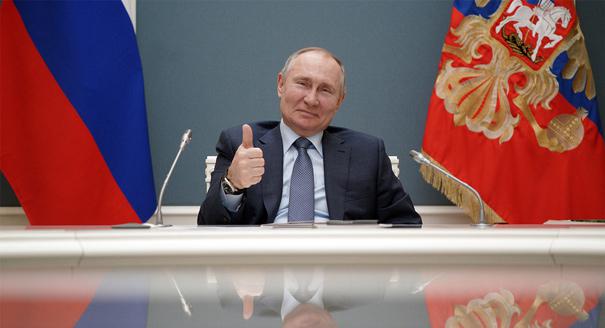
Source: Getty
Putin will probably be interested in assessing where Biden’s real concerns lie; where the sensitive areas may be in which mutual restraint, rather than unattainable compromise arrangements, may be the best way forward for now; and how the United States might act and respond under different scenarios.
In anticipation of the meeting between presidents Vladimir Putin and Joe Biden in Geneva, the Kremlin is not looking for a reset, or even a détente. Nor is there any prospect of a grand bargain of the kind that some Russians thought potentially doable at the start of the Donald Trump presidency. There are no illusions in Moscow: adversarial relations with Washington are here to stay.
Russian unilateral concessions are also out of the question in the face of consolidated U.S. power and Washington’s closer coordination with allies. In principle, President Putin would be open to some sort of strategic compromise with the United States, but he must know that President Biden and the U.S. political class as a whole are not interested in that, to put it mildly.
Nor does Putin need the meeting as proof of him being on an equal footing with Biden. From the Kremlin’s perspective, Russia’s international status does not rest on the fact of holding periodic one-on-one meetings with an American president, but rather on the ability to reliably deter U.S. military power and on being resilient to mounting U.S. economic, financial, and political pressure in the form of various restrictions.
That said, Moscow has set itself several tasks for the Geneva meeting: above all, to explain to Joe Biden in no uncertain terms where Russia’s red lines lie. These include inviting Ukraine to join NATO, deploying U.S. military forces and bases—particularly INF-range missiles—in Ukraine, condoning Kyiv’s attempts to recover Donbas or Crimea by force, seeking to prize Belarus away from Russia, and so on.
In addition to that, Putin will engage with Biden on the modalities of a structured dialogue on strategic stability, potentially leading to negotiations on a new U.S.-Russian arms control accord. It might also be good to mutually lift restrictions on Russian and U.S. diplomatic representations in each other’s country, to include the return of Russian diplomatic property seized by Washington. In Moscow’s view, a dialogue on cybersecurity issues with the United States would make sense. However, no Russian apology with regard to its alleged interference in U.S. elections should be expected.
Putin is certainly not looking for a shouting match with Biden in Geneva. He does not have to prove to his audience at home that he can stand his ground and push back against Biden’s rhetoric. Putin will listen, of course, to what Biden has to say, but no discussion of Russian domestic politics will ensue.
Rather, Putin will probably be interested in assessing where Biden’s real concerns lie; where the sensitive areas may be in which mutual restraint, rather than unattainable compromise arrangements, may be the best way forward for now; and how the United States might act and respond under different scenarios. The focus of the conversation will be solely on international issues, both bilateral and global.
The importance of Vladimir Putin’s meeting with Joe Biden should not be exaggerated. Putin did not seek out the meeting. When offered one by Biden, Putin did not rush to accept Biden’s invitation, but took time to consider it. To Putin, Biden’s invitation was never a reward: as the leader of a great power and one of the two nuclear superpowers, he finds it normal to transact business with his U.S. counterpart. Putin’s recent messages to the wider world are less about what he can do together with the American president, and more about what Russia can do alone—and, if need be, against the wishes of the U.S. government.
With all that in mind, the meeting in Geneva may be useful to both sides. The confrontation between them will continue, but hopefully with more secure guardrails built and maintained around it. As for the future of the U.S.-Russia relationship, it will not be decided at top-level meetings, but shaped in the very course of the ongoing confrontation. The most important thing is that it does not get out of hand.
Former Director, Carnegie Moscow Center
Trenin was director of the Carnegie Moscow Center from 2008 to early 2022.
Recent Work
Dmitri Trenin
Dmitri Trenin
Carnegie does not take institutional positions on public policy issues; the views represented herein are those of the author(s) and do not necessarily reflect the views of Carnegie, its staff, or its trustees.
China has showcased its engineering prowess with small modular reactor demonstration projects. But turning these technological achievements into commercial success will be a greater challenge.
Tong Zhao

The Plaza Accord was not an externally imposed punishment of Japan but part of a broader restructuring that Japanese economists and policymakers themselves recognized was necessary. Its effects were undermined, however, when Tokyo responded to the resulting slowdown with policies that exacerbated investment, credit expansion, and the very imbalances the adjustment was intended to resolve.

Michael Pettis
China’s banking crisis in the 2000s was resolved by transferring the costs to households through financial repression—a decision that recapitalized the banks while exacerbating the structural imbalances that continue to shape the Chinese economy today.
Michael Pettis
In the latest Five-Year Plan, the Chinese president cements the shift to an innovation-driven economy over a consumption-driven one.

Damien Ma
Rather than climate ambitions, compatibility with investment and exports is why China supports both green and high-emission technologies.

Mathias Larsen