The demand for effective multilateralism is increasingly outpacing supply. In a world where zero-sum mentalities and power plays between global heavyweights affect advances on anything from climate to technology, countries caught in the middle are increasingly frustrated by their perceived lack of agency.
Clearly the existing multilateral system is broken or, at best, malfunctioning. So, if the institutions and rules that were created after 1945 are no longer sufficient for addressing the globe’s twenty-first-century problems, should multilateral institutions be reinvented? Or would a complete re-do risk throwing the baby out with the bathwater?
The total, or even partial, reinvention of a decades-old system will take time, effort, and compromise. Habits are, after all, hard to break. Yet a way of rekindling today’s declining multilateral system is perhaps to look at things through a slightly different lens.
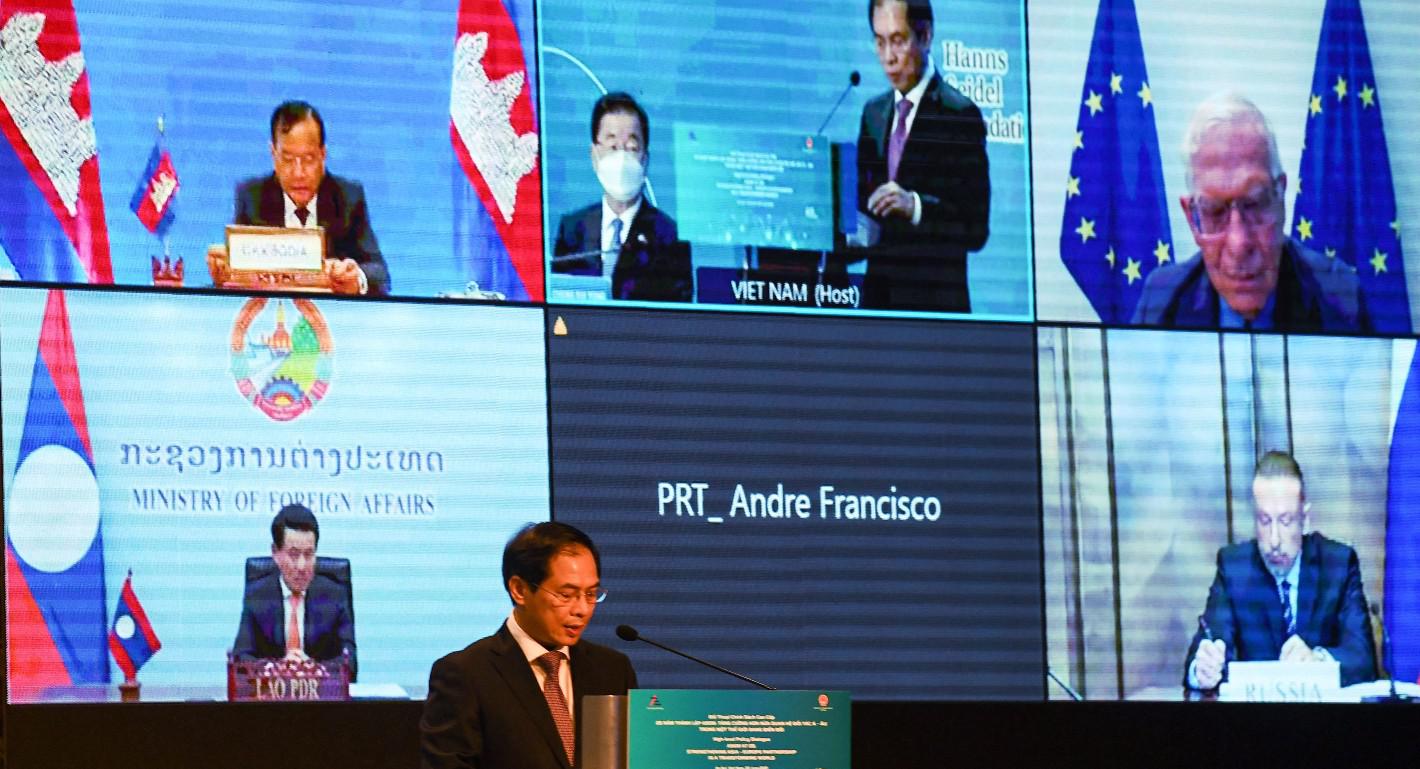
Later this week, fifty-one countries and two regional bodies (the European Union and the Association of Southeast Asian Nations) will convene in a biennial summit called the Asia-Europe Meeting (ASEM). This summit is an informal, high-level political gathering created to foster dialogue and cooperation between members on political, economic, and sociocultural issues. ASEM is one of the biggest political jamborees outside of the United Nations, representing some 50 percent of global GDP and about half of the world’s population.
Now a quarter of a century old, foreign policy watchers on both continents have become increasingly disillusioned by ASEM. Since its hopeful beginnings in Bangkok in 1996, it has been criticized for, among other things, its large size, informality, and inability to deliver binding decisions. And yet, flipping these criticisms on their head and looking at ASEM exactly through its perceived deficiencies will reveal its added value.
Where Minilateralism Can Succeed
A regular criticism of ASEM is that due to its large size, it has basically become a talk shop for everything and anything with little tangible outcome to its name. Yet by virtue of its size, ASEM provides a distinct and structured opportunity to foster the concept of minilateralism.
At its core, minilateralism—a type of instrumentalized variable geometry approach to international relations—“consists of gathering the smallest number of countries necessary to make a major change to the way the world addresses a particular issue.” ASEM’s sheer size provides a framework—and veritable smorgasbord—within which ad-hoc variable alliances can take place, be they big, small, formal, informal, thematic, geographic, or along other lines.
The European Union has become particularly adept at this, understanding that in order to make incremental change at the policy level—with twenty-seven different member states with different capacities and priorities—building coalitions of the willing may actually be the only viable option. There is a dark side to minilateralism, of course. By its very nature it implies division and can lead to long-suffering stalemates. And yet, there are ways of preventing such drift. More coordination or simply more exchange of information between small entities capable of reaching out to each other could help the system recover some nimbleness.
In a similar vein, the informality of ASEM allows it a level of flexibility that other, more structured, formal entities do not have. Removed from the theater of treaties or formalized rules-based procedures, it can flexibly initiate and develop recommendations and proposals on a vast array of issues—something it already does in areas as diverse as business, religion, education, and cultural partnerships.
ASEM is unique for this purpose precisely because there are no requisite outcomes and less expectation (and hence pressure) to deliver concrete results. Yet because it is acknowledged and recognized at the head-of-state level, it can be a valuable motor driving toward change. In contrast, other multilateral settings—such as the United Nations or the Organisation for Security and Co-operation in Europe—have become battlegrounds for bilateral confrontation, because so much hinges on formal outcomes.
Minilateralism at ASEM
ASEM is an interesting case because it brings together countries as diverse as Russia and New Zealand, China and Switzerland, Belgium and the Philippines. And while many of ASEM’s members actually have anywhere from mini- to maxi- beefs with each other, in the context of ASEM—as in any multilateral context for that matter—social norms dictate that countries put their individual differences aside, no matter how large, so that participants can have a collective discussion that is greater than the sum of its parts.
The theme of ASEM 2021 will be “strengthening multilateralism for shared growth.” Irony aside, this leaves little room to get heated about Myanmar’s unpalatable behavior or the acrimony between the UK and the European Union over Brexit. Instead, it is expected that this year’s ASEM will tackle not only socioeconomic recovery after the coronavirus pandemic but also connectivity—which, in ASEM speak, is about fostering “deeper economic and people-to-people ties.” As such, the potential for having a more sober discussion on other, longer-term, horizon challenges should not be underestimated.
Within this context, one horizon issue that could be addressed is the ongoing global supply chain problem facing industries ranging from pharmaceuticals to automobiles. Across the globe, businesses are rethinking their logistic models and supply chain dependencies; companies that can are hedging bets, either opting to ride out the pandemic and limiting production or rethinking supply chain models. As ever, the impact is not evenly spread, with smaller actors bearing the brunt of the consequences. Additionally, there is the very real possibility that, with all the focus currently on firefighting the immediate consequences of the pandemic, little thought is being put toward its long-term implications, especially for the Global South.
Any strategic solution could take years to realize and will be subject to a host of supply, technological, and geopolitical limitations. Given how charged discussions are likely to become, ASEM—through a more diffuse process than a bilateral context and in smaller quorums of similarly, even if temporarily, aligned partners—provides a good opportunity to start addressing these issues now.
Is the Future Minilateral?
Minilateralism and all its up and downs will not be the miracle solution to the lack of effective multilateralism. Indeed, the concept is not new and has been around under different guises throughout political history. But it can work in tandem with multilateralism.
For example, the Global Covenant of Mayors for Climate & Energy is a coalition of cities and local governments that circumvented their nations’ stances on either side of the climate debate to become a powerful voice of their own. Theirs is an example of how civil society has learned to walk the walk and talk the talk of diplomacy by leveraging its own form of minilateralism toward a greater good.
The ASEM process actually accommodates this type of engagement very well—precisely because it has opened its doors, at least in principle, to new actors from civil society, local governments, the corporate sector, and academia, among others, through its various engagement forums. And so, while it may be that a more transactional, realpolitik approach will have to be the concession to advance minilateralism, that doesn’t necessarily need to equate to a complete abandonment of core values.