

Q&A
Dara Massicot, Aaron David Miller, Andrew S. Weiss
{
  "authors": [
    "Aaron David Miller"
  ],
  "type": "commentary",
  "centerAffiliationAll": "dc",
  "centers": [
    "Carnegie Endowment for International Peace"
  ],
  "collections": [],
  "englishNewsletterAll": "americanStatecraft",
  "nonEnglishNewsletterAll": "",
  "primaryCenter": "Carnegie Endowment for International Peace",
  "programAffiliation": "ASP",
  "programs": [
    "American Statecraft"
  ],
  "projects": [],
  "regions": [
    "United States",
    "Middle East",
    "Israel",
    "Palestine"
  ],
  "topics": [
    "Democracy",
    "Foreign Policy"
  ]
}
Source: Getty
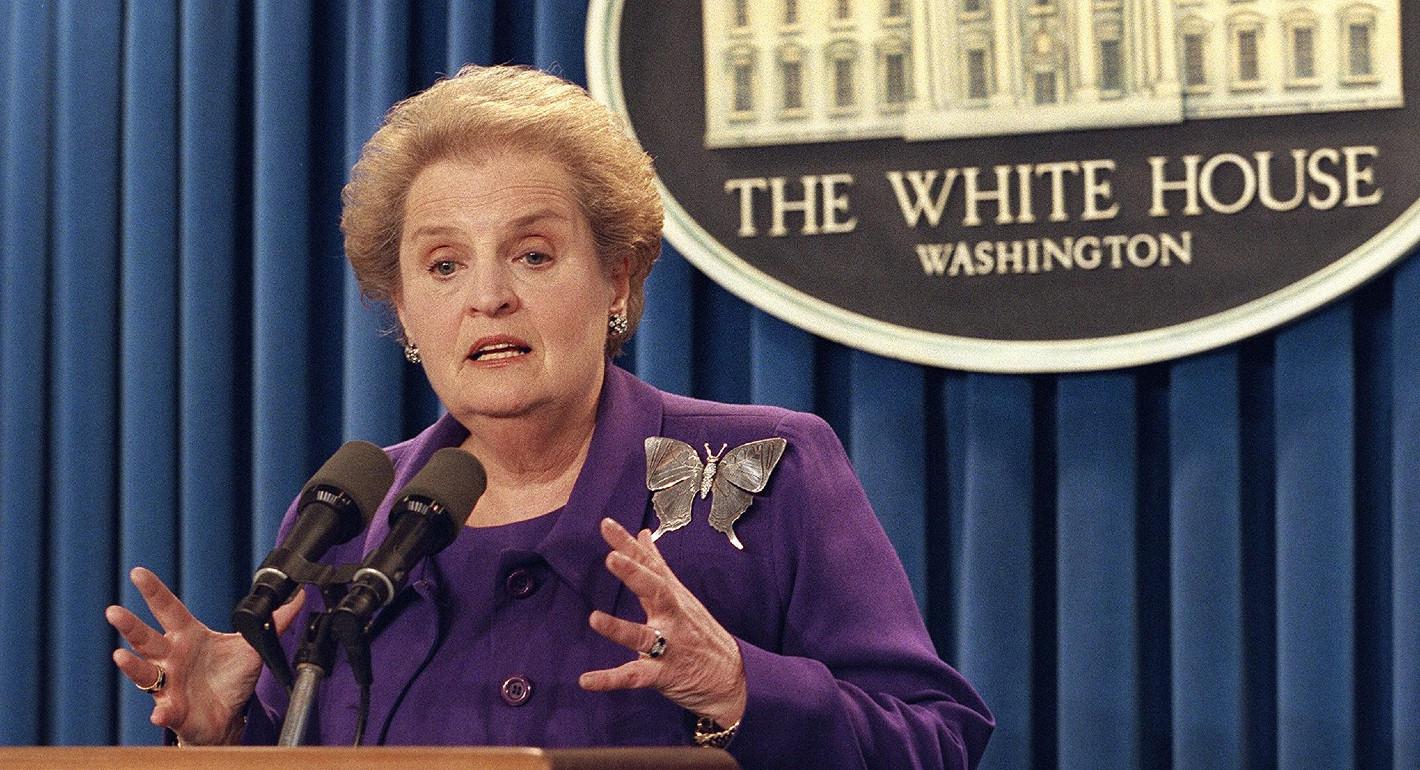
The former secretary of state was funny, irreverent, and determined to broker peace.
After she’d left the State Department, former secretary of state Madeleine Albright was passing through Heathrow when a British customs official questioned one of her travel documents. “Do you know who I am?” Albright asked, frustrated and late for a meeting. “No,” the official replied, “but we have doctors here who can help you to figure that out.”
I had the honor and privilege of working for Albright, who died on Wednesday at age 84, during former president Bill Clinton’s second administration. Having worked for half a dozen secretaries of state, I also wondered who Madeleine Albright was and how she might compare with the others. Her immigrant experience imbued her with a deep appreciation of and love for the United States and a determination to advocate wherever and whenever she could for nations and groups struggling for freedom. Her discovery of her Jewish roots only deepened this identification. As the first female secretary of state, she knew all too well the travails of women struggling to break into what had been a man’s world of government. And as a diplomat, she believed deeply in U.S. leadership and democracy, the importance of alliances, and the value of diplomacy.
I’ll leave the evaluation of her performance as secretary of state to the historians. But from my vantage point—working for her as part of a small team charged with handling Arab-Israeli diplomacy—she was smart, funny, irreverent, sometimes profane, protective of the president, and determined (if she could) to play a lead role in brokering peace. A few impressions from those four years traveling the negotiator’s highway with her follow.
On her view of Arafat and Netanyahu. If Albright had one bias—as she herself readily admitted—it was that Israel was the United States’ special ally and that its security needed to be protected. This of course didn’t stop her from rapidly losing patience with former Israeli prime minister Benjamin Netanyahu, the first of two Israeli leaders with whom she would deal. She described Netanyahu as an Israeli Newt Gingrich, and I know she felt he patronized her. As for former Palestinian president Yasser Arafat, I think her real sympathies and empathy were with the Palestinian people and their suffering, not with their leader. Still, she knew that without Arafat no deal was possible, and she would later come to see that even with him there wasn’t much of a chance.
In her office, she had two lookalike figurines of Arafat and Netanyahu. I imagined her squeezing the hell out of both of them, and on least one occasion, she actually did. Doing that in the real world was another matter. She wanted to, but I think she always worried that Clinton—who was always concerned about jamming the Israelis—might not have her back. Nonetheless, it was Albright who presided over the Sharm el-Sheikh memorandum in September 1999, the last agreement Israelis and Palestinians would reach before the process collapsed a year later.
On her role as first female secretary of state. She was clearly proud to be the first woman to hold that position. But it took me about ten seconds to understand that I was working for the sixty-fourth secretary of state of the United States of America—period. Whatever their biases, Arabs and Israelis had no choice but to deal with Albright as the president’s personal representative. If they thought they could manipulate her, it wasn’t because she was a woman, but because of the limits within which U.S. policy was framed. We weren’t tough enough with either side, and they knew it.
Holding down the fort at Camp David. Some of my most vivid impressions of Albright were in the final stretch of the Camp David summit with Arafat and then Israeli prime minister Ehud Barak in July 2000. The president had gone off to the G8 in Japan, hoping that a break might build pressure for an eleventh-hour deal and leaving Albright to work with the parties.
The break turned out to be a disaster. In fact, the secretary would later recall that if two women had behaved the way Arafat and Barak had, they would have been dismissed as menopausal. The secretary did everything she could to lighten Barak’s mood, who, like a pouting Achilles, had retreated to his cabin, convinced Arafat was pocketing all his concessions but making none of his own. She even took Barak on a day trip to the Gettysburg battlefield and ferried Arafat to her nearby farm. No dice, no deal. When I asked her after she’d left the State Department what her greatest disappointment was as secretary, she replied immediately: we couldn’t get an Israeli-Palestinian peace agreement. She was as always too hard on herself. No deal was possible during those years.
Last summer, I attended the funeral for Colin Powell, the final secretary of state for whom I worked. During the service, I found myself contemplating whether there could ever be another Powell. I’m now asking myself the same question about Madeleine—she insisted I call her that, but I never could. Neither was perfect; both made mistakes that they later would regret. But even though they were products of very different experiences and different political persuasions, they shared this in common: they loved the United States despite its imperfections, and they believed that despite those failings, America could be a force for good in this world. And they had goodness in their hearts and faith in the future. Like Powell, Madeleine—I’ll call her that now—was indeed one of a kind. “A worried optimist,” she’d call herself. Worry no more, Madam Secretary. May her legacy be a source of inspiration to those who admired and loved her from near and afar.
Subscribe to Carnegie Connects to hear more timely conversations, such as the recent episode featuring Albright.

Senior Fellow, American Statecraft Program
Aaron David Miller is a senior fellow at the Carnegie Endowment for International Peace, focusing on U.S. foreign policy.
Recent Work


Dara Massicot, Aaron David Miller, Andrew S. Weiss

Sophia Besch, Eric Ciaramella, Steve Feldstein, …
Carnegie does not take institutional positions on public policy issues; the views represented herein are those of the author(s) and do not necessarily reflect the views of Carnegie, its staff, or its trustees.

But their "principal to principal" model will only be as effective as the political strength of each leader back home.

Damien Ma

U.S. unpredictability has allowed China to capitalize on its positioning as the “responsible great power”. Paradoxically, the more China wins the perception game, the more likely expectations will rise for Beijing to deliver not just words but to demonstrate with its deeds.

Chong Ja Ian

Hanoi and Beijing have long treated each other as distant cousins rather than comrades in arms. That might be changing as both sides draw closer to hedge against uncertainty and America’s erratic behavior.

Nguyễn Khắc Giang

Across Asia, China is better positioned to withstand energy shocks from the fallout of the Iran war. Its abundant coal capacity can ensure stability in the near term. Yet at the same time, the country’s energy transition away from coal will make it even less vulnerable during the next shock.
Damien Ma

Malaysia’s chairmanship sought to fend off short-term challenges while laying the groundwork for minimizing ASEAN’s longer-term exposure to external stresses.

Elina Noor