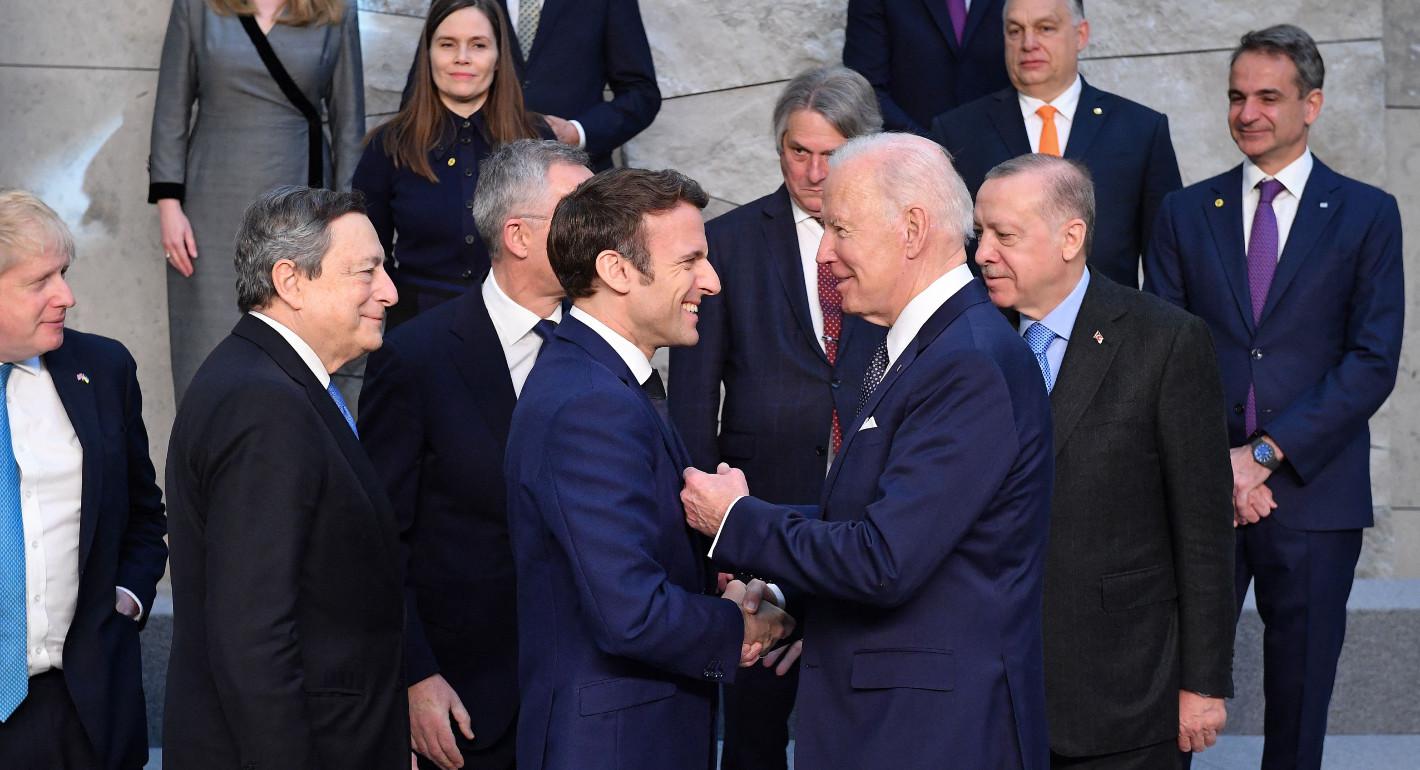
On Thursday, U.S. President Joe Biden will welcome French President Emmanuel Macron to the White House with the full pomp of an official state visit. France and America need each other now more than ever, but history suggests that cooperation won’t be easy.
Macron’s visit is a chance for Washington to get over its hang-ups about his sometimes irascible foreign policy and realize that France’s independence is at the root of what makes it such a valuable ally. For its part, France needs to show that its transformative agenda for Europe and its role in the world can deliver concrete benefits for America.
Macron’s predecessors have been aggravating Washington for more than fifty years, starting with president Charles De Gaulle, who lambasted America for the Vietnam War, protested the U.S. dollar’s global dominance, built France’s own nuclear weapons, and distanced France from NATO. Macron has been no less frank. When he called NATO “brain dead” in 2019, heads exploded in the corridors of the Pentagon, CIA, and State Department. When the Biden administration announced new plans for military cooperation with Australia and Britain in 2021, U.S. officials were stunned by Paris’s sharp rebuke. Macron’s insistence on keeping a diplomatic channel open with Moscow after its invasion of Ukraine only made more steam blow from the ears of U.S. policy elites. Most of all, Macron’s energetic cheerleading for European “strategic autonomy”—by which he means that Europe needs the economic and military might to take on much more responsibility for its foreign policy—rankles ardent NATO backers here and in and Europe.
But Washington needs to recognize the inherent value of having an ally that speaks its mind and thinks for itself. France’s independence is inextricably linked to its global aspirations and strategic vision, and these are highly valuable to the United States. It may be annoying when Macron acknowledges when French interests clash with America’s, but it’s an acceptable price to pay for an ally willing to spend money to defend itself—and an ally that offers global leadership on climate issues, understands the challenge China poses, supports the rule of law, is a member of the U.N. Security Council, has nuclear weapons, and, not least, shares America’s core political values.
True, Macron’s approach to strategic autonomy may make things more difficult for U.S. diplomats in Brussels laboring to create some semblance of agreement from the divergent views of NATO’s thirty nations, but it’s exactly the kind of thing Washington should embrace.
Security in Europe has been shattered by Russian President Vladimir Putin’s aggression against Ukraine, and America should want the stronger, more united Europe that Macron seeks, especially in an era where the costs of deterring China in the Indo-Pacific are certain to mount. Thanks to its presence and experience in Africa and in the Middle East, France is also very well equipped to fight terrorism and strengthen security in regions from which the United States is pivoting—a sort of pivot enabler.
Moreover, Macron’s rebukes have often been right. When Macron criticized NATO as brain dead, not a few U.S. and European officials were secretly gratified that someone was finally telling the truth about how dysfunctional the alliance had become thanks to the internal feuding and ill will of its leaders. Macron’s critique was a wake-up call that helped strengthen debate about the alliance’s future.
France’s complaints about the U.S. and UK sale of nuclear submarines to Australia may have been too emphatic, but France was genuinely surprised and its interests damaged. Moreover, as the time lines for U.S. and U.K. nuclear cooperation with Australia stretch out into the distant future, France’s original plan to provide Australia with diesel submarines may turn out to have been the more realistic one to achieve something everyone wants: strengthening Australia’s underwater capabilities against China in the Indo-Pacific.
France is now spearheading a European approach to the Indo-Pacific that will deepen its relationship with India, Indonesia, and the United Arab Emirates. These relationships can serve U.S. regional interests as well. Biden and Macron should set up mechanisms to communicate and coordinate their regional approaches.
Finally, Macron’s diplomatic channel with Moscow could soon seem prescient if Ukraine’s advances slow and Biden decides to heed growing calls for a diplomatic way out of the war.
To be sure, Macron sometimes promises too much. His appetite for disruption can backfire when it becomes too disconnected from reality—for example, at the outset of the war in Ukraine. His approach can also be self-isolating when it’s too rigid, as it sometimes has been in resisting U.S. economic and security efforts in the Indo-Pacific.
Franco-American relations will be put to the test as the war in Ukraine pushes Europe to the brink of its energy and defense capacities—areas where Macron has strongly advocated for European sovereignty and independence, yet the reality is glaring dependence on the United States. The two presidents will need to prevent this divergence between reality and expectations from causing collateral damage. They’ll also need to keep in view their common interest in combatting climate change as they work out their differences over emerging elements of their industrial policies, such those in Biden’s Inflation Reduction Act.
When Macron and Biden speak, their conversation should also extend beyond foreign policy to the question of the underlying values that underpin French and U.S. political systems and how to secure and adapt these values wisely for the future. Despite his reelection, Macron faces an uphill political battle for many of his objectives at home and a struggle against a nationalist right that resembles Biden’s own. France and America are democracies with different experiences and political traditions but also much in common. They can learn from each other.
If Biden and Macron can establish priorities and set the stage for cool-headed cooperation, both nations stand to gain. Above all, they will further their common interest in ensuring a predictable international order that is grounded in universally accepted rules and safe for democracy. Like long-bickering siblings, Paris and Washington need to put petty squabbles behind them and focus on the bigger—and rapidly evolving—global picture.