

Article
Dan Baer
{
  "authors": [
    "Dan Baer"
  ],
  "type": "commentary",
  "centerAffiliationAll": "dc",
  "centers": [
    "Carnegie Endowment for International Peace"
  ],
  "collections": [
    "European Defense"
  ],
  "englishNewsletterAll": "ctw",
  "nonEnglishNewsletterAll": "",
  "primaryCenter": "Carnegie Endowment for International Peace",
  "programAffiliation": "EP",
  "programs": [
    "Europe"
  ],
  "projects": [],
  "regions": [
    "Eastern Europe",
    "Ukraine"
  ],
  "topics": [
    "Security",
    "Foreign Policy"
  ]
}
Source: Getty
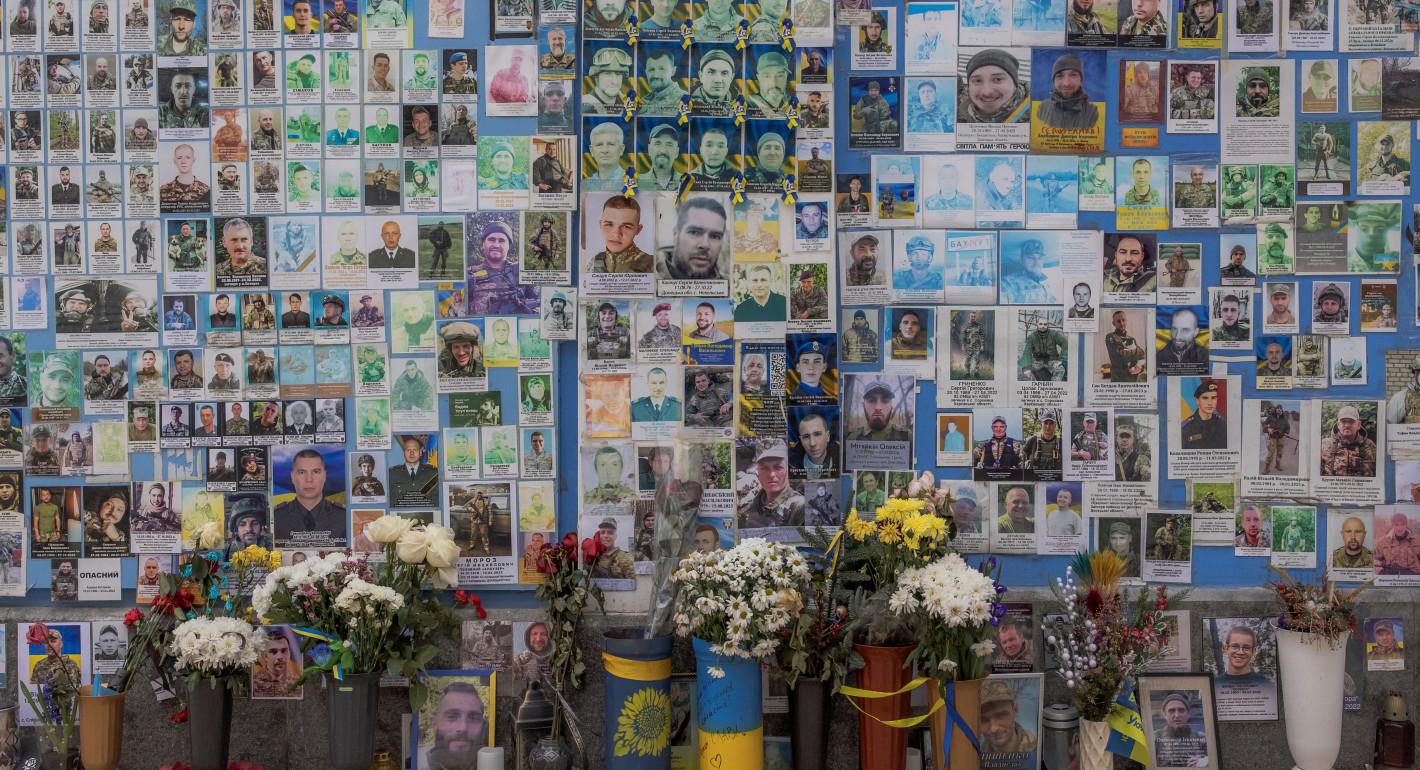
The moral and political stakes of Russia’s war in Ukraine have not changed. But in the West, the sense of urgency has waned.
Two years ago, I quickly documented six reflections on the first day of Russia’s war against Ukraine. Tomorrow marks the beginning of the third year of that war—an unprovoked, unlawful, brutal assault on what was, before the war, a country of 40 million people. Over the past two years, political theorists, historians, and pundits have traded explanations for this tragedy—pruning and decorating one another’s theories like Christmas trees. But amid this macabre forest, the most straightforward explanation is still the truest: Russia’s war is a war of choice, and there was no structural or historical factor that made it inevitable. It is the bloody sinister making of Russian President Vladimir Putin. Yes, a majority of the Russian people support him. Yes, Putin’s dictatorship at home has had an escalating dependence on Russia’s criminal and violent behavior abroad. But none of this was fated or required. It was a choice.
As this wrenching anniversary approaches, I have found myself looking at fragments from two writers. The first is from the Ukraine-born Russian writer Mikhail Bulgakov (1891–1940), who, processed through the grinding teeth of both his own opposition to Ukrainian nationalism and more recent history, is now reviled in Ukraine. Best known in the West for The Master and Margarita, Bulgakov set his first novel, The White Guard, in the Ukrainian war of independence. He wrote:
Everything passes away—suffering, pain, blood, hunger, pestilence. The sword will pass away too, but the stars will remain when the shadows of our presence and our deeds have vanished from the Earth. There is no man who does not know that. Why then will we not turn our eyes toward the stars? Why?
The second is from the young Ukrainian poet Maksym Kryvtsov, born in 1990. He concluded a poem he wrote in the wake of Russia’s brutal war crimes and massacre at Bucha in 2022 with what could read as a haunting reply to Bulgakov across a century:
We wanted
to count the days until summer
count kittens
count children
count stars
count to a hundred to count ourselves to sleep.
Number 176 rests here, rest in peace
Number 201 rests here, rest in peace
Number 163 rests here, rest in peace
Number 308 rests here, rest in peace.
The first fragment is about choices not made, the second about choices taken away. Violence is always an attempt at domination. And this is what war—any war—does: it takes away the choices that human beings have, the choices—most of them too pedestrian not only for history but even for our own memories—that make up our daily lives, and that collectively express our uniquely human ability to create lives of our own design.
After two years of Russia’s war against Ukraine, the stakes—moral and political—have not changed. But in the rest of Europe and in North America, the sense of urgency and connection to the war has waned. Too many of us—even those who don’t now skip over the stories that have migrated from the daily front page to the weekly interior of newspapers—have become numb to the accounts and accounting of human tragedy. Too many in the West—even those who continue to espouse support for Ukraine—have lost sight of how essential Russia’s defeat is for the security of Europe and, indirectly, for the security of all people on Earth from wars of aggression. Too many Americans—even those who still follow the dystopian farce of the behavior and function of the U.S. Congress—have become complacent about domestic political disagreements entangling foreign policy priorities in ways that weaken our standing in the world and make other conflicts that threaten U.S. interests more likely.
Human psychology plays a role, of course. Just as Ukraine’s initial success in repelling and routing the invaders attracted enthusiastic cheerleaders, the assessment that Russian and Ukrainian forces are now in a monotonously gruesome war of attrition is a discouraging narrative that even the singular charisma of Ukrainian President Volodymyr Zelensky cannot remedy. It is difficult to stay focused on a goal when it feels like it is floating further and further back on the horizon, or when the pursuit of it seems like a Sisyphean grind. But are we such moral children that we cannot overcome these human frailties? Yes, two years—now more—is a long time to focus on a war that feels far away, but how can the United States and its allies expect to succeed in an increasingly complex and dangerous world if they can’t sustain attention to big problems for the long haul?
Anniversaries are arbitrary reminders, but they focus, if ever so briefly, our attention. And attention is the obstacle right now. The United States can afford to continue to support Ukraine indefinitely. Washington spends nearly a trillion dollars a year on defense, and in comparison, support for Ukraine—which has been significant and consequential—is a tiny fraction of overall defense spending. The challenge is not the dollars but the discipline to focus on a core national security interest. Europe, too, can sustain and increase its support. But European leaders must not allow fatigue or a deficit of attention to allow the delusions some of them once held about Putin to reinfect the continent.
If Russia wins, the war of Putin’s choice will end with a defeat of choice. It will be a defeat of the West’s choosing. And, if it happens in the coming months, given the essential nature of U.S. military assistance, it will be a defeat of the U.S. Congress’s choosing. The supplemental funding bill in front of Congress is of existential importance to Ukraine’s fight. Whether it passes the bill or not, Congress will be making history. The question is only whether that history will be noble or shameful.
The choices of leaders and the progress of time are together the fibers that make up the weft and warp in the fabric of international politics. And when the choices of one leader distort, other actors either respond or don’t. Either the pattern is mended, or the perversion sets the course for a new weave. That Putin’s vile choices should go insufficiently answered, that they should be allowed to define the norms and practices of international politics, is both a moral tragedy and a dangerous development in international politics.
As the third year of the war begins, and as the United States and Europe falter in different ways in their support for Ukraine, it is difficult to look up, difficult to know where to look to see the stars that Bulgakov reckoned we should seek.
So many of our guiding lights have faded, including this one: Ukrainian poet Maksym Kryvtsov was killed defending his country from the Russian invasion on January 7, 2024. He was thirty-three years old. Rest in peace.
Senior Vice President; Director, Europe Program
Dan Baer is a senior vice president of the Carnegie Endowment for International Peace and director of the Europe Program. Under President Obama, he was U.S. ambassador to the Organization for Security and Cooperation in Europe (OSCE) and he also served deputy assistant secretary of state for the Bureau of Democracy, Human Rights, and Labor.
Recent Work


Richard Youngs, Erik Jones, Dan Baer, …
Carnegie does not take institutional positions on public policy issues; the views represented herein are those of the author(s) and do not necessarily reflect the views of Carnegie, its staff, or its trustees.

But their "principal to principal" model will only be as effective as the political strength of each leader back home.

Damien Ma

U.S. unpredictability has allowed China to capitalize on its positioning as the “responsible great power”. Paradoxically, the more China wins the perception game, the more likely expectations will rise for Beijing to deliver not just words but to demonstrate with its deeds.

Chong Ja Ian

Hanoi and Beijing have long treated each other as distant cousins rather than comrades in arms. That might be changing as both sides draw closer to hedge against uncertainty and America’s erratic behavior.

Nguyễn Khắc Giang

Across Asia, China is better positioned to withstand energy shocks from the fallout of the Iran war. Its abundant coal capacity can ensure stability in the near term. Yet at the same time, the country’s energy transition away from coal will make it even less vulnerable during the next shock.
Damien Ma

Malaysia’s chairmanship sought to fend off short-term challenges while laying the groundwork for minimizing ASEAN’s longer-term exposure to external stresses.

Elina Noor