

Paper
The nuclear relationship between China and the United States is increasingly shaped by widening perception gaps rather than deliberate strategic design.
Tong Zhao
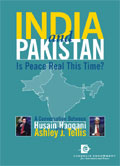
Will the latest diplomatic engagement between India and Pakistan lead to lasting peace, or simply be another in a long string of disappointments?

In the following discussion, Haqqani and Tellis highlight key issues they raised in their respective visits. Both were particularly interested in assessing whether this latest diplomatic engagement would lead to lasting peace, or simply be another in a long string of disappointments.
Click on the link above for full text of this report.
About the Authors
Husain Haqqani is a visiting scholar at the Carnegie Endowment. He is also a leading journalist and diplomat, and a former adviser to Pakistani prime ministers, as well as a syndicated columnist for the Indian Express, Gulf News, and The Nation (Pakistan). He is the author of Pakistan: Between Mosque and Military (Carnegie Endowment for International Peace, 2005).
Ashley J. Tellis is a senior associate at the Carnegie Endowment for International Peace in Washington, D.C. Previously, he served as senior adviser to the ambassador at the embassy of the United States in India. He also served on the National Security Council staff as special assistant to the president and senior director for strategic planning and Southwest Asia. Before his government service, he was for eight years a senior policy analyst at RAND and professor of policy analysis at the RAND graduate school. He is the author of India’s Emerging Nuclear Posture and co-author of Interpreting China’s Grand Strategy. He has co-edited Strategic Asia 2004-05: Confronting Terrorism in the Pursuit of Power and Strategic Asia 2005-06: Military Modernization in an Era of Uncertainty.

Former Visiting Scholar
Former Senior Fellow
Ashley J. Tellis was a senior fellow at the Carnegie Endowment for International Peace.
Carnegie does not take institutional positions on public policy issues; the views represented herein are those of the author(s) and do not necessarily reflect the views of Carnegie, its staff, or its trustees.

The nuclear relationship between China and the United States is increasingly shaped by widening perception gaps rather than deliberate strategic design.

Tong Zhao

But their "principal to principal" model will only be as effective as the political strength of each leader back home.

Damien Ma

U.S. unpredictability has allowed China to capitalize on its positioning as the “responsible great power”. Paradoxically, the more China wins the perception game, the more likely expectations will rise for Beijing to deliver not just words but to demonstrate with its deeds.

Chong Ja Ian

For Malaysia, the conjunction that works is “and” not “or” when it comes to the United States and China.

Elina Noor

Regulation, not embargo, allows Beijing to shape how other countries and firms adapt to its terms.
Alvin Camba