

But their "principal to principal" model will only be as effective as the political strength of each leader back home.
Damien Ma
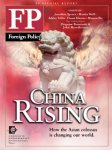
See what these leading experts have to say on such key questions as, are the United States and China on a collision course? And, what are the economic and strategic implications of China's transformation?
Source: Foreign Policy, January/February 2005

The report is based on the Carnegie conference, "China's Peaceful Rise?” held in the fall of 2004. Click here for speaker biographies, videos, and transcripts of that event.
The Once and Future China by Jonathan Spence
Clash of the Titans by Zbigniew Brzezinski and John Mearsheimer
Why is China Growing So Slowly by Martin Wolf
A Grand Chessboard by Ashley Tellis
Lifting All Boats by Homi Kharas
Dangerous Denials by Minxin Pei
Click on the link above for full text of this report.
Jonathan Spence
Zbigniew Brzezinski
Dr. Zbigniew Brzezinski served as national security adviser to President Jimmy Carter from 1977-1981. He is the author of several acclaimed books on foreign policy, most recently, Strategic Visions: America and the Crisis of Global Power.
John Mearsheimer
Martin Wolf
Former Senior Fellow
Ashley J. Tellis was a senior fellow at the Carnegie Endowment for International Peace.
Homi Kharas
Former Adjunct Senior Associate, Asia Program
Pei is Tom and Margot Pritzker ‘72 Professor of Government and the director of the Keck Center for International and Strategic Studies at Claremont McKenna College.
But their "principal to principal" model will only be as effective as the political strength of each leader back home.
Damien Ma
U.S. unpredictability has allowed China to capitalize on its positioning as the “responsible great power”. Paradoxically, the more China wins the perception game, the more likely expectations will rise for Beijing to deliver not just words but to demonstrate with its deeds.
Chong Ja Ian
Hanoi and Beijing have long treated each other as distant cousins rather than comrades in arms. That might be changing as both sides draw closer to hedge against uncertainty and America’s erratic behavior.
Nguyễn Khắc Giang
Across Asia, China is better positioned to withstand energy shocks from the fallout of the Iran war. Its abundant coal capacity can ensure stability in the near term. Yet at the same time, the country’s energy transition away from coal will make it even less vulnerable during the next shock.
Damien Ma
In the latest Five-Year Plan, the Chinese president cements the shift to an innovation-driven economy over a consumption-driven one.
Damien Ma





