

In The Media
Minxin Pei
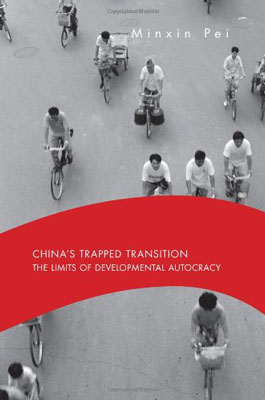
Minxin Pei examines the sustainability of the Chinese Communist Party's strategy of pro-market economic policies under one-party rule. China is trapped in partial economic and political reforms, and because the Communist Party must retain significant economic control to ensure its political survival, gradualism will ultimately fail.
Source: Harvard University Press

Pei casts doubt on three central explanations for why China's strategy works: sustained economic development will lead to political liberalization and democratization; gradualist economic transition is a strategy superior to the "shock therapy" prescribed for the former Soviet Union; and a neo-authoritarian developmental state is essential to economic take-off. Pei argues that because the Communist Party must retain significant economic control to ensure its political survival, gradualism will ultimately fail.
The lack of democratic reforms in China has led to pervasive corruption and a breakdown in political accountability. What has emerged is a decentralized predatory state in which local party bosses have effectively privatized the state's authority. Collusive corruption is widespread and governance is deteriorating. Instead of evolving toward a full market economy, China is trapped in partial economic and political reforms.
Combining powerful insights with empirical research, China's Trapped Transition offers a provocative assessment of China's future as a great power.
This book is available from Harvard University Press.
To order the book from HUP, please click here.
Minxin Pei is Senior Associate and Director of the China Program at the Carnegie Endowment for International Peace.

Former Adjunct Senior Associate, Asia Program
Pei is Tom and Margot Pritzker ‘72 Professor of Government and the director of the Keck Center for International and Strategic Studies at Claremont McKenna College.
Recent Work
Minxin Pei
Minxin Pei
Carnegie does not take institutional positions on public policy issues; the views represented herein are those of the author(s) and do not necessarily reflect the views of Carnegie, its staff, or its trustees.

The Plaza Accord was not an externally imposed punishment of Japan but part of a broader restructuring that Japanese economists and policymakers themselves recognized was necessary. Its effects were undermined, however, when Tokyo responded to the resulting slowdown with policies that exacerbated investment, credit expansion, and the very imbalances the adjustment was intended to resolve.

Michael Pettis

The nuclear relationship between China and the United States is increasingly shaped by widening perception gaps rather than deliberate strategic design.

Tong Zhao
China’s banking crisis in the 2000s was resolved by transferring the costs to households through financial repression—a decision that recapitalized the banks while exacerbating the structural imbalances that continue to shape the Chinese economy today.
Michael Pettis

Chinese biotech companies have been on the receiving end of U.S. economic coercion. Yet their responses have differed significantly because firm and state interests are not uniformly aligned. For Washington, treating all Chinese tech firms the same, irrespective of their actual interests, risks pushing them farther into Beijing’s corner.

Xue Gong

China’s latest energy plan explicitly calls for integrating data centers into the electricity system, particularly connecting them to green energy. It appears Beijing wants to use compute as a source of domestic demand to absorb renewables excess capacity.

Damien Ma