

Report
- +4
Ms. Sandra Polaski, Joaquim Bento de Souza Ferreir, Janine Berg, …
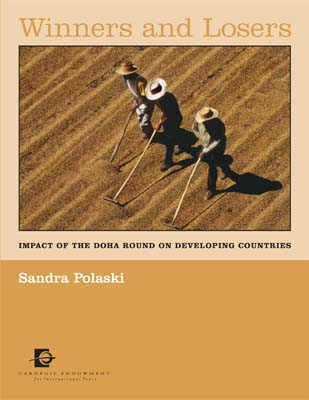
This report presents a new, path breaking model of global trade as a tool to analyze the potential impacts of the negotiations and underlying economic interests of the WTO’s diverse members.
Source: Carnegie Endowment

Meeting in Hong Kong in December 2005, trade ministers from World Trade Organization member countries were unable to bridge major disagreements in virtually every area of the Doha Round negotiations. As the global trade regime has expanded to include most developing countries, the range of divergent priorities within the negotiations has widened. What would it take to produce a global trade agreement that addresses the interests of developing countries and holds the potential to lift their incomes, while at the same time offering advantages for developed countries?
Winners and Losers: Impact of the Doha Round on Developing Countries presents a new, path breaking model of global trade as a tool to analyze the potential impacts of the negotiations and underlying economic interests of the WTO’s diverse members. This new Carnegie model makes several critical innovations—notably, modeling unemployment in developing countries and separating agricultural labor markets from urban unskilled labor markets. The result is a thorough, detailed, and more accurate analysis of the impact of trade policies on both developing and developed countries.
The report’s major findings are striking: any of the plausible trade scenarios will produce only modest gains for the world; agricultural trade is not a panacea for most poor countries; the poorest countries may actually lose from any agreement; and additional special measures will be needed to ensure that the least developed countries succeed. The full document includes technical specifications of the Carnegie model, simulation results, a wealth of regional and national data, over 50 full color charts and graphs, policy implications and recommendations.
What people are saying about Winners and Losers: Policymakers and journalists have commented on the results of the Carnegie model. Click on the links below to read their responses:
Click on one of the links above for the full text of this Carnegie report.
Sandra Polaski is senior associate and director of the Trade, Equity, and Development Project at the Carnegie Endowment. She served as the U.S. secretary of state's special representative for international labor affairs from 1999 to 2002, playing a leading role in the development of U.S. government policy on international labor and trade issues.

Former Senior Associate, Director, Trade, Equity and Development Program
Until April 2002, Polaski served as the U.S. Secretary of State’s Special Representative for International Labor Affairs, the senior State Department official dealing with such matters.
Recent Work
Ms. Sandra Polaski, Joaquim Bento de Souza Ferreir, Janine Berg, …
Ms. Sandra Polaski
Carnegie does not take institutional positions on public policy issues; the views represented herein are those of the author(s) and do not necessarily reflect the views of Carnegie, its staff, or its trustees.

China’s banking crisis in the 2000s was resolved by transferring the costs to households through financial repression—a decision that recapitalized the banks while exacerbating the structural imbalances that continue to shape the Chinese economy today.

Michael Pettis

Chinese biotech companies have been on the receiving end of U.S. economic coercion. Yet their responses have differed significantly because firm and state interests are not uniformly aligned. For Washington, treating all Chinese tech firms the same, irrespective of their actual interests, risks pushing them farther into Beijing’s corner.

Xue Gong

China’s latest energy plan explicitly calls for integrating data centers into the electricity system, particularly connecting them to green energy. It appears Beijing wants to use compute as a source of domestic demand to absorb renewables excess capacity.

Damien Ma

But their "principal to principal" model will only be as effective as the political strength of each leader back home.
Damien Ma

U.S. unpredictability has allowed China to capitalize on its positioning as the “responsible great power”. Paradoxically, the more China wins the perception game, the more likely expectations will rise for Beijing to deliver not just words but to demonstrate with its deeds.

Chong Ja Ian