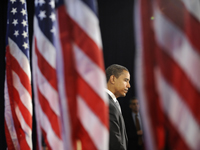
Americans elected a new president, a 47-year-old biracial man who embodies the dream of change and introduces a new political discourse.
“Obama fever” revived the interest of millions of young Americans in politics and created a tsunami that changed the political landscape in the Democratic Party, brushing aside the Clintons. The Obama tide brings to memory John Kennedy’s rise to power in the 1960s and signals a change in the cultural and political climate in the United States. It also brings to an end Reaganism, which reached its lowest point under the presidency of George W. Bush and the neoconservative “princes of darkness.”
Before answering the question of why Obama won or why he had to win, one must not forget that Obama is the son of the U.S. establishment. It is true that he emerged from its peripheries and broke the taboo of a black man being nominated for the presidency. However, breaking the taboo was in harmony with the renewed discourse in the Democratic Party and among U.S. liberals. This desire for renewal was exemplified by the fact that Obama’s opponent for the Democratic Party’s nomination was a woman who also had managed to break through the glass ceiling that prevented women from reaching the presidency.
As the son of establishment, Obama will not adopt domestic reforms and foreign policies that go beyond adding a touch of liberalism to the political reality. He will adopt more reasonable economic policies, establish a better healthcare system—its absence constitutes a moral scandal—and end the reckless rightwing policies that led to disaster in Iraq.
What inspired the political enthusiasm for Obama, especially among the youth? In order to understand Obama’s rise to power, we have to view it in two contexts. The first―the disastrous policies of President Bush and Vice President Dick Cheney― led to a series of scandals and debacles ranging from the war in Iraq to the current economic crisis. The problem with the neoconservatives is that they showed no respect for world and destroyed moral values. They thought that as “winners” in the Cold War, they were entitled to play with money and indulge their instincts and desires in the pursuit of money without any restrictions. The mentality of the neoconservatives is evident in the ways in which they fabricated Saddam Hussein’s possession of weapons of mass destruction and his ties with al-Qaeda. This mentality was formed by a convergence of two sets of delusions: those of some former Trotskyites and those of revivalists and Zionist Evangelicals. The outcome was the alliance of President Bush, a man of low intelligence who believes that God chose him to lead the world, with former leftists who turned to the far right in order to control and exploit the world. The resulting orgy of deception and fraud led the American military to the bloodshed in Iraq and crystallized theories of the military enforcement of democracy. Thus Iraq was filled with mercenaries of security companies and war profiteers. The Bush doctrine collapsed and so did Secretary of Defense Donald Rumsfeld’s military theories, as the United States seems to be on the brink of defeat not only in Iraq but also Afghanistan.
The second context is the resurrection of the centrist liberal trend in the Democratic Party. The unexpected and undemocratic defeat of Al Gore by George W. Bush eight years ago created a sense of despair and helplessness in the face of the rocketing rise of the neoconservatives, particularly after 9/11.
The right wing was successful in imposing a racist language that not only targeted Arabs and Muslims, but also anyone and anything that was not “purely” American. This reached a farcical level when “French fries” were renamed “freedom fries” and French wine was boycotted in protest against French opposition to the invasion of Iraq. The reemergence of the liberals was the result of Bush’s failed policies and the humiliation the United States had suffered in Iraq, which was the last straw for the American voter weary of lies and arrogance.
Barack Obama’s magic originated in the convergence of these two factors. Despite being associated with Reverend Jeremiah Wright and his leftist anti-American stance and being accused of collaborating with Professor Bill Ayres, who had been arrested for belonging to an extreme leftist group that had planted explosives in New York City in the 1970s, the biracial presidential candidate managed to surmount these obstacles with his humanistic rhetoric and stunning charisma.
Obama did not disown his African roots and his Muslim father, but he unequivocally declared his American allegiance. He proposed a centrist political vision that allowed him to penetrate Republican fortresses and reach people’s hearts. It is too early to speak about Obama’s policies, especially in the volatile Middle East, and evaluate the extent to which U.S. foreign policy will change, but there is no doubt that Obama’s election reflects primarily an American moral need. It is one of the rare cases in which ethics and human values play a decisive role in politics. After years of stupidity, deception, lack of integrity, and tactlessness that led Bush to speak of a new “crusade” in Iraq, the United States needs a new language that restores a minimum degree of credibility.
The United States was dragged to the current shameful situation in Iraq by greedy and dishonest companies under the care of Dick Cheney. Today, the United States needs an ethical discourse to rescue it from its feeling of material and moral deterioration. The American middle class as a concept and as a reality is threatened by the reinterpretation of capitalism since the Reagan–Thatcher era. It is also strange that American fundamentalists, like all fundamentalists around the world, have adopted the merciless rhetoric of rejecting the other and hating what is different. This young biracial man brings moral salvation to an America that wants an exit from George Bush’s shame, racism, and inanity. Here lies the essence of Obama’s project and from here stems his magic.
But how will he translate his project politically? What will the U.S. image be as the country moves from Martin Luther King’s revolution to the Obama presidency? The answer will come soon.
Elias Khoury, Chief Editor of the Cultural Section in the Nahar newspaper, Lebanon.