

Article
Henri J. Barkey
Source: Getty
President Obama should use the opportunity presented to him by winning the Nobel Peace Prize to make bold and concrete movements toward reducing stockpiles of nuclear weapons and restarting the Israeli-Palestinian negotiations.
The award of the Nobel Peace Prize to President Barack Obama has taken everyone by surprise, most of all the White House. The Nobel Committee has clearly decided that it wants to support Obama’s vision and, more importantly, wants to push him to accomplish what he has been promising. Morgan Tsvangirai, Zimbabwe’s prime minister may have truly deserved the prize for his heroic efforts, but the Nobel Committee wanted to change the world. Obama, therefore, was its logical choice. The pressure is on!
President Obama in the short eight months he has been in office has changed America’s discourse, moved away from the policies of the previous administration, at least rhetorically, and has taken some steps towards a more harmonious U.S. foreign policy. The committee in its statement especially recognized his promise to create a world without nuclear weapons and lauded his new vision.
Maybe the committee is worried that the obstacles in front of him are too formidable, the Middle East Peace Process, the Iranian and North Korean nuclear programs, and climate change each would deserve a prize of their own if fulfilled. Hence the committee members decided to help him; by giving him the award they decided to strengthen his hand and give him that extra credibility when dealing with recalcitrant leaders.
If so they may have miscalculated. Russian prime minister Vladimir Putin will be dismissive of the award simply because it was given to an untested newcomer. The likes of Kim Jong-il, Mahmoud Ahmadinejad and Hugo Chavez do not have much respect for this award in the first place (except that Chavez certainly thinks he deserves it). Yet they will however be miffed that Obama got it because they will perceive it as a slap at them.
It is President Obama who will be under the most intense pressure; people will expect him to deliver. He is not a miracle worker and many of these issues, as President Obama suggested in his White House speech, require the active and willing collaboration of other parties. This is exactly what the Nobel Committee intended to achieve. But there is an unintended downside to this prize; every failed effort from now will receive far more scrutiny and negative commentary. Every failure will have a compounding psychological on other efforts. This is why had he received it in two years after some concrete accomplishment, such the completion of the withdrawal from Iraq or a success in climate change negotiations, the White House would have been far more at ease. Thus the poisoned chalice.
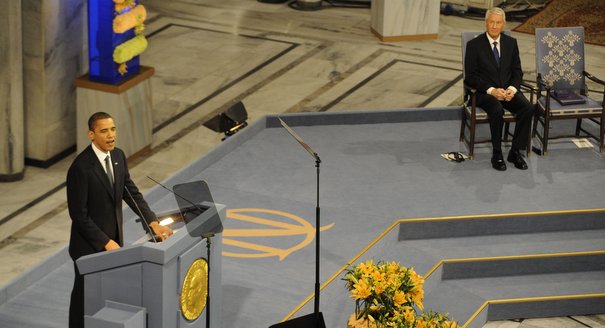
Now that he has the prize, what ought he do? His immediate reaction was inspiring and modest; he does not expect to solve all the problems of the world. The immediate focus will be on his acceptance speech in December. The speech is an occasion to capitalize on the award; he should make two bold and concrete announcements. One could be an announcement on reducing stockpiles of nuclear weapons, this could be a unilateral action designed to prompt others, mainly Russia, to follow suit. Alternatively, the administration can work with the Russians in advance of the speech to make it a cooperative announcement.
A second concrete and also very symbolic action would be an announcement that he will be traveling to Jerusalem and Ramallah to restart the Israeli-Palestinian negotiations. He would be telling the world that he is putting the whole imprimatur of his office and of the prize behind the effort. Such a trip, preferably immediately after his receiving of the award, would upset the balances in the region and in each of the countries involved. It is high risk, but as he himself stated, the prize is often a call for action or an amplification of the momentum.
As admirably modest as President Obama was in acknowledging the prize, a Nobel Peace Prize is a terrible thing to waste. He has no choice but to rise to the occasion. We all wish him well.

Former Visiting Scholar, Middle East Program
Barkey served as a member of the U.S. State Department Policy Planning Staff, working primarily on issues related to the Middle East, the Eastern Mediterranean, and intelligence from 1998 to 2000.
Recent Work
Henri J. Barkey
Henri J. Barkey
Carnegie does not take institutional positions on public policy issues; the views represented herein are those of the author(s) and do not necessarily reflect the views of Carnegie, its staff, or its trustees.

But their "principal to principal" model will only be as effective as the political strength of each leader back home.

Damien Ma

U.S. unpredictability has allowed China to capitalize on its positioning as the “responsible great power”. Paradoxically, the more China wins the perception game, the more likely expectations will rise for Beijing to deliver not just words but to demonstrate with its deeds.

Chong Ja Ian

Hanoi and Beijing have long treated each other as distant cousins rather than comrades in arms. That might be changing as both sides draw closer to hedge against uncertainty and America’s erratic behavior.

Nguyễn Khắc Giang

Across Asia, China is better positioned to withstand energy shocks from the fallout of the Iran war. Its abundant coal capacity can ensure stability in the near term. Yet at the same time, the country’s energy transition away from coal will make it even less vulnerable during the next shock.
Damien Ma

Malaysia’s chairmanship sought to fend off short-term challenges while laying the groundwork for minimizing ASEAN’s longer-term exposure to external stresses.

Elina Noor