
• Commentary
  • Research
  • Experts
  • Events
Carnegie China logoCarnegie lettermark logo
Afghanistan: A View from Moscow
Report
Carnegie Russia Eurasia Center

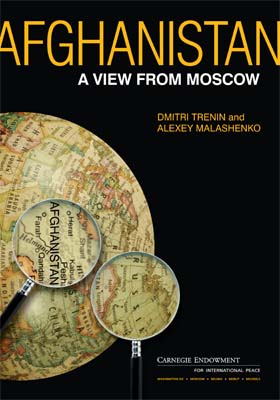
Afghanistan: A View from Moscow

Despite its importance, Russia’s perspective on the war in Afghanistan has typically been missing from previous analyses of coalition policy. Moscow views Afghanistan largely through the prism of security threats to itself and its Central Asian neighborhood.

Link Copied
By Dmitri Trenin and Alexey Malashenko
Published on Apr 27, 2010

Additional Links

Full Text
Project hero Image

Project

Eurasia in Transition

Learn More

Despite its importance, Russia’s perspective has been missing from many previous analyses of coalition policy in Afghanistan. Dmitri Trenin and Alexey Malashenko fill that gap with a report that takes a fresh look at the coalition’s involvement in Afghanistan. They conclude that Moscow is an essential part of the Afghan equation that is often overlooked.

Russia remains cautious about becoming too involved in the conflict, but Moscow fears the prospect of instability in Central Asia and drug trafficking from Afghanistan. Russia wants to:

  • Prevent an outright Taliban victory fearing that if the Taliban regain control they could export radicalism and support rebel activity in Russia’s near abroad. Even though there is a rivalry with the United States for influence in Central Asia, Russia essentially supports the U.S.–led coalition.
     
  • Stem the flow of drugs out of Afghanistan to Russia’s consumers. Its leaders worry about the exponential growth in narcotics production of narcotics in Afghanistan since the fall of the Taliban.
     
  • Restore a neutral, pacified Afghanistan to serve as a buffer state between Central Asia and the Greater Middle East.

“Russia views Afghanistan today largely through the prism of security threats to itself and its Central Asian neighborhood, where Moscow aspires to soft dominance,” write Trenin and Malashenko.
 

About the Authors

Dmitri Trenin

Former Director, Carnegie Moscow Center

Trenin was director of the Carnegie Moscow Center from 2008 to early 2022.

Alexey Malashenko

Former Scholar in Residence, Religion, Society, and Security Program

Malashenko is a former chair of the Carnegie Moscow Center’s Religion, Society, and Security Program.

Authors

Dmitri Trenin
Former Director, Carnegie Moscow Center
Alexey Malashenko
Former Scholar in Residence, Religion, Society, and Security Program
Alexey Malashenko
South AsiaAfghanistanCaucasusRussiaAsiaForeign Policy

Carnegie does not take institutional positions on public policy issues; the views represented herein are those of the author(s) and do not necessarily reflect the views of Carnegie, its staff, or its trustees.

More Work from Carnegie China

  • Commentary
    Malaysia’s Year as ASEAN Chair: Managing Disorder

    Malaysia’s chairmanship sought to fend off short-term challenges while laying the groundwork for minimizing ASEAN’s longer-term exposure to external stresses.

      Elina Noor

  • Commentary
    When It Comes to Superpower Geopolitics, Malaysia Is Staunchly Nonpartisan

    For Malaysia, the conjunction that works is “and” not “or” when it comes to the United States and China.

      Elina Noor

  • Commentary
    Neither Comrade nor Ally: Decoding Vietnam’s First Army Drill with China

    In July 2025, Vietnam and China held their first joint army drill, a modest but symbolic move reflecting Hanoi’s strategic hedging amid U.S.–China rivalry.

      • Nguyen-khac-giang

      Nguyễn Khắc Giang

  • Commentary
    China’s Mediation Offer in the Thailand-Cambodia Border Dispute Sheds Light on Beijing’s Security Role in Southeast Asia

    The Thai-Cambodian conflict highlights the limits to China's peacemaker ambition and the significance of this role on Southeast Asia’s balance of power.

      Pongphisoot (Paul) Busbarat

  • An aerial view shows containers stacked at a port in Taicang, in eastern China's Jiangsu province on May 18, 2025.
    Commentary
    How to Predict China’s Economic Performance for 2025: A Sectoral Approach

    GDP growth means something fundamentally different in China than in most countries.

      Michael Pettis

Get more news and analysis from
Carnegie China
Carnegie China logo, white
Keck Seng Tower133 Cecil Street #10-01ASingapore, 069535Phone: +65 9650 7648
  • Research
  • About
  • Experts
  • Events
  • Contact
  • Careers
  • Privacy
  • For Media
Get more news and analysis from
Carnegie China
© 2026 Carnegie Endowment for International Peace. All rights reserved.






