

Commentary
Alexey Malashenko
Source: Getty
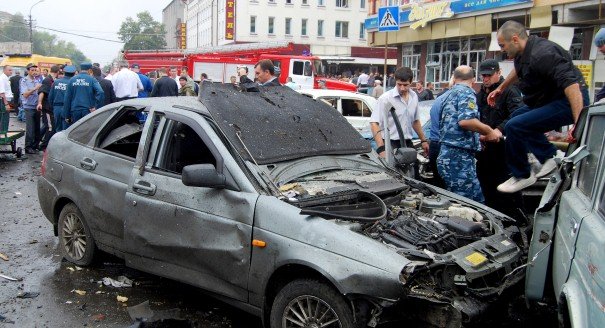
The blast in Vladikavkaz is the latest episode in what is becoming a latent civil war in the North Caucasus, where the Russian authorities are facing an opposition with its own specific religious and political ideology.
The blast in Vladikavkaz – which killed seventeen and injured 130 people on September 9 – was sadly just another in a series of terrorist attacks taking place in Russia’s Northern Caucasus almost daily. The perpetrators should, of course, be caught and punished, but their capture will not change the situation there.
Restoring order and bringing stability to this volatile region will require a political solution instead. The reality is that neither the political authorities nor the security forces have succeeded in turning the violent situation around.
The reason for this failure is that the authorities do not understand that the recent event, far from being the consequence of battles with groups of bandits, are evidence of a latent civil war, the reality of which they do not wish to and cannot recognize, just as they cannot recognize the existence in the region of an opposition with its own religious and political ideology.
This opposition is not a single organization but rather a roiling mix of the aggrieved, including people who seek revenge for the death or disappearance of relatives at the hands of the security forces. This opposition has the sympathy of some sections of society in the region – far more, I would say, than the security forces. It also acts as an umbrella for the often-mentioned criminal groups that are so adept at feeding off protest movements.
In establishing the new North Caucasus Federal District and sending a new man to run it, Moscow was hoping for a miracle in dealing with this opposition. It put its faith in achieving quick success, while neglecting to develop a long-term strategy. A miracle, however, was not forthcoming. The situation is only becoming more complicated, and the authorities’ proclamations about economic, social, and other reforms in the region appear divorced from reality. The authorities can talk all they want about promoting tourism, for example, but what tourists will go to a region plagued by terrorism?
Is there anything positive in this situation? An increasing number of voices, particularly at the local, and federal levels, are calling for a more diversified approach to the opposition. In Ingushetia, Dagestan, and Kabardino-Balkaria, the authorities want to engage in dialogue, even though they are conscious of the difficulties (and sometimes dangers) involved. Facing them on the other side of the barricades, after all, are a good number of die-hard adversaries who reject dialogue completely and view their lives only in the context of war. This is the way they have learned to think.
And yet dialogue is inevitable. The Russian leadership is beginning to realize that those hiding out in the mountains and forests include not only criminals. A dialogue with these people will require patience and a calm, steady hand. This would be not a manifestation of weakness, but evidence of strength.

Former Scholar in Residence, Religion, Society, and Security Program
Malashenko is a former chair of the Carnegie Moscow Center’s Religion, Society, and Security Program.
Recent Work
Alexey Malashenko
Alexey Malashenko
Carnegie does not take institutional positions on public policy issues; the views represented herein are those of the author(s) and do not necessarily reflect the views of Carnegie, its staff, or its trustees.

In the latest Five-Year Plan, the Chinese president cements the shift to an innovation-driven economy over a consumption-driven one.

Damien Ma

It’s about managing oil prices, bread prices, and strategic partnerships.



Amr Hamzawy, Karim Sadjadpour, Aaron David Miller, …
As North Korea continues to stall talks with the United States and South Korea, there is a greater need for China to play a more assertive role to help break the impasse.

Tong Zhao
Pitched as a new Silk Road sweeping from Asia to Europe, China’s enormous Belt and Road Initiative is an ambitious, multinational infrastructure project. Experts from four Carnegie global centers explain other countries’ perspectives.


Paul Haenle, Dmitri Trenin, Alexander Gabuev, …
Despite the BRI’s prevalence in discussions of China’s global engagement, many experts are divided on how to interpret it. Is it a global strategy or just an interregional initiative? How can countries and international companies participate in its growth and development?
Feng Yujun, Alexander Gabuev, Paul Haenle, …