

Paper
Douglas H. Paal
Source: Getty
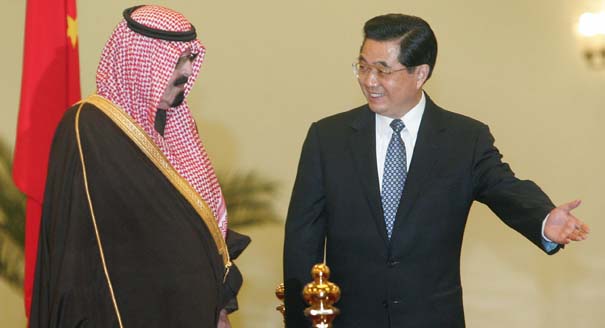
China's leaders have exercised tight control over media coverage of the Middle East protests and reacted quickly to quell any domestic civil unrest.
Beijing is very far from Tunis, Cairo, Manama, and Tripoli, but watching Chinese behavior you would think they were right next door. The Chinese Communist Party leadership has reacted to the Middle East turmoil as if it could arouse its own people to similar protests and possibly produce similar consequences.
In times like this, the United States would do well to adhere to its policy of principled support for the rights of people everywhere to freedom of assembly, speech, and choice of government. But, as in the Middle East, a little self-restraint in behavior and modesty about desired outcomes will serve American interests in the longer term.
Ever vigilant of the internet and social media, the authorities in Beijing worked hard from the beginning of the Egyptian protests to contain the spread of information to their own people about the popular challenge to the Mubarak government. While this was essentially an impossible task when it comes to China’s intelligentsia who know how to obtain information around the “great firewall,” it probably had the practical effect of keeping the laboring masses from knowing the details of the latest examples of how to challenge unpopular authorities.
As California professor and human rights advocate Perry Link disclosed in a New York Review of Books blog, the day after Mubarak’s fall, members of the Chinese Politburo convened an urgent, informal meeting to review the situation. Six days later, an independent Chinese news outlet, Boxun, revealed the results of the meeting:
“ – Halt all independent reports, commentaries, and discussions (including internet threads), whether in the print media or internet, on the situation in Egypt and similar places;
– Strengthen work in filtering and managing blogs, micro-blogs, and discussion forums;
– Assure that media in all locations uniformly adhere to the standard texts of the New China News Agency in any report or commentary on the Middle East.”
The next day, the Boxun blog that revealed this information was itself shut down. On the same day, Beijing summoned leaders of the provincial and central governments to a special meeting at the Central Party School, where Party Chairman and State President Hu Jintao addressed the audience on the need to strengthen information management and public guidance.
Then on Sunday February 20, the Politburo member responsible for security, Zhou Yongkang, told officials in a publicly reported speech to "strive to defuse conflicts and disputes while they are still embryonic." Clearly, Beijing is taking no chances that Middle East unrest might infect China.
That same day, however, internet activists succeeded in promoting ostensibly legal “strolling” past identified spots in twelve cities in China, including the McDonald’s at Wangfujing in Beijing, presumably to demonstrate solidarity with Middle East protestors in defying authority. Coincidentally, the U.S. ambassador to China, Jon Huntsman, went with his family to the McDonald’s just as hundreds of security officials, reporters, curiosity seekers, and possibly some protestors gathered there, only to make a hasty retreat when questioned by bystanders.
What does China fear? In discussions with well-regarded senior Chinese observers, they identified conditions in China that echo those in the troubled Middle East. China also has significant problems with corruption, large numbers of educated youth who cannot find jobs that meet their expectations, rising inflation, a related scarcity of available housing, and a closed political system.
But, they pointed out that China also has something the other countries lack: a strong and determined Communist Party leadership. As the precautionary steps outlined above show, Beijing is not about to permit another episode like that of Tiananmen Square in 1989.
Both Communist and imperial China have a strong tradition of leadership divisions promoting social unrest. It was the clear and public division among the leaders in 1989 over how to handle inflation, corruption, and the student protestors that encouraged millions to join the Tiananmen protests.
Hence, Beijing is forcefully and openly pressing for conformity among the leaders and demonstrating unity against social disorder. With a major leadership reshuffle due next year, Beijing will impose high costs on anyone who tries to influence the outcome through procedures not controlled by the Party.
With their nerves on edge, China’s leaders will be tempted to see everything through the filter of their concern for social stability. Ambassador Huntsman stumbling onto the scene of a potential protest could, for example, have had unforeseen effects. Beijing so far has reacted coolly, saying officially only that the facts of the incident are unclear. But anti-foreign bloggers (who are free to criticize outsiders) have raised suspicions that Huntsman was trying to foment trouble through his appearance at McDonald’s.
A decision to take a more active posture to support potential protests in China has not been made by the Obama administration, though some circles in the United States would wish for a more proactive approach. Ambassador Huntsman, however, has been personally engaged in trying to attend, unsuccessfully, the court trials of people in whom the United States has an interest. And he recently visited the family of an imprisoned dissident, which certainly would not please the Beijing authorities.
Huntsman and American policy are walking the fine line of a principled position promoting reform and increased freedom while prudently refraining from actually inciting protest or taking sides in China’s internal affairs. If Beijing were to judge that the United States is undermining its stability, the restoration of cooperation and reduction in friction that accompanied the recent state visit by President Hu could easily be tossed aside, with little prospect for an upside.
Distinguished Fellow, Asia Program
Paal previously served as vice chairman of JPMorgan Chase International and as unofficial U.S. representative to Taiwan as director of the American Institute in Taiwan.
Recent Work
Douglas H. Paal

Douglas H. Paal, Tong Zhao, Chen Qi, …
Carnegie does not take institutional positions on public policy issues; the views represented herein are those of the author(s) and do not necessarily reflect the views of Carnegie, its staff, or its trustees.

China’s banking crisis in the 2000s was resolved by transferring the costs to households through financial repression—a decision that recapitalized the banks while exacerbating the structural imbalances that continue to shape the Chinese economy today.

Michael Pettis

Chinese biotech companies have been on the receiving end of U.S. economic coercion. Yet their responses have differed significantly because firm and state interests are not uniformly aligned. For Washington, treating all Chinese tech firms the same, irrespective of their actual interests, risks pushing them farther into Beijing’s corner.

Xue Gong

China’s latest energy plan explicitly calls for integrating data centers into the electricity system, particularly connecting them to green energy. It appears Beijing wants to use compute as a source of domestic demand to absorb renewables excess capacity.

Damien Ma

But their "principal to principal" model will only be as effective as the political strength of each leader back home.
Damien Ma

U.S. unpredictability has allowed China to capitalize on its positioning as the “responsible great power”. Paradoxically, the more China wins the perception game, the more likely expectations will rise for Beijing to deliver not just words but to demonstrate with its deeds.

Chong Ja Ian