

Paper
Matthew Rojansky
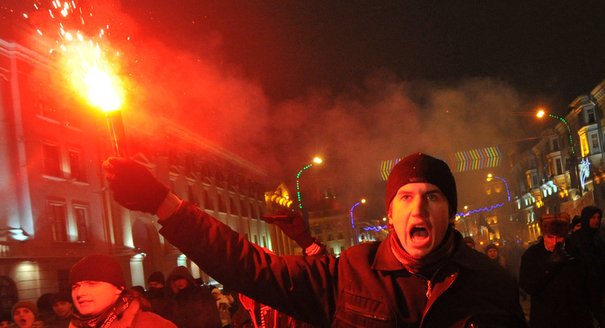
Source: Getty
As Belarus faces increased isolation and potential economic collapse, it is time for the international community to come together and seek a least bad outcome for the short term, while laying the foundation for long-term positive change.
Since President Alexander Lukashenka’s controversial reelection last December, a government crackdown has rained terror down on opposition activists and ordinary Belarusians, who have suffered arrest, detention, beatings, and torture. Now, with offers of Western assistance off the table and the national economy in a shambles, Belarus seems to present a case for urgent intervention. But when it comes to policy responses, there are no easy answers. Hard as it may be to swallow, there is no way the West can ensure that political prisoners go free, Lukashenka goes away, and average Belarusians go forward to a stable, prosperous, and democratic future.
The quickly deepening economic crisis in Belarus raises the stakes and the risk that Western policy responses with surface-level appeal could backfire terribly. Consider just the latest reports that the Belarusian ruble has plunged over 25 percent against the dollar. This means that average Belarusians who have not already exchanged their saved-up rubles for foreign hard currency are now 25 percent poorer in real terms. At the same time pensioners, employees of state-owned industries, and the very poor, all of whom depend on the state for their survival, are in danger of losing their livelihoods entirely now that the cash-strapped government has been denied a requested $3 billion bailout from Moscow. For its part, the Kremlin is salivating over the price it may exact for any aid, like control over Belarusian manufacturing, refining, and energy transit assets which the state will be forced to privatize.
In the meantime, there is a growing chorus in Washington—with some audible echoes in Brussels—calling for enhanced punitive measures against the Lukashenka regime, including beefed up economic sanctions. The United States has a minimal economic relationship with Belarus, so sanctions by Washington are meaningless except as a moral gesture. But restrictions on European trade with Belarusian state enterprises could be the straw that breaks the camel’s back, transforming a dire economic situation into a real humanitarian catastrophe.
We know that a closed door to the West leaves Lukashenka only one exit strategy from the current crisis—dependence on Russia—but this is not even the worst consequence of isolation. Were the European Union to impose punishing sanctions on Belarusian industries, it would hurt the regime a little, and the people much more. And it would present ordinary Belarusians with a cruel choice: either bow to their oppressive government and accept isolation from their European neighbors, or take to the streets, risking life and limb to bring down a regime that has proven its willingness to kill, maim, and torture in defense of its power and privileges.
What if a popular uprising, like the opposition rally on election night but on a much bigger scale, were to result from economic collapse and isolation? What if it were somehow to succeed in bringing down the Lukashenka regime? Then the real problems would set in, because there simply is not an effective substitute for authoritarianism in Belarus today. It is not just that the current opposition is fragmented and lacks any real vision for leading the nation beyond removing Lukashenka from power. Rather, Belarusian society itself is not prepared to participate in, support, and sustain effective democratic governance.
This means that Lukashenka could be removed from power today, tomorrow, or the next day, but without long-term changes in the way people think about the role of government and their relationship to the society around them, there is no hope for a sustainable democracy to emerge in his place. Indeed, a cruel irony would be if Belarusians endured the certain privations of a fight to remove Lukashenka and a tumultuous transition, only to find themselves ruled by an equally authoritarian successor in the end.
This is a bleak picture—and it is getting worse—which makes it seem all the more urgent for Western capitals concerned about the future of Belarus to enhance their attention and response. While more attention is important, now is not the time to rush headlong down the “moral high road” of punitive measures that could make things worse still.
So what can be done? First, we must watch, listen, and document what is going on in Belarus. Rather than dismissing each new reported atrocity with the caricature of Belarus as “Europe’s last dictatorship,” the international community should remember that each case involves individuals—both victims and perpetrators—and that they deserve to be treated as individuals. With the Organization for Security and Co-operation in Europe activating the Moscow Mechanism, a tool to help monitor human rights and democracy, and assigning a French expert as rapporteur, participating states should make certain that all crimes that have taken place since the December election are carefully documented and recorded. And, when possible, linkages between individuals who carried out attacks, torture, and other abuses, and their political masters, even at the highest levels of government, should be identified.
On this basis, Western governments can hold individuals, rather than the state as a whole, accountable, including through further targeted travel bans and asset freezes. Although Belarus itself is not a party to the statute of the International Criminal Court, the ICC prosecutor should consider issuing indictments under the “complementarity doctrine,” in case perpetrators ever travel to countries in which they can be arrested.
We can also make a difference today in the long-term viability of Belarusian democracy by enhancing programs that connect ordinary Belarusians with the technical, economic, and human resources of Europe and the wider world. Our goal should be to build the skills and capacity of Belarusians to take responsibility for their own political future, by shaking off persistent Soviet-era psychology and expectations about the role of the state and individuals in it.
Western assistance need not be aimed directly at national politics and should certainly not seek large-scale “regime change” to be delivered by opposition activists. Rather, it should offer small- and medium-sized grants to grassroots organizations, especially those outside of Minsk, treating social problems like drug and alcohol abuse and domestic violence, as well as groups that track reforms, monitor corruption, and help connect people and NGOs. Efforts like these can prove to Belarusians that ordinary people can organize to help themselves and even combat corruption in state services. Information is, of course, the key to this psychological transformation, so Western aid should be especially geared toward enhancing the capacity of Belarusian independent media to reach audiences throughout the country.
Although some in Russia stand to benefit from the looming crisis in Belarus, especially if Lukashenka is forced into a quick and non-transparent sale of state assets to pay the bills, Moscow has little to gain from greater instability on its western border, nor does it wish to see the economy of its customs union partner contract further. Thus, it is wrong to think of Belarus’ relations with East and West in zero-sum terms.
As the economic crisis deepens and the risk of further political upheaval grows, it makes sense for Washington and Brussels to coordinate their responses with Moscow. The West should be prepared to recognize that its priorities of democratic development and prosperity for Belarus need not come at the cost of severing the country’s historically close ties with Russia, and Moscow should in turn acknowledge that just as it seeks Western technological assistance for its own modernization drive, Belarusians have the right to prosper through engagement with their European neighbors.
Whatever further steps the United States, European Union, or Russia may take, the crisis in Belarus is likely to get much worse before it gets better. And the risk of a humanitarian and political calamity developing as the economy falters is still very real, especially if Western governments take steps to deepen the country’s isolation. Amid all this gloom and doom, perhaps the only silver lining is that Belarus watchers in Washington, Brussels, and Moscow will be forced to acknowledge that there are no more easy answers and it is at last time for all sides to come together and seek a least bad outcome for the short term, while laying the foundation for long-term positive change.

Former Deputy Director, Russia and Eurasia Program
Rojansky, formerly executive director of the Partnership for a Secure America, is an expert on U.S. and Russian national security and nuclear-weapon policies.
Recent Work
Matthew Rojansky
Matthew Rojansky
Carnegie does not take institutional positions on public policy issues; the views represented herein are those of the author(s) and do not necessarily reflect the views of Carnegie, its staff, or its trustees.

US unpredictability has allowed China to capitalize on its positioning as the “responsible great power”. Paradoxically, the more China wins the perception game, the more likely expectations will rise for Beijing to deliver not just words but to demonstrate with its deeds.

Chong Ja Ian

Hanoi and Beijing have long treated each other as distant cousins rather than comrades in arms. That might be changing as both sides draw closer to hedge against uncertainty and America’s erratic behavior.

Nguyễn Khắc Giang

Across Asia, China is better positioned to withstand energy shocks from the fallout of the Iran war. Its abundant coal capacity can ensure stability in the near term. Yet at the same time, the country’s energy transition away from coal will make it even less vulnerable during the next shock.

Damien Ma

Malaysia’s chairmanship sought to fend off short-term challenges while laying the groundwork for minimizing ASEAN’s longer-term exposure to external stresses.

Elina Noor

For Malaysia, the conjunction that works is “and” not “or” when it comes to the United States and China.
Elina Noor