

Commentary
- +2
Memduh Karakullukçu, Dmitri Trenin, Ümit Pamir, …
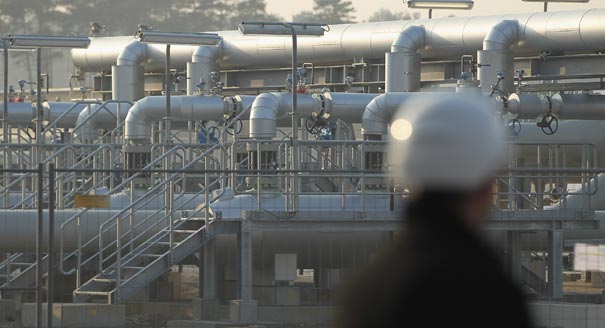
Source: Getty
Brussels should make certain that Europe does not miss the opportunity to seize the strategic potential offered by unconventional gas.
As the unconventional gas “revolution” was quietly unfolding in the United States, its potential to transform the U.S. gas market, and the country’s national energy discourse, was not apparent until recently. It has now become clear that shale gas development is perhaps the biggest energy sector innovation for the United States in recent decades. For Europe, however, the role shale gas will play in transforming energy markets is far from certain. The old continent’s unconventional gas reserves are substantial, but the question is how fast and to what extent Europe will develop them.
Europe needs a clear roadmap for the prospects of unconventional gas in its energy future. The current situation calls for an approach that is based on realistic expectations about the pace of shale gas development, as well as a strategy that is well-informed about potential costs and benefits. Continuing uncertainty could not only hamper the flow of investment into potential unconventional gas reserves, but could also impede the development of informed plans about Europe’s energy security and ability to fight climate change.
To begin with, it is worth recognizing Europe’s limitations. The combination of factors that led to the unconventional gas “revolution” in the United States—favorable geology, developed gas markets, and until recently, limited regulatory and public constraints—is not easy to replicate. Geologically, knowledge of unconventional gas in Europe does not go much beyond rough estimates. Where exactly are the shale deposits located? At what depth? And in what type of formations? At what cost could they be extracted? Europe still needs to start mapping out its shale gas reserves—a process that started almost three decades ago in the United States. At this point all that is known is that there are sufficient reserves to transform Europe’s gas market. Estimates vary but they consistently put the European Union’s unconventional reserves well above its conventional ones. Knowing this alone, however, is not enough.
The cost of developing shale gas reserves will be a principal factor in determining the future of unconventional gas in Europe. The sharp growth in shale gas output in the United States owes much to the considerable cost reduction witnessed over the past decades. Europe stands at the beginning of that process. Lack of comprehensive geological knowledge about shale precludes a precise estimate, though costs are expected to be high not least because of the scattered nature of reserves in Europe. The absence of a vibrant services sector for the gas market presents another bottleneck. The European gas sector’s limited capacity to provide cost-effective equipment for shale gas development along with a shortage of qualified labor will undoubtedly lead to higher development costs than in the United States. Costs can certainly go down, just like they did in the United States, as the industry gradually reacts to the needs of the market. But initial costs will pose a challenge.
In its quiet “revolution,” America’s unconventional gas industry outpaced both the regulators and the public. By the time stringent environmental demands became part of the national energy discourse, unconventional gas had already assumed its transformative role in the U.S. gas sector.
In Europe, if this revolution is ever to be repeated, it will not be a quiet one. The rigorous environmental regulations that are already in place—particularly with regard to water use—are prompting investors to think twice about managing costs before they commit. With their high population density, many European governments are less willing to embrace shale gas before its environmental impacts become apparent. In many countries, particularly in Western Europe, governments ignore environmental movements at their own peril. More investment in shale development will almost certainly have to confront calls for even stricter ecological requirements.
The EU’s energy and climate policy needs to recognize these constraints. It would be unrealistic to expect shale gas to be a panacea for the Union’s growing concerns on energy security and climate mitigation. This is true at least in the short and medium term.
And yet, discounting the potential role of unconventional gas in Europe’s future would be a mistake. It is in the EU’s long-term interest to maintain a role for shale gas development. Most industry insiders argue that unconventional gas will not contribute in any significant form to Europe’s energy supply until at least the end of this decade. Its role beyond that point, however, is anyone’s guess. How fast Europe develops these resources depends on today’s policy choices.
European policymakers should give shale gas development a chance. First, as a latecomer compared to the United States, Europe is more likely to find a way to develop its unconventional resources in an environmentally friendly fashion. Stricter regulations and low public tolerance for potential environmental risks may slow the pace of shale gas development. They can, however, also ensure that Europe develops these resources in the right way, avoiding some of the mistakes witnessed in America.
Second, the benefits of shale gas development could be disproportionately large. European gas supplies are in decline, while demand is expected to continue to grow. The EU’s ever growing need for imported gas is compounded by its dependence on a rather small number of external suppliers—Russia, Norway, and Algeria account for nearly three quarters of Europe’s imports. It is not certain that unconventional gas can reverse the decline in domestic gas output. However, it could certainly enhance the position of European importers when bargaining with their limited number of suppliers. Most recently, gas sold at spot markets, which constitutes only a fraction of total gas imports in Europe, effectively served such a role. Even Gazprom, known for its firm bargaining position, felt the need to revise a portion of its contracts. Shale gas could play a similar role for European importers in the future by enhancing competition. Increased liquefied natural gas (LNG) imports could potentially have a similar impact. But, they will be need to be sourced from outside the EU, maintaining Europe’s dependence on global LNG market trends.
Even if unconventional gas is not a “game changer” for Europe as a whole, it could be a “game changer” for a select group of EU members. Ironically, some of the countries with greater prospects for shale gas development—Poland, Hungary, and Bulgaria—are among the most dependent on Russian gas.
At this point, the future of shale gas in Europe is very much in the hands of national governments. Legal competence for hydrocarbon development is mainly within the domain of these governments rather than Brussels. What they need is a well-informed national discourse on unconventional gas that involves all the main stakeholders. In effect, they need to avoid what France recently did—a rushed decision outlawing hydraulic fracturing—and instead attempt to fully assess the potential for developing shale gas while complying with strict environmental standards.
Brussels, on the other hand, does have a role to play. In addition to ensuring higher environmental standards, it could attempt to bring greater clarity about the future of natural gas in Europe’s energy balance. Mixed signals about its expected role have understandably preoccupied investors. Also, it could elaborate investment mechanisms for shale gas development that would serve its long-term decarbonization objectives by displacing more carbon-intensive sources of energy. Ultimately, Brussels should make certain that Europe does not miss this opportunity to seize the strategic potential offered by unconventional gas.

Former Senior Associate, Energy and Climate Program
Vatansever was a senior associate in the Energy and Climate Program where he specializes in the energy sectors of the former Soviet republics and Eastern Europe.
Recent Work
Memduh Karakullukçu, Dmitri Trenin, Ümit Pamir, …
Adnan Vatansever, Анна Корппоо
Carnegie does not take institutional positions on public policy issues; the views represented herein are those of the author(s) and do not necessarily reflect the views of Carnegie, its staff, or its trustees.

But their "principal to principal" model will only be as effective as the political strength of each leader back home.

Damien Ma

U.S. unpredictability has allowed China to capitalize on its positioning as the “responsible great power”. Paradoxically, the more China wins the perception game, the more likely expectations will rise for Beijing to deliver not just words but to demonstrate with its deeds.

Chong Ja Ian

Hanoi and Beijing have long treated each other as distant cousins rather than comrades in arms. That might be changing as both sides draw closer to hedge against uncertainty and America’s erratic behavior.

Nguyễn Khắc Giang

Across Asia, China is better positioned to withstand energy shocks from the fallout of the Iran war. Its abundant coal capacity can ensure stability in the near term. Yet at the same time, the country’s energy transition away from coal will make it even less vulnerable during the next shock.
Damien Ma

Malaysia’s chairmanship sought to fend off short-term challenges while laying the groundwork for minimizing ASEAN’s longer-term exposure to external stresses.

Elina Noor