

Commentary
Michael Pettis
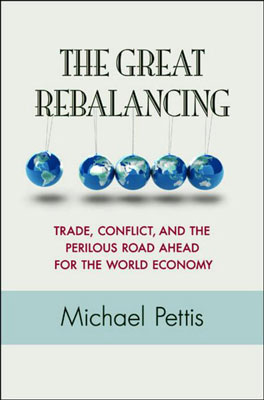
China's economic growth is sputtering, the Euro is under threat, and the United States is combating serious trade disadvantages. However, this is not another great recession but rather a critical rebalancing of world economies.
Source: Princeton University Press
China's economic growth is sputtering, the Euro is under threat, and the United States is combating serious trade disadvantages. Another Great Depression? Not quite. Noted economist and China expert Michael Pettis argues instead that we are undergoing a critical rebalancing of the world economies. Debunking popular misconceptions, Pettis shows that severe trade imbalances spurred on the recent financial crisis were the result of unfortunate policies that distorted the savings and consumption patterns of certain nations. Pettis examines the reasons behind these destabilizing policies, and he predicts severe economic dislocations--a lost decade for China, the breaking of the Euro, and a receding of the U.S. dollar--that will have long-lasting effects.Pettis explains how China has maintained massive--but unsustainable--investment growth by artificially lowering the cost of capital. He discusses how Germany is endangering the Euro by favoring its own development at the expense of its neighbors. And he looks at how the U.S. dollar's role as the world's reserve currency burdens America's economy. Although various imbalances may seem unrelated, Pettis shows that all of them--including the U.S. consumption binge, surging debt in Europe, China's investment orgy, Japan's long stagnation, and the commodity boom in Latin America--are closely tied together, and that it will be impossible to resolve any issue without forcing a resolution for all.
Demonstrating how economic policies can carry negative repercussions the world over, The Great Rebalancing sheds urgent light on our globally linked economic future.

Nonresident Senior Fellow, Carnegie China
Michael Pettis is a nonresident senior fellow at the Carnegie Endowment for International Peace. An expert on China’s economy, Pettis is professor of finance at Peking University’s Guanghua School of Management, where he specializes in Chinese financial markets.
Recent Work
Michael Pettis
Michael Pettis
Carnegie does not take institutional positions on public policy issues; the views represented herein are those of the author(s) and do not necessarily reflect the views of Carnegie, its staff, or its trustees.

China’s banking crisis in the 2000s was resolved by transferring the costs to households through financial repression—a decision that recapitalized the banks while exacerbating the structural imbalances that continue to shape the Chinese economy today.
Michael Pettis

Chinese biotech companies have been on the receiving end of U.S. economic coercion. Yet their responses have differed significantly because firm and state interests are not uniformly aligned. For Washington, treating all Chinese tech firms the same, irrespective of their actual interests, risks pushing them farther into Beijing’s corner.

Xue Gong

China’s latest energy plan explicitly calls for integrating data centers into the electricity system, particularly connecting them to green energy. It appears Beijing wants to use compute as a source of domestic demand to absorb renewables excess capacity.

Damien Ma

But their "principal to principal" model will only be as effective as the political strength of each leader back home.
Damien Ma

U.S. unpredictability has allowed China to capitalize on its positioning as the “responsible great power”. Paradoxically, the more China wins the perception game, the more likely expectations will rise for Beijing to deliver not just words but to demonstrate with its deeds.

Chong Ja Ian