

Commentary
Michael Pettis
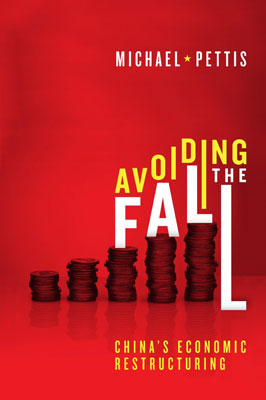
Beijing has no choice but to take significant steps to restructure its economy. The only question is how to proceed.
Source: Carnegie Endowment for International Peace
The days of rapid economic growth in China are over. Mounting debt and rising internal distortions mean that rebalancing is inevitable. Beijing has no choice but to take significant steps to restructure its economy. The only question is how to proceed.Michael Pettis debunks the lingering bullish expectations for China’s economic rise and details Beijing’s options. The urgent task of shifting toward greater domestic consumption will come with political costs, but Beijing must increase household income and reduce its reliance on investment to avoid a fall.
INCXYZ[dis_AuthorBox1.cfm]INCZYX“Michael Pettis combines deep personal knowledge of China with a remarkably broad perspective on economic and financial history generally. This lets him embed the China story in a larger framework of global imbalances, so the reader can see the U.S. subprime crisis, the European sovereign crisis, and the current stresses in China as all part of one massive, global rebalancing.”
—David Beim, Professor of Professional Practice, Columbia Business School
“Pettis probes deeply into the widening cracks in China’s ‘miracle’ economy and lays bare the tough choices that Beijing faces if it is to repair them, demolishing some popular myths and misconceptions about both China and economics. Insightful and compellingly argued, this well-timed book is a valuable key to understanding why the engine that has propelled China’s thirty-year ascent is now threatened with power failure.”
—Guy de Jonquières, Senior Fellow, European Centre for International Political Economy
“Over the past several years, Pettis has been a rare level-headed China observer who has kept his focus on accounting identities and hard economic constraints. Long before it became mainstream, he maintained that China’s economic growth model was unsustainable. In this highly insightful and forward-looking book, Pettis argues that the major uncertainty regarding the rebalancing of China’s economy is not whether but how it will unfold. He applies his characteristic logic and analytical rigor to delineate the range of realistic economic scenarios. It’s a fascinating and provocative read for anyone interested in China’s economy.”
—JC de Swaan, Lecturer in Economics, Princeton University and Principal, Cornwall Capital
“Can China make it past the middle-income trap? Having lived and taught in Beijing for more than a decade, Pettis is uniquely qualified to address this and many other key issues. Don't miss this book.”
—Arminio Fraga Neto, Former President, Central Bank of Brazil

Nonresident Senior Fellow, Carnegie China
Michael Pettis is a nonresident senior fellow at the Carnegie Endowment for International Peace. An expert on China’s economy, Pettis is professor of finance at Peking University’s Guanghua School of Management, where he specializes in Chinese financial markets.
Recent Work
Michael Pettis
Michael Pettis

China’s latest energy plan explicitly calls for integrating data centers into the electricity system, particularly connecting them to green energy. It appears Beijing wants to use compute as a source of domestic demand to absorb renewables excess capacity.

Damien Ma

But their "principal to principal" model will only be as effective as the political strength of each leader back home.
Damien Ma

U.S. unpredictability has allowed China to capitalize on its positioning as the “responsible great power”. Paradoxically, the more China wins the perception game, the more likely expectations will rise for Beijing to deliver not just words but to demonstrate with its deeds.

Chong Ja Ian

Hanoi and Beijing have long treated each other as distant cousins rather than comrades in arms. That might be changing as both sides draw closer to hedge against uncertainty and America’s erratic behavior.

Nguyễn Khắc Giang

Across Asia, China is better positioned to withstand energy shocks from the fallout of the Iran war. Its abundant coal capacity can ensure stability in the near term. Yet at the same time, the country’s energy transition away from coal will make it even less vulnerable during the next shock.
Damien Ma