


Commentary
But their "principal to principal" model will only be as effective as the political strength of each leader back home.
Damien Ma
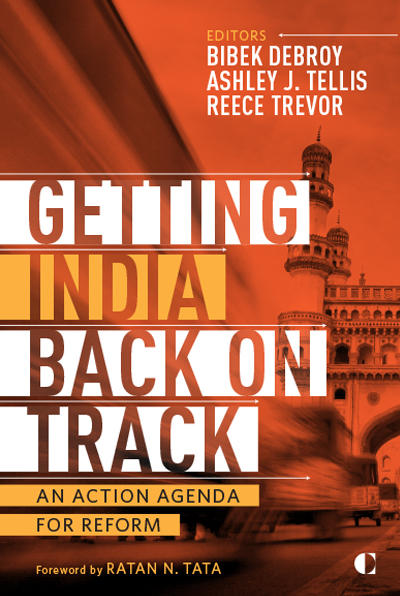
A playbook for how Indian policymakers can return the country to a path of high and sustained economic growth.
Source: Carnegie Endowment for International Peace
India has fallen far and fast from the runaway growth rates it enjoyed in the first decade of the twenty-first century. In order to reverse this trend, New Delhi must seriously reflect on its policy choices across a wide range of issue areas.
Getting India Back on Track broadly coincides with the 2014 Indian elections to spur a public debate about the program that the next government should pursue in order to return the country to a path of high growth. It convenes some of India’s most accomplished analysts to recommend policies in every major sector of the Indian economy. Taken together, these seventeen focused and concise memoranda offer policymakers and the general public alike a clear blueprint for India’s future.

“Congratulations to the authors and Carnegie.”
–Narendra Modi, prime minister of India
“I am going to read every part of this book. It will help us to do our job better. The book is well-timed and the title is apt.”
–Arun Jaitley, Indian minister of finance and defense
“Bibek Debroy and Ashley J. Tellis have brought together an impressive group of experts who provide a clear road map to move India forward in 2014. Anyone invested in the country’s success should read this book.”
–Arun Shourie, formerly India’s minister of disinvestment and minister of communications and information technology
“Focusing on a range of key issues, Getting India Back on Track has captured the scale and complexity of as well as the need for resetting India’s policies at the national and state levels. This excellent volume will be a very valuable resource to key policy framers and decisionmakers in India’s new government.”
–Naresh Chandra, former cabinet secretary and former Indian Ambassador to the United States
“It is rare to find a group of experts as accomplished and diverse as those represented in Getting India Back on Track. Their work builds a strong foundation for a real dialogue about India’s future at a time when a generational change in India’s leadership will set the course for decades to come. The Carnegie Endowment for International Peace should be complimented for undertaking such a worthwhile project.”
–Frank Wisner, former U.S. Ambassador to India and former under secretary of defense for Policy
Manifesto For Growth
–BW | BusinessWorld
‘Getting India Back on Track,’ by Bibek Debroy, Ashley Tellis, and Reece Trevor
–Financial Times
INCXYZ[SimpleAccordion.html]INCZYX
Bibek Debroy
Former Senior Fellow
Ashley J. Tellis was a senior fellow at the Carnegie Endowment for International Peace.
Reece Trevor
Former Research Assistant , South Asia Program
Carnegie does not take institutional positions on public policy issues; the views represented herein are those of the author(s) and do not necessarily reflect the views of Carnegie, its staff, or its trustees.

But their "principal to principal" model will only be as effective as the political strength of each leader back home.

Damien Ma

U.S. unpredictability has allowed China to capitalize on its positioning as the “responsible great power”. Paradoxically, the more China wins the perception game, the more likely expectations will rise for Beijing to deliver not just words but to demonstrate with its deeds.

Chong Ja Ian

Hanoi and Beijing have long treated each other as distant cousins rather than comrades in arms. That might be changing as both sides draw closer to hedge against uncertainty and America’s erratic behavior.

Nguyễn Khắc Giang

Across Asia, China is better positioned to withstand energy shocks from the fallout of the Iran war. Its abundant coal capacity can ensure stability in the near term. Yet at the same time, the country’s energy transition away from coal will make it even less vulnerable during the next shock.
Damien Ma

In the latest Five-Year Plan, the Chinese president cements the shift to an innovation-driven economy over a consumption-driven one.
Damien Ma