• Commentary
  • Research
  • Experts
  • Events
Carnegie China logoCarnegie lettermark logo
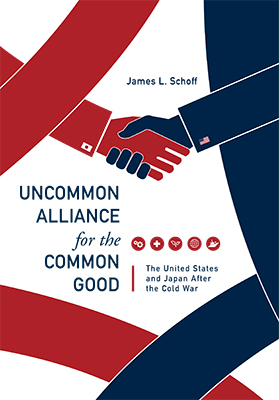
Uncommon Alliance for the Common Good: The United States and Japan After the Cold War
Report

Uncommon Alliance for the Common Good: The United States and Japan After the Cold War

At the current juncture of global uncertainty and diversified threats to prosperity, the United States and Japan should work to incorporate their full range of cooperation in more direct service of comprehensive national strategies.

Link Copied
By James L. Schoff
Published on Jan 23, 2017

Additional Links

Full TextBrief日本語

The three decade-old U.S.-Japan alliance faced a major turning point in 1990, as the Cold War wound down and a central pillar of the relationship—containment of the Soviet Union—began to fall away just as bilateral trade competition was peaking. Despite this, the allies deepened security cooperation throughout the next quarter century, in addition to broadening collaboration in economics, technology, and diplomacy. At the current juncture of global uncertainty and diversified threats to prosperity, the allies should work to incorporate their full range of cooperation in more direct service of comprehensive national strategies, recognizing the unique ways that their alliance supports global stability and serves mutual interests. The start of a new U.S. administration is an opportune time to recalibrate alliance interaction to keep it relevant and productive.

Pressures After the Cold War

  • Broadly speaking, Washington and Tokyo seek stability, openness, and access around the world, with access defined as an ability to secure the first two goals, particularly in the Asia-Pacific region. Their post–Cold War vision for the alliance combines hard security cooperation—bilaterally and with others—with a wide range of coordinated economic, technology, and diplomatic activities to support these basic objectives.
  • In the wake of the Gulf War, both countries desired greater Japanese contributions to global security, reinforced later by North Korea’s nuclear development and China’s military modernization. The growing threat from terrorist networks in fragile states was another prompt for what became Japan’s steady series of legal changes to allow its armed forces to participate in a wider range of overseas missions and to provide more robust national defense. The alliance is better able to respond to potential crises, but Japan has little room left to expand military engagement under its current constitution.
  • The United States and Japan have also collaborated to try preventing security and economic challenges before they manifest, through infrastructure investment in the Asia- Pacific region, development assistance, support for global healthcare and the environment, and promoting good governance and institution building. While useful, most of these grand alliance endeavors have devolved into a collection of disjointed programs with only marginal strategic impact.
  • Meanwhile, the acceleration of globalization is increasing pressure on what has been a productive and open international system for managing economic and diplomatic affairs since the end of World War II, a system the allies pushed to expand in the post–Cold War era through various trade, finance, and technology standardization initiatives.
  • China’s future economic and political evolution is one of the most consequential variables for the allies, but even though the U.S. and Japanese relationships with China feature strong economic interdependence and growing areas of common interest, there are still frequent instances of zero-sum competition, limited mutual trust, and conflicting world views that hinder collaboration and provide dry tinder for a destructive clash.
  • One way for the allies to balance China positively is to help build a strong, stable, and prosperous Southeast Asia along China’s periphery that is relatively open and able to cooperate effectively to protect shared interests. The purpose is not to contain China or minimize Chinese influence in Southeast Asia but to foster the growth of a region where outside nations have equal access and vital resources are protected sustainably.

Steps for the Allies in 2017 and Beyond

  • Conduct a five-step alliance strategy consultation early in the Donald Trump administration that combines top-down strategic direction on common priorities with bottom-up interagency discussions to effectively bridge the gap between alliance vision and coordinated action in the field.
  • Put China policy and support for balanced development in Southeast Asia at the top of the allies’ consultation agenda, followed by use of trilateral diplomacy to coordinate containment of the North Korean nuclear threat and support multilateral cooperation for common interests in the Asia region. Environmental protection and fisheries management in the South China Sea could be a productive focus for sustained and strategic engagement.
  • Patiently but ambitiously implement the 2015 defense guidelines, a process that began in 2016 but will require multiple years of planning, training, and tinkering by the allies to make the most of new opportunities for more integrated security cooperation. North Korea and East China Sea contingencies should be the primary focus in the near term.
  • Reinvigorate engagement among the governments of Japan, the United States, and Okinawa to pursue additional measures for U.S. military footprint and overall impact reduction over the long term for political sustainability, even as the allies move forward with current plans for reduction and relocation of U.S. Marines stationed there.
  • Elevate one or two areas of strategically important science and technology collabo- ration for more significant and sustained investment by the allies, not only from a technical perspective but also in terms of associated policy development at a global level. The field of artificial intelligence is a good candidate, given how impactful and potentially disruptive this technology could be in economics, politics, and security.

Read Full Text

About the Author

James L. Schoff

Former Senior Fellow, Asia Program

James L. Schoff was a senior fellow in the Carnegie Asia Program. His research focuses on U.S.-Japan relations and regional engagement, Japanese technology innovation, and regional trade and security dynamics.

    Recent Work

  • Paper
    A High-Tech Alliance: Challenges and Opportunities for U.S.-Japan Science and Technology Collaboration

      James L. Schoff, Douglas E. Rake, Joshua Levy
  • Commentary
    What’s the U.S. Take on Russia-Japan Relations?

      James L. Schoff

James L. Schoff
Former Senior Fellow, Asia Program
James L. Schoff
North AmericaUnited StatesEast AsiaJapanClimate ChangeSecurityForeign Policy

Carnegie does not take institutional positions on public policy issues; the views represented herein are those of the author(s) and do not necessarily reflect the views of Carnegie, its staff, or its trustees.

More Work from Carnegie China

  • Commentary
    Malaysia’s Year as ASEAN Chair: Managing Disorder

    Malaysia’s chairmanship sought to fend off short-term challenges while laying the groundwork for minimizing ASEAN’s longer-term exposure to external stresses.

      Elina Noor

  • Commentary
    When It Comes to Superpower Geopolitics, Malaysia Is Staunchly Nonpartisan

    For Malaysia, the conjunction that works is “and” not “or” when it comes to the United States and China.

      Elina Noor

  • Commentary
    Neither Comrade nor Ally: Decoding Vietnam’s First Army Drill with China

    In July 2025, Vietnam and China held their first joint army drill, a modest but symbolic move reflecting Hanoi’s strategic hedging amid U.S.–China rivalry.

      • Nguyen-khac-giang

      Nguyễn Khắc Giang

  • Commentary
    Today’s Rare Earths Conflict Echoes the 1973 Oil Crisis — But It’s Not the Same

    Regulation, not embargo, allows Beijing to shape how other countries and firms adapt to its terms.

      Alvin Camba

  • Commentary
    China’s Mediation Offer in the Thailand-Cambodia Border Dispute Sheds Light on Beijing’s Security Role in Southeast Asia

    The Thai-Cambodian conflict highlights the limits to China's peacemaker ambition and the significance of this role on Southeast Asia’s balance of power.

      Pongphisoot (Paul) Busbarat

Get more news and analysis from
Carnegie China
Carnegie China logo, white
Keck Seng Tower133 Cecil Street #10-01ASingapore, 069535
  • Research
  • About
  • Experts
  • Events
  • Contact
  • Careers
  • Privacy
  • For Media
Get more news and analysis from
Carnegie China
© 2026 Carnegie Endowment for International Peace. All rights reserved.