

Article
Steve Feldstein
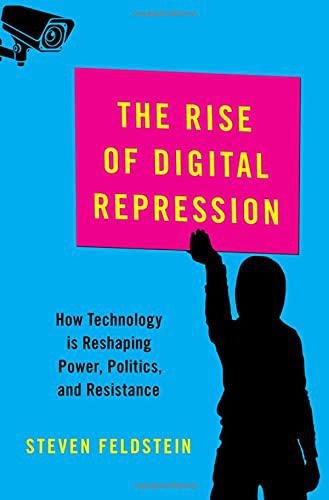
How anti-democratic leaders harness powerful technologies to advance their political objectives and some innovative ideas for civil society and opposition movements to respond to the digital autocratic wave.
Source: Oxford University Press
The world is undergoing a profound set of digital disruptions that are changing the nature of how governments counter dissent and assert control over their countries. While increasing numbers of people rely primarily or exclusively on online platforms, authoritarian regimes have concurrently developed a formidable array of technological capabilities to constrain and repress their citizens.
In The Rise of Digital Repression, Steven Feldstein documents how the emergence of advanced digital tools bring new dimensions to political repression. Presenting new field research from Thailand, the Philippines, and Ethiopia, he investigates the goals, motivations, and drivers of these digital tactics. Feldstein further highlights how governments pursue digital strategies based on a range of factors: ongoing levels of repression, political leadership, state capacity, and technological development. The international community, he argues, is already seeing glimpses of what the frontiers of repression look like. For instance, Chinese authorities have brought together mass surveillance, censorship, DNA collection, and artificial intelligence to enforce their directives in Xinjiang. As many of these trends go global, Feldstein shows how this has major implications for democracies and civil society activists around the world.
A compelling synthesis of how anti-democratic leaders harness powerful technology to advance their political objectives, The Rise of Digital Repression concludes by laying out innovative ideas and strategies for civil society and opposition movements to respond to the digital autocratic wave.
“Digital technologies were once seen as a harbinger of liberalization and democratization. Thanks to ’big data,’ A.I., machine learning, facial recognition, and other mass surveillance systems, they have now become an autocrat’s best friend and a big business opportunity. With precision and clarity, Steven Feldstein documents the disturbing spread of the political economy of digital repression and offers pathways to help resist it. The Rise of Digital Repression is an important contribution to the scholarly literature on information controls.”
—Ron Deibert, Director, the Citizen Lab, Munk School of Global Affairs and Public Policy, the University of Toronto
“The Rise of Digital Repression invites us to look beyond digital politics in North America and Europe. Technology in authoritarian hands creates smothering repression in the Philippines, Ethiopia, Thailand, or anywhere one finds governments fear of their own citizens. Advances in artificial intelligence, especially when developed by techno-authoritarian regimes, deepens the concern. Yet, in the end, Feldman guides us through more hopeful alternatives. This is essential reading for those who are concerned about the struggle between freedom and repression.”
—Steven Livingston, Professor and Founding Director Institute for Data, Democracy, and Politics, George Washington University
“Steve Feldstein delivers a book that will be viewed as indispensable to anyone concerned with the intersection of technology and the state, and particularly, the evolving impact on people’s quest for freedom the world over. In original case studies, he details how the current rising tide of authoritarianism has been enabled by digital repression. This tide could recede; equally compelling are the strategies he outlines for democratic governments, for civil society activists, and for those in the private sector looking to stem the tide.”
—Sarah E. Mendelson, Distinguished Service Professor of Public Policy, Carnegie Mellon University, Former U.S. Ambassador to the UN’s Economic and Social Council
“This book is a must-read on the myriad ways that state repression has adapted to the digital age. Through data-driven analysis and original case studies, Steven Feldstein provides a comprehensive guide to online censorship, disinformation, and surveillance. This is an excellent primer for those looking to understand how to push back against digital authoritarianism.”
—Adrian Shahbaz, Director for Technology and Democracy, Freedom House
“Feldstein’s book provides the most detailed stocktaking of the various aspects of digital repression to date. For readers, especially those looking for an introduction into the topic, it offers a sheer treasure trove of examples and details on contemporary forms of digital repression.”
—Anita R. Gohdes, Perspectives On Politics
“Feldstein’s book makes a noteworthy methodological contribution to the literature by introducing digital repression, digital repression capacity, and the AI and big-data global surveillance indexes. It offers a strong foundation for future research through its analytical approach to case studies and methodological contributions to a fast-growing field.”
—Reyhan Topal, The Information Society

Senior Fellow, Democracy, Conflict, and Governance Program
Steve Feldstein is a senior fellow at the Carnegie Endowment for International Peace in the Democracy, Conflict, and Governance Program. His research focuses on technology, national security, the global context for democracy, and U.S. foreign policy.
Recent Work
Steve Feldstein

Steve Feldstein, Dara Massicot
Carnegie does not take institutional positions on public policy issues; the views represented herein are those of the author(s) and do not necessarily reflect the views of Carnegie, its staff, or its trustees.

But their "principal to principal" model will only be as effective as the political strength of each leader back home.

Damien Ma

U.S. unpredictability has allowed China to capitalize on its positioning as the “responsible great power”. Paradoxically, the more China wins the perception game, the more likely expectations will rise for Beijing to deliver not just words but to demonstrate with its deeds.

Chong Ja Ian

Hanoi and Beijing have long treated each other as distant cousins rather than comrades in arms. That might be changing as both sides draw closer to hedge against uncertainty and America’s erratic behavior.

Nguyễn Khắc Giang

Across Asia, China is better positioned to withstand energy shocks from the fallout of the Iran war. Its abundant coal capacity can ensure stability in the near term. Yet at the same time, the country’s energy transition away from coal will make it even less vulnerable during the next shock.
Damien Ma

In the latest Five-Year Plan, the Chinese president cements the shift to an innovation-driven economy over a consumption-driven one.
Damien Ma