

Commentary
But their "principal to principal" model will only be as effective as the political strength of each leader back home.
Damien Ma
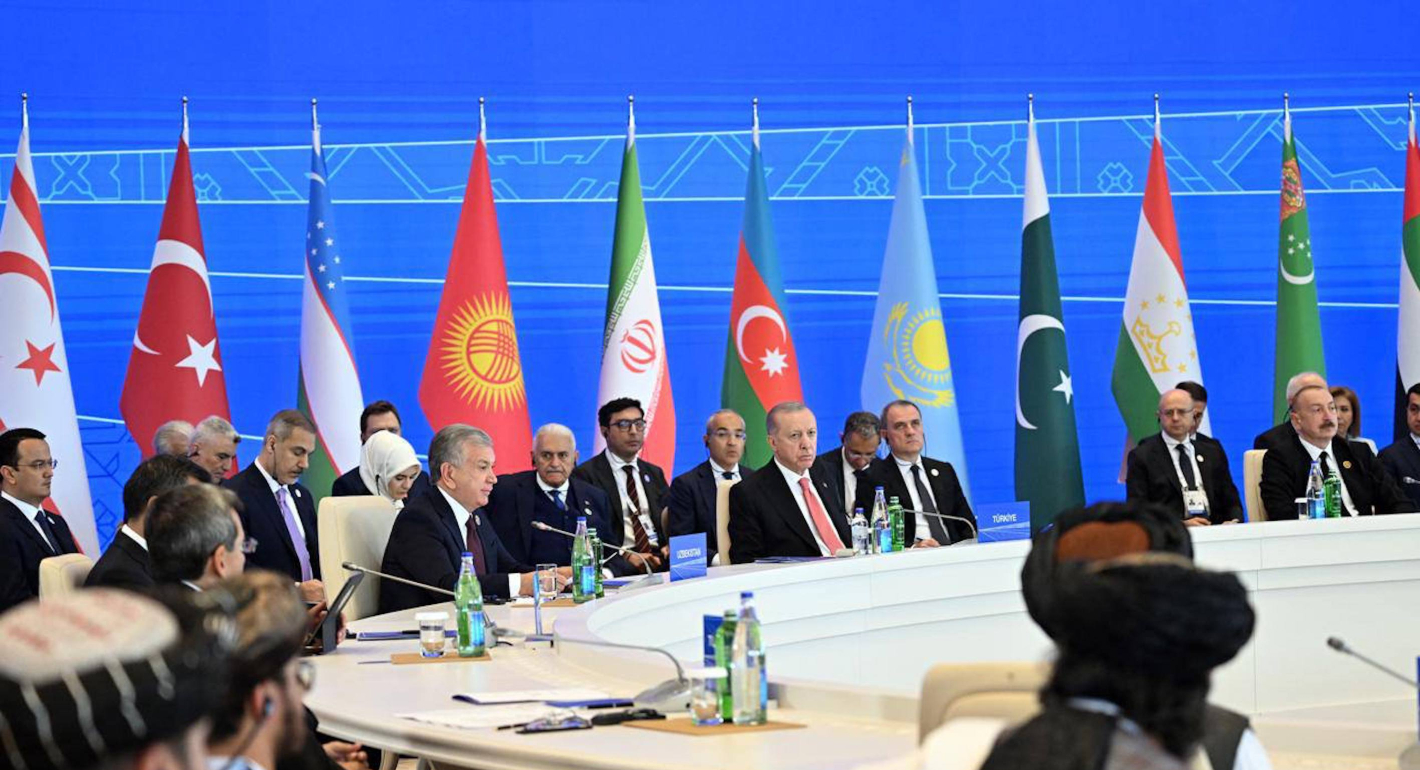
Photo by Presidency of Uzbekistan / Handout/Anadolu via Getty Images
Over the past two decades, regional collaboration in the South Caucasus has intensified. Turkey and the EU should establish a cooperation framework to accelerate economic development and diversification.
Russia’s declining influence in the South Caucasus since the start of the war in Ukraine has opened a window of opportunity to reshape the region’s security and economic landscape. Today, countries in the South Caucasus have a chance to diversify their economies by linking up to the EU’s advanced value chains. This prospect is strategically important, as economic diversification and competitiveness are closely tied to regional stability, resilience, and security. Recent cooperation initiatives could become game changers in this regard if pursued in tandem with national economic diversification and development strategies in the countries of the region.
Turkey can play a unique role in these efforts. Opening the Turkey-Armenia border and upgrading Soviet-era rail connections could create the foundations of a South Caucasus connectivity hub crisscrossed by energy projects and a nexus for climate cooperation, security collaboration, and tourism-based development. Turkish companies could spearhead this regional transformation on multiple fronts: manufacturing, logistics, and transportation.
A comprehensive, forward-looking strategy for the South Caucasus that also factors in the potential of Central Asia is critical to help the South Caucasus strengthen its competitiveness, diversify its economic relations, and move beyond its traditional path dependencies. One key step would be to establish a regional cooperation framework that leverages the industrial potential of countries such as Uzbekistan by linking them more closely with EU technology and Turkey’s commercialization capacity. This would make envisaged connectivity projects meaningful and truly transformative. At the same time, smaller South Caucasus economies could benefit from targeted sectoral transformation in areas such as cultural exchanges, ecotourism, and IT, which offer opportunities for inclusive job creation.
After the collapse of the Soviet Union, the economic trajectories of the South Caucasus and Central Asia diverged sharply from those of former Soviet republics and socialist countries in Central Europe. South Caucasus and Central Asian states experienced marked declines in their levels of economic complexity—a key indicator of productive capacity (see figure 1). Eastern European countries, including Belarus, Moldova, and Ukraine, which did not join the EU, also recorded declines. By contrast, Central European countries—Bulgaria, the Czech Republic, Hungary, Poland, Romania, and Slovakia—and the Baltic states of Estonia, Latvia, and Lithuania, all of which became EU members, managed to preserve (and, in some cases, even increase) their productive capacity.
The divergence between these two blocs may be explained by their differing economic orientations after the fall of the Soviet Union. The exports of the Central European countries and the Baltic states are destined primarily for elsewhere in the EU. These countries have benefited significantly from their integration into EU markets and the union’s advanced value chains—whether through trade or foreign direct investment (FDI). As a result, they have absorbed productive capacity that has contributed to their growth and development.
By contrast, most countries in the South Caucasus and Central Asia are largely embedded in Russian trade and investment networks. The EU’s share in these countries’ exports is limited (see figure 2). The exceptions are Azerbaijan and Kazakhstan, which export large portions of their petroleum products to the EU. When oil, gas, and gold are excluded from the analysis, Russia’s prominence as an export partner becomes even more pronounced for all countries, including Azerbaijan and Kazakhstan (see figure 3).
Intraregional trade patterns also highlight a sharp contrast between the two groups of former socialist countries. The Central European and Baltic states direct most of their exports to their own regions. For instance, an average of 59 percent of the Czech Republic’s exports other than oil, gas, and gold in 2016–2021 went to EU markets beyond Central Europe; when trade with other Central European EU members is included, this figure rises to 76 percent. By comparison, intraregional exports in the South Caucasus and Central Asia are limited, with the exceptions of Kyrgyzstan, Tajikistan, and, to some extent, Uzbekistan, which maintain notable export links with one another.
Overall, regional integration in the South Caucasus and Central Asia is very low, for example compared with intraregional trade in the Economic Community of West African States (ECOWAS) or Mercosur (see figure 4). This can be partly explained by the hub-and-spoke design of the Soviet Union, which prioritized links between the center (Moscow) and the periphery, not between different Soviet republics.
A 2010 Asian Development Bank report highlighted Central Asia’s limited intraregional trade and weak value-chain integration, noting that trade in parts and components within the region accounted for only 1.2 percent of total trade in this sector in 2008—compared with 56.3 percent in East Asia. Despite their geographic proximity to China, Central Asian countries remain heavily dependent on energy exports, with minimal intraregional industrial linkages.
In addition to the Soviet legacy, closed borders and frozen conflicts in the South Caucasus have contributed to economic stagnation. The conflict between Armenia and Azerbaijan, the closed frontier between Armenia and Turkey, and tensions between Georgia and Russia over the breakaway regions of Abkhazia and South Ossetia have all hindered the free flow of goods and people.
The EU-Turkey Customs Union has been a pivotal force in transforming Turkey’s economy into one that is industrialized and deeply integrated into European value chains. Since the 1990s, this integration has significantly increased the global competitiveness of the country’s exports.
Turkey’s role as a regional production hub had become firmly established by 2023 (see figures 5 and 6). Since 1995, Turkey has achieved a dual success by expanding both the variety of its competitive export products and the number of markets to which it exports its products competitively. Turkey has emerged as a key global supplier—a transformation driven largely by the customs union framework. Turkey now outperforms Central European countries in terms of both product diversity and market reach.
Turkey is among the top five trading partners of many countries in the South Caucasus and Central Asia (see table 1). Even Armenia counted Turkey as its tenth-largest import partner in 2023, with imports from Turkey amounting to $341 million—via Georgia, as the land border between Armenia and Turkey is closed. However, the actual volume of Turkish exports to Armenia may be higher, as some are likely reexported as Georgian goods. According to the UN Comtrade database, which provides data on reexports, Georgia’s exports to Armenia totaled $787 million in 2023, of which $621 million were reexports that could include Turkish goods.
Turkey’s first strategic objective in its neighborhood is to expand the trading and investment activities of Turkish companies in Central Asia. It will be critical for Turkey to establish independent value chains free from Russian influence and, increasingly, from China, which has emerged as a competitor to Turkish goods. In this context, Central Asia is an investment destination for Turkish firms, while the South Caucasus is a vital transit hub. Turkey’s diversification across products and markets has reshaped its strategic economic position. With its experience and productive capacity, Turkey has also positioned itself as a critical connector for integrating its eastern neighbors into EU value chains.
At the same time, Ankara places a strong emphasis on regional stability as a prerequisite for the security of its companies’ trade and investments. This emphasis is linked to Turkey’s position as a country that faces cross-border security and migration challenges while maintaining an export-oriented economy that depends on stable relations and reliable market access. In short, economic resilience and diversification in Turkey’s neighborhood are essential components of the regional stability that Turkey requires.
Curbing migration induced by climate change will also be a priority. By 2070, large parts of Southeast Asia, the Middle East, and Africa are projected to face the pressures of extreme heat, potentially making them uninhabitable. In contrast, temperature increases in the EU, Turkey, the South Caucasus, and Central Asia are expected to be less severe. Given this disparity, significant waves of migration from heavily populated heat-affected countries in the Global South toward the EU and Turkey will become more likely. At the same time, the relatively low population densities and substantial land resources of the South Caucasus and Central Asia make these regions potential alternative destinations for climate-related migration.
To manage this prospect effectively, the South Caucasus and Central Asia must strengthen their economic resilience and institutional capacity, particularly by fostering job creation through economic diversification. Countries in Turkey’s neighborhood risk losing their resource-based economic models under the pressures of the global green transition. Some of these countries, such as Azerbaijan and Kazakhstan, are already pursuing diversification strategies, while others, like Iran and Iraq, also face security and political risks beyond resource dependence. Still, from the perspectives of both the EU and Turkey, economic diversification in the South Caucasus and Central Asia will be essential to mitigate migration pressures and safeguard political stability.
In the past decade, a key element of Ankara’s regional strategy has been the development of the Trans-Caspian East-West-Middle Corridor Initiative, also known as the Middle Corridor. The route extends from China through Central Asia, passing via Kazakhstan and Turkmenistan with rail and road connections, before crossing the Caspian Sea, Azerbaijan, and Georgia, and continuing onward via Turkey to Europe. Through this initiative, Turkey initially sought to position itself as a major logistics hub for EU-China trade and establish an alternative route for Turkish exports, as trucks on the previous route through Iran often faced long delays at congested border crossings.
However, climate change has reshaped both the geopolitical importance of Central Asia and the role of the Middle Corridor. The purpose of the latter is no longer primarily to reach China but to engage directly with Central Asian countries to support their transformations into strong, viable economies in the space between China and Russia. Climate change therefore reinforces the need for diverse and resilient economies in Central Asia—and, hence, in the South Caucasus—that can adapt to structural shifts, reduce their dependence on single-resource models, and contribute to a more stable regional order.
Last but not least, Turkey’s strategic orientation toward the South Caucasus serves a domestic purpose of reducing economic disparities within the country’s borders. Eastern Anatolia, especially the provinces that border Armenia, is one of the least developed parts of Turkey. In 2022, GDP per capita in these provinces was below $6,593—with the level in many provinces under $5,188—compared with the national average of $10,640 (see map 1). The possible opening of Turkey’s border with Armenia—brought about by the new peace environment in the South Caucasus—presents an opportunity to incorporate these lagging provinces into a broader development strategy. Strengthening economic and transportation linkages through Turkey’s eastern provinces would not only improve regional integration but also help revitalize the economy of eastern Turkey.
Over the past two decades, regional collaboration and commercial activity have intensified in the South Caucasus. In the 2000s, Azerbaijan and Georgia, together with Turkey, cooperated on major transportation and energy projects, some of which also involved the Central Asian republics. Among the transportation and energy links that cross the South Caucasus into Turkey are the Baku–Tbilisi–Ceyhan oil pipeline and the Baku–Tbilisi–Erzurum gas pipeline, also known as the South Caucasus Pipeline, both of which became operational in 2006. Another milestone was the 2017 completion of the Baku–Tbilisi–Kars railroad, which provides a direct route from the South Caucasus and Turkey to Europe.
Today, there are new opportunities for regional connectivity and cooperation. In August 2025, during an Armenia-Azerbaijan summit hosted in Washington by U.S. President Donald Trump, the two countries’ leaders signed a draft peace treaty and a document on transportation connectivity, with a focus on new road and rail projects. Also signed by the U.S. president, this joint declaration committed the two sides to a framework for the creation of the Trump Route for International Peace and Prosperity (TRIPP). TRIPP runs through Armenia’s southern Syunik province (historically known as Zangezur), which links mainland Azerbaijan to its Nakhchivan exclave, and onward to Turkey.
TRIPP involves reviving Soviet-era rail connections and providing alternatives to the current, longer route through Georgia. The availability of alternative links is critical in case one route is disrupted—as occurred during the Russia-Georgia war in 2008, when both road and rail connections through Georgia were disrupted. More recent geopolitical disruptions, including tensions in the Red Sea and the Russia-Ukraine war, have similarly underscored the importance of securing reliable and diversified trade routes.
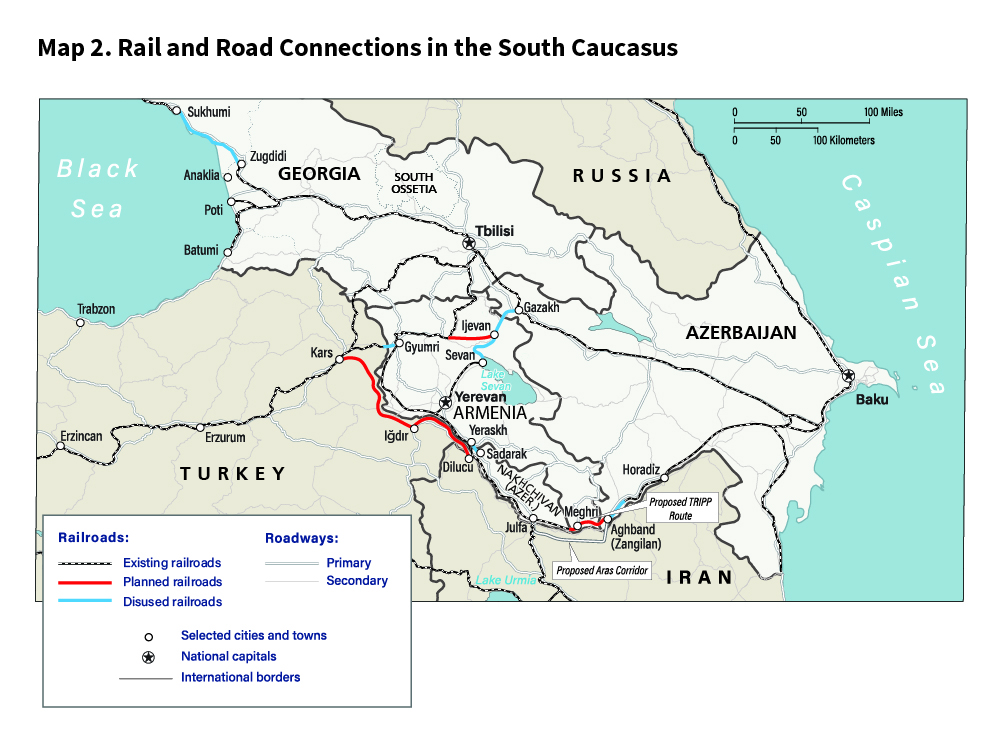
In this context, TRIPP can play a central role in the broader framework of Turkey’s Middle Corridor strategy. Specifically, TRIPP can link the country to Nakhchivan either with existing Soviet-era rail lines along the Akhurik–Yeraskh segment or via the proposed Kars–Iğdır–Dilucu rail connection (see map 2). The latter is a new Turkish proposal that was unveiled in August 2025 following the Washington summit. The project would cost an estimated €2.4 billion ($2.8 billion), span approximately 224 kilometers (139 miles), and take at least four years to complete. The existence of multiple routes would contribute to building stronger and more resilient trading infrastructure across the region, helping preempt supply-chain disruptions while enabling vibrant regional economic activity.
Greater connectivity is vital for all countries in the region, as it enables more diversified and efficient access to global markets. Specifically, realizing TRIPP and the Middle Corridor strategy depends on overcoming significant obstacles to the movement of goods—in terms of both infrastructure (which can be thought of as hardware) and the regulatory and procedural frameworks that shape cross-border trade (software). According to the World Bank’s Logistics Performance Index, countries in the South Caucasus and Central Asia perform poorly on these measures (see figure 7).
Effective use of the Middle Corridor in the region is limited not only by physical and procedural shortcomings but also, most importantly, by a lack of coordination between countries and institutions. A 2023 World Bank study identified this lack of coordination as the foremost challenge; no single operator manages transportation from origin to destination, which results in delays at connection points. The same study highlighted other software-related issues—such as the absence of integrated IT systems, and tariffs—and hardware constraints, including vessel and rail equipment shortages. The impact of these obstacles is most pronounced at Caspian and Black Sea crossings, port–rail interfaces, and national borders, where delays are most severe.
Countries in the South Caucasus and Central Asia face additional institutional constraints. Their private sectors are relatively underdeveloped, and they have been slow to implement necessary reforms in their institutional, legal, and regulatory environments—particularly in areas such as trade and investment policy. These shortcomings hamper trade and the two regions’ ability to attract FDI, especially in value-added and technology-intensive sectors. As a result, over half of all FDI in the regions continues to flow into resource-based industries, reinforcing a commodity-dependent development path and limiting long-term economic diversification and resilience.
In the post-Soviet era, the South Caucasus and Central Asian states remained largely tied to Russian supply chains and mirrored Russia’s decline in economic competitiveness. Today, however, countries in the two regions have an opportunity to build partnerships and diversify their economies by linking to EU value chains. The rapprochement between Armenia and Azerbaijan, combined with Russia’s waning influence in the South Caucasus because of the ongoing war in Ukraine, has created space for enhanced regional cooperation and new openings.
Along with improved transportation and logistics infrastructure, a strategic vision that encompasses both the South Caucasus and Central Asia is essential to advance economic diversification. Efforts should focus on stimulating economic activity by leveraging the comparative strengths of different countries. Central Asian states, such as Uzbekistan, hold potential for industrial development and could pursue sector-specific transformation models in collaboration with the EU and Turkey. Within this framework, the EU would serve as the primary source of technology and knowledge creation, while Turkey could commercialize these innovations and connect them with Central Asian economies, unlocking their competitive advantages.
Meanwhile, economies in the South Caucasus, which lack industrial capacity, require targeted strategies to complement connectivity. Tourism presents a particularly promising entry point, especially through cross-border cooperation. For example, the border regions between Armenia and Turkey could provide an untapped peace dividend in the form of considerable cultural and ecotourism potential, which offers opportunities for inclusive and sustainable job creation. Joint initiatives between the two countries could generate synergies that boost regional tourism and foster economic transformation in both Armenia and the less developed eastern regions of Turkey.
To this end, the first important milestone will be the opening of the Armenia-Turkey border, which has become a realistic possibility given the improving peace environment in the South Caucasus and in the context of the proposed TRIPP. The January 2026 joint statement by Armenia and the United States on the Armenia-U.S. TRIPP Implementation Framework, which provides the basis for establishing the TRIPP Development Company, indicates that a regional connectivity project is indeed moving forward. As negotiations progress, one practical first step could be to allow international tourists to cross the Armenia-Turkey border.
A second track would involve establishing business-to-business contacts, particularly between Armenian and Turkish tour operators, to kick-start the design of cross-border tourist routes. Bringing together firms from both countries to identify multiple routes would lay the groundwork for broader collaboration. A structured framework for business cooperation—leveraging Armenian tour operators’ expertise in package tourism—would help unlock the region’s tourism potential. As a pilot initiative, operators from Armenia could be invited to design and experience routes that connect Yerevan to the Turkish cities of Kars, Doğubayazıt, and Van.
Taken together, these steps would bring about economic development and regional economic integration, which are important for job creation and sustainable peace in the region. In this context, Turkey—with its strong trade and commercialization capacity—can support the wider region, stretching to the South Caucasus and Central Asia, to better connect to the EU and upgrade the region’s economies. Specifically, Turkish companies could spearhead this regional transformation across key sectors, including manufacturing, logistics, and transportation.
Feride İnan is the director of the Center for Geoeconomic Studies at the Economic Policy Research Foundation of Turkey (TEPAV).
Güven Sak is the founding managing director of TEPAV.
Berat Yücel is a senior policy analyst at TEPAV.

Feride İnan
Director, TEPAV
Feride İnan is the director of the Center for Geoeconomic Studies at the Economic Policy Research Foundation of Turkey (TEPAV).

Güven Sak
Founding Managing Director, TEPAV
Güven Sak is the founding managing director of TEPAV.

Berat Yücel
Senior Policy Analyst, TEPAV
Berat Yücel is a senior policy analyst at TEPAV.
Carnegie does not take institutional positions on public policy issues; the views represented herein are those of the author(s) and do not necessarily reflect the views of Carnegie, its staff, or its trustees.

But their "principal to principal" model will only be as effective as the political strength of each leader back home.

Damien Ma

U.S. unpredictability has allowed China to capitalize on its positioning as the “responsible great power”. Paradoxically, the more China wins the perception game, the more likely expectations will rise for Beijing to deliver not just words but to demonstrate with its deeds.

Chong Ja Ian

Hanoi and Beijing have long treated each other as distant cousins rather than comrades in arms. That might be changing as both sides draw closer to hedge against uncertainty and America’s erratic behavior.

Nguyễn Khắc Giang

Across Asia, China is better positioned to withstand energy shocks from the fallout of the Iran war. Its abundant coal capacity can ensure stability in the near term. Yet at the same time, the country’s energy transition away from coal will make it even less vulnerable during the next shock.
Damien Ma

Malaysia’s chairmanship sought to fend off short-term challenges while laying the groundwork for minimizing ASEAN’s longer-term exposure to external stresses.

Elina Noor