

Article
Viktor Kevliuk, Olesya Favorska, Andriy Zagorodnyuk
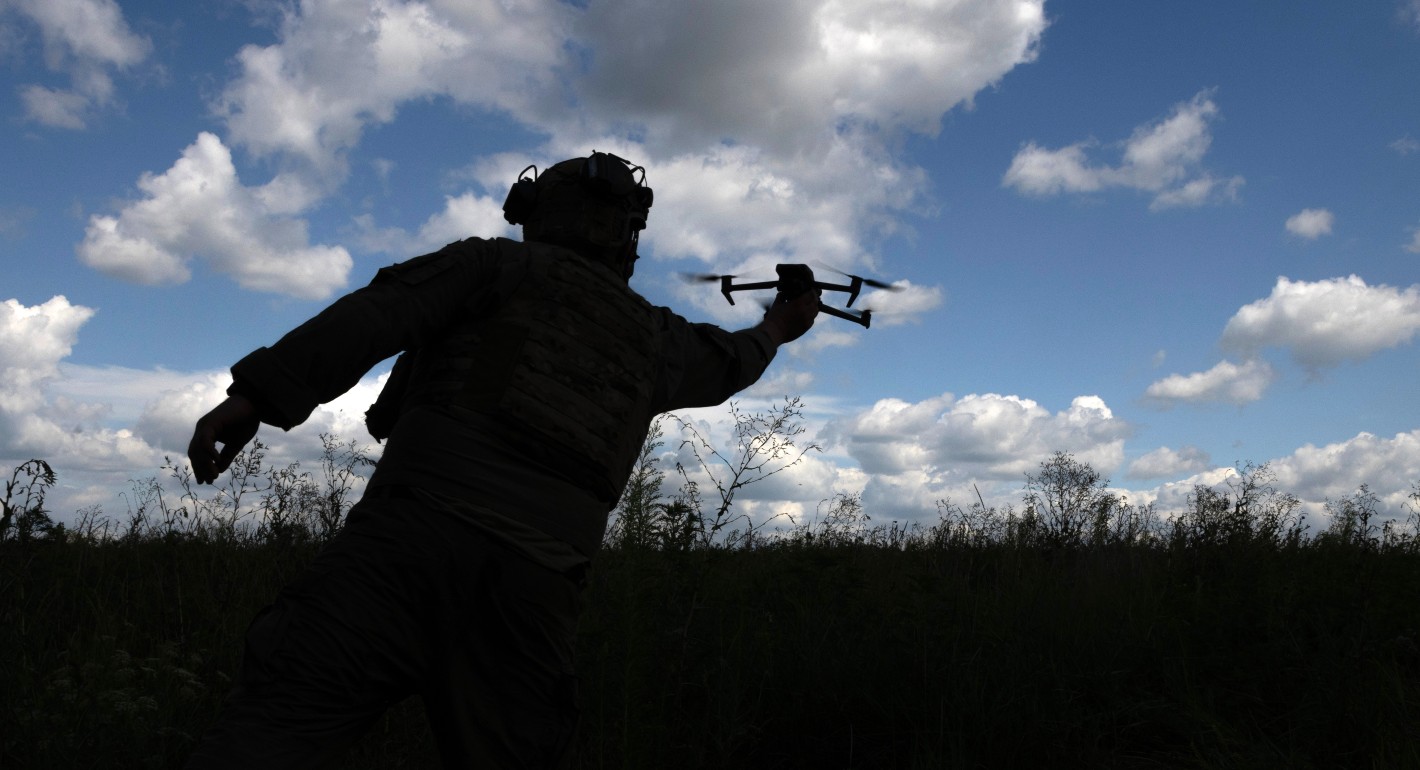
A Ukrainian drone operator lands his drone after a surveillance flight near Bakhmut in the Donetsk Region of Ukraine. (Photo by Paula Bronstein/Getty Images)
How Ukraine is driving doctrinal change in modern warfare.
Russia’s war against Ukraine has entered a new phase, one defined less by territorial gains than by intense technological competition. Both sides are now engaged in a sustained effort to gain advantage through rapid innovation and adaptation, introducing new types of unmanned systems, countermeasures, and operating methods at unprecedented speed. Ukraine is championing a distributed, bottom-up innovation model with hundreds of firms and volunteer groups, close integration between frontline units and manufacturers, and research-and-development activity embedded directly in combat formations. Russia, by contrast, pursues a centralized approach, with the state playing a dominant role in steering, producing, and scaling new weapon systems and capabilities. Ukraine is ahead in some areas and Russia in others, but both have moved far beyond prevailing Western practices, transforming the battlefield into a live environment of continuous military-technical experimentation.
One illustration of this is the effort by both sides to extend first-person-view (FPV) control and remote operation to ever-greater distances. In February 2026, Ukraine successfully restricted Russia’s use of Starlink commercial satellite communications on its long-range unmanned aerial vehicles (UAVs), which highlighted the alarming reality that drones with real-time FPV control were operating at ranges once associated only with strategic weapons. This development challenges the common claim that long-range drones are merely “cheap cruise missiles.” Cruise missiles do not provide persistent situational awareness and FPV-enabled re-tasking. What is emerging is an entirely new category of unmanned weapons that combine reach, adaptability, and low cost with direct human control.
The popular Ukrainian motto, “Let the robots fight” (instead of people) reflects the possibility of using existing enabling technologies—simple or sophisticated, low-cost or more expensive—to provide an effective remote-controlled or autonomous long-range reach with a high degree of precision. Numerous new weapons systems that would have been hard to imagine just a few years ago now dominate the operational environment of Russia’s war in Ukraine.
But the changes extend well beyond the introduction of new weapons. In Ukraine’s case, these technological innovations are reshaping operating concepts, challenging established doctrines, altering force structure, and redefining the relationship between industry and the battlefield.
Some write off these developments in unmanned warfare as the result of Ukraine’s lack of more advanced weapons. For example, the dismissive comments by Armin Papperger, the CEO of the German defense giant Rheinmetall, in March 2026 about the country’s drone innovations reflect a sentiment shared across some Western militaries and defense industries, which prize costly high-end programs. However, the new technologies that are being pioneered by Ukraine will profoundly shape the battlefield in clashes involving more sophisticated forces, as already evidenced by the challenges posed recently by Iran’s drones for U.S. and Gulf-state militaries.
The question is how deeply these developments will transform warfare. This paper explores several emerging trends from the battlefield in Ukraine and argues that, taken together, they meet the criteria for what military strategists refer to as a revolution in military affairs (RMA): a structural shift in warfare in which new technologies drive the development of novel operational concepts and doctrines, fundamentally altering how military power is generated and employed, and forcing enduring changes in military organizations. These trends include the emergence of affordable precise mass,1 the fragmentation of the air domain, the growing difficulty of maneuver, the centrality of networked warfare, and the elevation of rapid adaptation as a core military capability. This transformation is still in its early stages, but countries that fail to recognize and adapt to it risk preparing for a form of war that has lost its decisiveness.
Analysts of the Russo-Ukrainian war often use the phrase “drone revolution.” But what is the systemic impact of drone warfare?
The term “revolution” in a military context has historically been applied sparingly. Military historians and theorists have used it to describe inflection points when massive changes in technology converged with new fundamental doctrines that forced states to reorganize their militaries. Michael Roberts and later Geoffrey Parker used the concept of a military revolution to explain how the adoption of firearms in early modern Europe triggered profound transformations in warfare, state capacity, and political order. Later wars brought equally profound changes to the character of conflicts, including industrial warfare in the First World War and the nuclear age ushered in by the Second World War.
During the late Cold War, Soviet military theorists developed the idea of a military-technical revolution (MTR). Writing in the 1970s and 1980s, they focused on the emergence of new non-nuclear conventional high-tech weapons, including networked precision weapons—which they termed “reconnaissance-strike complexes”—and argued that their integration into war-fighting could provide early adopters with advantages “greater than an order of magnitude.” The Soviet Union never achieved this advantage, but the concept did not disappear.
Around the same time, a similar idea flourished in military circles in the United States. As Washington invested heavily in precision-guided munitions, sensors, and connectivity, strategists from the Department of Defense’s Office of Net Assessment reframed the MTR into the RMA, a broader framework that emphasized not only technology but also the operating concepts and organizational changes required to exploit it. The 1991 Gulf War was the canonical demonstration of this idea.
The core promise of the RMA was that smart, precise, and interconnected systems could substitute for a large mass of older weapons systems. Hence, technologically superior forces would decisively prevail over larger but less advanced adversaries by seeing more, striking more accurately, and coordinating faster. This logic reshaped Western military doctrines, force structures, and procurement practices from the 1990s. Precision firepower, delivered primarily through airpower, became central. Maneuver warfare was increasingly premised on sustained air superiority. Ground forces evolved into operators of advanced, expensive platforms optimized for environments in which friendly control of the air was assumed.
Over time, this vision led to smaller forces, reduced stockpiles of weapons and ammunition, and a growing reliance on highly sophisticated systems that required long development cycles, extensive training, and significant financial investment. Political and public expectations of casualties in combat declined.
What is happening today in Ukraine and in other conflicts suggests that many of these assumptions are under strain. As scholars of past military revolutions have often noted, technology alone does not constitute a revolution. Railways and the telegraph transformed logistics and command in the nineteenth century, yet left the fundamental logic of battlefield doctrine largely intact. Revolutions occur when new technologies undermine core operating concepts and render major established doctrines unreliable.
Revolutions occur when new technologies undermine core operating concepts and render major established doctrines unreliable.
During genuine revolutions, long-standing war-fighting concepts cease to produce expected results. Forces that persist in applying them do not merely become less efficient; they become decisively noncompetitive. As Barry Watts observed in summarizing the thinking of Andrew Marshall and Andrew Krepinevich, operational concepts and organizational adaptation often matter more than the technologies themselves.
The battlefield in Ukraine increasingly reflects this kind of discontinuity. Many of the systems and practices dominating combat there differ sharply from what Western planners and defense industries envisioned even a few years ago. Whether these developments will ultimately be universally considered a new RMA will be determined in the future, as such shifts are rarely recognized in real time. What is already clear, however, is that they are reshaping how competitive military power is generated and employed, and addressing their implications cannot be deferred until consensus emerges.
While many U.S. and Western military leaders praise Ukraine’s military innovation, several misconceptions continue to shape skeptical interpretations of its experience.
One tendency is to reduce drone warfare to the proliferation of small, short-range systems and to dismiss their significance on the grounds that other weapons—such as armor and artillery—remain necessary. That is a correct observation, but it is beside the point. Ukraine’s experience does not suggest that one type of drone can replace all other means of warfare. Just as in previous RMAs, today’s new technologies and doctrines do not make all other weapons systems redundant. Ukraine still depends on many other capabilities in addition to unmanned ones. What matters are the changes in the balance of capabilities required to achieve consistent battlefield outcomes and in the roles and organization of the joint operational structure.
A second misconception treats the current state of drone warfare in Ukraine as an endpoint. In reality, it most likely represents only an early phase. Russian and Ukrainian systems are becoming more sophisticated, more technologically demanding, and, in many cases, more costly. And, just as early muskets did not represent the endpoint in the development of modern firearms, Ukraine’s early conversion of Chinese-made and -sourced drones on the cheap does not constitute the endpoint in the development of unmanned warfare.
Ukraine obviously did not invent aerial drone warfare. Unmanned systems were actively used throughout previous wars, especially in the U.S. “global war on terror” over the past quarter century. Small drones, often civilian models adapted for military purposes, have been used as an asymmetric method in irregular warfare. What is different in the Russo-Ukrainian war is the extent to which unmanned systems are replacing legacy weapons systems and, as a result, are affecting military organization and doctrine in a lengthy conventional conflict involving hundreds of thousands of troops from each side.
In this respect, perhaps the most persistent and misleading interpretation frames Ukraine’s drone warfare as a form of “poor man’s airpower,” adopted only because the country lacks a large, modern air force. It is true that its use of drones initially emerged as a consequence of severe constraints on its ability to contest the air domain conventionally. It is also true that its lack of infantry has pushed Ukraine to adopt unmanned systems across its force even faster. But what Ukraine has developed is not merely a substitute for missing capabilities; rather, it is a set of platforms and operating methods that are relevant more widely, including for NATO doctrine.
The persistence of such misconceptions is not limited to analytical debates; it is also visible in reactions from parts of the established defense industry. The Rheinmetall CEO’s dismissal of Ukraine’s drone innovation as simplistic or improvised illustrates a disconnect between traditional measures of military capability and battlefield outcomes. Ukrainian responses to the comments, including from prominent frontline officers, have emphasized that many of these systems are simple by design and that their effectiveness derives from how they are employed: at scale, integrated into networked situational awareness, and continuously adapted in response to operational feedback. Whereas traditional defense-industrial models tend to equate innovation with technological sophistication and platform complexity, the emerging model demonstrated in Ukraine prioritizes cost efficiency, speed of iteration, and system-level integration.
In any case, the analytical focus should not rest on specific technologies or individual systems. As revolutionary developments are defined by changes in operating concepts and doctrines, Ukraine’s experience must first be examined through this lens.
The implications of the above developments for operating concepts and military doctrines will not be uniform and are not fully predictable at this stage. As in previous periods of deep military transformation, some changes are already visible in operations, others are emerging but not yet fully formed, and still others remain anticipated and subject to uncertainty. Rather than attempting to define a complete doctrinal outcome, this paper focuses on several interrelated developments that are already seen to shape the conduct of war. These include the emergence of affordable precise mass; the fragmentation of airspace, reduction of maneuver, and rise of dispersed small-unit tactics; the centrality of networked warfare; the elevation of rapid adaptation into a critical military capability; and the growing, but still uneven, role of autonomy. Together, these elements provide a clearer basis for assessing the direction and significance of the ongoing transformation.
The defining characteristic of Ukraine’s unmanned warfare revolution is the dominance of affordable precise mass. Current battlefield technologies grew out of the precision-guided munitions RMA of the 1990s, but the current transformation fundamentally alters the economic and operational logic of the earlier one. That RMA was based on substitution, with accuracy more important than volume. Western militaries often built doctrines around reduced numbers of highly sophisticated, precise, and expensive weapons. Precision became the decisive attribute, while mass was de-emphasized.
What is unfolding in Ukraine challenges that assumption. Precision, including over long distances, is no longer expensive and scarce. Technologies that once required state-level resources are now widely accessible through simpler components, open-source software, and short innovation cycles. As a result, precision can be applied at scale and at much lower cost. Ukraine has, in effect, democratized precision and made its mass employment feasible. In this respect, the historical importance of the country’s “drone revolution” is about reinventing precision through widespread dispersion at relatively low cost.2
The preponderance of FPV drones in the battlefield in Ukraine illustrates this shift, but affordable precise mass now extends far beyond short-range systems. Iran pioneered the development and production of long-range drones, which it calls Shaheds, and introduced them as a new class of weapon. Since late 2022, Russia has routinely employed hundreds of these—recently almost one thousand per night—in attack waves against Ukrainian targets, exploiting their relatively low cost per unit to exhaust Ukraine’s air defenses. It heavily invests in mass production of such drones and has increased their sophistication, payloads, navigation, and targeting. Russia is also especially active in fiber-optic drones.
Ukraine fields domestically produced long-range strike drones capable of flying hundreds of kilometers in order to strike targets deep inside Russia with a precision previously associated only with much more expensive cruise missiles. Ukraine has produced millions of drones; it reportedly made and deployed 4 million in 2025. While the vast majority were small FPV drones for the tactical zone, it has also produced deep-strike drones and “democratized” the use of one-way “missile drones.” Large Ukrainian companies make several thousand drones a day. As a result, despite accounting for 20 percent of force personnel, drone units deliver over 80 percent of enemy casualties.
A particularly relevant illustration is the emergence of a new type of UAV known as mid-strike systems: UAV-based strike platforms operating at a distance of roughly 30 to 300 kilometers from the front line. This range encompasses the logistics hubs, command-and-control nodes, air defense assets, reserves, and transport corridors that enable Russia’s frontline forces to function. While NATO doctrine has long emphasized air and joint interdiction as a crucial type of operation, the use of traditional tools—manned aircraft and long-range missiles—is increasingly constrained by cost, stockpile limits, political risk, and survivability in contested environments. Mid-strike drones change this equation by offering scalable and adaptable strike capacity that can sustain pressure on the enemy over time, complicate its movement, and degrade its operational cohesion without requiring air superiority. Such systems could provide a crucial capability in a contingency in which an enemy relied on layered air defense and dense electronic warfare to limit NATO’s freedom of action.3
The strategic implications extend beyond Ukraine. In September 2025, nineteen Russian drones penetrated Poland’s airspace. They were intercepted, but the cost of doing so far exceeded the cost of the drones themselves. This asymmetry matters. While confronting a small number of incursions can be managed, sustained saturation with hundreds of drones per attack would present a very different challenge. During the above incident, several NATO members had to engage their aviation assets to respond, raising the question of what they would do if the proportion of attacking drones to manned interceptor aircraft reached ten to one or more. Affordable precise mass therefore does not merely cheapen firepower. It reshapes the cost calculus of air and missile defense, extends precision strike into strategic depth, and introduces a form of mass that even advanced militaries may struggle to counter sustainably.
Affordable precise mass is not limited to aerial drones. The same logic is increasingly visible across domains and weapon types. On land, unmanned vehicles are used for logistics, reconnaissance, and attack roles. At sea, Ukraine has demonstrated the effectiveness of uncrewed surface and, increasingly, underwater systems. At the same time, relatively inexpensive precision strike capabilities are emerging in other forms, including moderately priced missile systems. Russia’s widespread use of glide bombs further reflects this trend, as these combine lower-cost delivery with precision effects at scale. Taken together, these developments indicate that affordable precise mass is not a platform-specific phenomenon, but a broader shift toward scalable, relatively inexpensive cross-domain precision.
The abovementioned analytical misinterpretations risk widening the gap between how warfare is practiced by those countries now at war and how it is understood and institutionalized by those at peace. Many of the systems that offer affordable precise mass are not technologically complex. A large share of Ukrainian unmanned systems is deliberately simple, relying on commercially available components, modular design, and rapid assembly. Their effectiveness does not derive from their individual sophistication but from how they are integrated into a broader system of warfare—one that combines fast scaling, adaptability, networked awareness, and rapid iteration. The tendency among Western militaries to equate innovation with complexity risks overlooking the central feature of this transformation: relatively simple systems, when produced and employed in large numbers and continuously adapted, can generate effects that rival or exceed those of far more sophisticated platforms.
This shift has already been acknowledged in Western strategic thinking. For example, the United Kingdom’s 2025 Strategic Defence Review notes that uncrewed and autonomous systems are now used “to generate mass and lethality,” rather than merely to enhance high-end platforms. Drawing directly on lessons from Ukraine, it argues that such systems “provide greater accuracy, lethality, and cheaper capabilities—changing the economics of defence.” It calls for integrating them “in high numbers” as part of a “high-low” force mix, implicitly challenging doctrines built around small numbers of what are termed “exquisite” assets.4
For decades, air superiority has been the cornerstone of Western war-fighting concepts. Control of the air domain enables freedom of maneuver on land, protects friendly forces, and allows the systematic destruction of enemy formations and infrastructure. Modern operational art evolved around the expectation that air dominance, once achieved, would shape the entire battlefield.
That model assumed that the air domain was largely unitary. Control of the skies by manned combat aircraft was assumed to give effective control of the air environment as a whole. The wars in Ukraine and more recently in Iran challenge this assumption.
In Ukraine’s case, the air domain is increasingly fragmented into multiple vertical and functional layers. Control in one layer does not guarantee control in others. A force may contest, or even deny, the use of higher-altitude airspace to enemy aircraft while remaining unable to suppress low-altitude unmanned systems operating tens or hundreds of meters above the ground. Large numbers of drones now operate across these layers: high-altitude reconnaissance platforms, medium-altitude long-range strike drones, and dense swarms of low-altitude tactical systems. Each layer presents distinct detection challenges, requiring different sensor types and different countermeasures.
In Ukraine’s case, the air domain is increasingly fragmented into multiple vertical and functional layers.
The operational consequences are profound. Even where traditional tactical aviation cannot operate freely, or where its presence is intermittent, drones continue to provide persistent surveillance and strike capability. Conversely, even when a force achieves temporary or localized control of higher-altitude airspace, this does not eliminate the threat posed by low-altitude unmanned systems.
NATO doctrine distinguishes between different degrees of control of the air domain, notably air superiority and air supremacy. Air superiority refers to one force’s ability to conduct operations without prohibitive interference from the enemy at a given time and place, and air supremacy to a higher level in which the enemy is incapable of effective interference. These concepts are grounded in the contest between relatively scarce, high-value systems—manned aircraft, supported by integrated air defense networks—and they assume that a force can secure the air domain sufficiently by defeating or suppressing these systems to enable operations on land and at sea. Control of the domain, in this sense, has traditionally been an enabler of maneuver: once the enemy’s air capabilities are neutralized, forces can expect a permissive environment in which to move, concentrate, and sustain operations.
The increasing stratification of the air domain challenges the operational meaning of these concepts. While a force may still achieve air superiority or approach air supremacy in the layer of manned aviation, its control will not necessarily extend across the full vertical battle space. The proliferation of UAVs at low and medium altitudes introduces persistent surveillance and strike capabilities that are not easily suppressed through traditional counter-air approaches. As a result, effective interference no longer depends primarily on opposing aircraft or targeting ground-based air defense; it can be sustained by numerous, dispersed, and “attritable” systems operating below the reach of, or at a cost disadvantage for, conventional aviation. In such conditions, air superiority becomes increasingly band-limited: It provides advantage within specific altitude ranges and time windows but no longer guarantees safe skies enabling ground maneuver. The outcome is not the disappearance of control of the air domain as a concept, but its fragmentation: achieving dominance in one layer does not ensure freedom of action across the whole battle space.
Unlike previous RMAs—which generally favored offensive operations by increasing speed, precision, and the ability to concentrate battlefield effects—the current transformation appears, at least in its present phase, to favor defense or area denial. Persistent surveillance, low-cost precision at scale, and rapid adaptation create environments in which movement is quickly detected and punished, making large-scale maneuver increasingly costly and difficult. This new balance is not necessarily permanent, but it is a critical departure from past expectations and has immediate implications for doctrine and force design.
As a result, ground maneuver in Ukraine has become extremely difficult in areas saturated with drones. Movement is detected quickly. Troop concentrations attract immediate strikes. Attempts to mass forces usually results in losses before contact with enemy ground units occurs.
One direct consequence of the reduced freedom of maneuver has been a shift toward dispersed small-unit tactics for offensive operations. In response to Ukraine’s pervasive drone surveillance and strike tactics, Russia’s forces have largely abandoned large formations in favor of small assault groups, often consisting of a handful of soldiers. These units use dispersion and concealment to advance incrementally. Such tactics challenge doctrines optimized for engaging massed forces and is a structural consequence of drone-saturated battlefields—one that complicates NATO’s existing operational concepts.
The relevance of these dynamics is not confined to Ukraine. Iran’s recent use of Shahed-type drones against U.S. forces and the infrastructure of U.S. allies across the Middle East demonstrates that the challenge of affordable precise mass to the traditional approach to air supremacy is now a central feature of conflict. Large numbers of low-cost, one-way attack drones have been used to strike military bases and critical infrastructure, often exposing the limits of even advanced Western air and missile defense systems. The cost asymmetry is stark: Intercepting relatively inexpensive drones frequently requires significantly more expensive defensive munitions, creating an unfavorable economic exchange ratio over time.5
At the same time, Ukraine’s experience in countering mass drone attacks has become directly relevant for the forces of the United States and its allies. The approaches it has developed—integrating electronic warfare, interceptor drones, and networked situational awareness—are being studied and, in some cases, deployed to protect U.S. installations in the Middle East. The operational model that is emerging in Ukraine is thus an early manifestation of a wider transformation in warfare.
The implication is not simply that additional air-defense systems are required. It is that the conceptual relationship between control of the air domain and freedom of action on land is being rewritten. If dominance in conventional airpower no longer guarantees effective control across airspace, and therefore no longer reliably enables maneuver, one of the central pillars of contemporary operational art is under strain.6
Another reason why large-scale maneuver has become increasingly difficult in Ukraine is the ubiquitous visibility of the battlefield. In a drone-saturated environment, large troop formations are detected and targeted faster than they can achieve concentration. This pervasive surveillance reinforces the shift toward dispersed small-unit tactics and incremental advances rather than conventional maneuver.
The technological foundations of this environment are not new. In the late 1990s and early 2000s, the United States developed the concept of “net-centric warfare,” premised on the idea that superior information sharing and networked sensors could generate decisive advantage. Although elements of this approach were incorporated into U.S. doctrine, the concept was never fully realized in practice and gradually receded as operational priorities shifted.
Ukraine has implemented a version of net-centric warfare under radically different conditions. Beginning in 2014, its military technologists, volunteers, and innovators adapted network-centric ideas for the resource-constrained country in the new conflict with Russia. This evolved into the indigenous Delta platform: a system of systems that fuses inputs from drones, electronic intelligence, acoustic sensors, satellites, and reporting by individual soldiers and reconnaissance operators into a shared operational picture. With the availability of broadband internet in even the most remote parts of the front line, use of Delta boomed after the start of the full-scale invasion in 2022.
The result is an unprecedented level of tactical visibility. What often appears as drone precision is in fact a function of system-level situational awareness. Data moves fast enough to compress sensor-to-shooter cycles to minutes, sometimes seconds.
The capability to collect information from multiple sources, like Delta and other systems operated in Ukraine, is an essential element of drone warfare: A drone’s flight time is as critical as knowledge of the target. The simplicity of a UAV, which is sometimes considered a weakness, is in many cases a consequence of the device performing only the final part of the find, fix, and finish process. A joint system of situational awareness is critical for coordination between multiple groups on the battlefield, as well as for air defense.
One of the most striking features of the warfare practiced by Ukraine is the speed at which systems adapt. Innovation cycles are no longer measured in years or defined by formal acquisition programs. They are often measured in months, weeks, or days in some cases. Design changes emerge directly from frontline experience, are implemented rapidly by small engineering teams or unit-level workshops, and used on the battlefield almost immediately. In this environment, battlefield outcomes depend not only on the performance of individual systems, but on the speed at which they can be modified, replaced, and reintegrated into operations. The decisive advantage lies with those who can shorten the loop between combat experience, technical adaptation, and redeployment. As a result, ultra-fast adaptation becomes a paramount requirement for survival—and directly shapes force organization.
In Ukraine, this pattern has also driven a shift toward brigade-centric innovation, with individual units increasingly acting as focal points for experimentation, adaptation, and capability development. Rather than relying solely on centralized processes, brigades integrate operational feedback, technical modification, and tactical innovation in near real time. This decentralization is a functional response to the reality of the battlefield, where the ability to adapt faster than the adversary becomes a decisive advantage.
In most Ukrainian units, the personnel responsible for operating drones are directly involved in modifying them. Units maintain their own repair facilities, component stocks, and small-scale production capabilities. Some operate informal research-and-development cells. Successful adaptations spread laterally through personal networks, messaging platforms, and volunteer communities rather than through centralized bureaucratic channels. This echoes Israel’s experience with research-and-development teams working closely with the military and delivering custom-made solutions. In practical terms, this reinforces a broader shift in which units are no longer just consumers of capability, but participants in generating it.
At the industrial level, the most competitive Ukrainian firms are those embedded in this ecosystem. They maintain continuous contact with operational units, receive immediate feedback, and iterate designs accordingly. Physical proximity to the battlefield matters less than functional proximity to users. This dynamic blurs traditional boundaries between operators, developers, and manufacturers, while elevating functions traditionally considered to be supporting—engineering, manufacturing, software development, and logistics—into central components of combat effectiveness.
The classical model of defining requirements, issuing a tender, developing a system, testing it, producing it, and then fielding it is too slow to remain relevant in a rapidly evolving environment such as the one in Ukraine. The center of gravity in warfare is shifting from the front line to the system that generates, adapts, and sustains combat power—industry, software, and innovation cycles. Military effectiveness is no longer determined solely by force structure or firepower, but by the responsiveness and adaptability of the broader ecosystem that sustains it. As a result, rapid and near-seamless adaptation has become a determinant of combat power—and a core requirement of modern military capability.
This is in sharp contrast to many Western military systems, where legal, contractual, and technical restrictions often prevent units from modifying or repairing their own equipment. In the United States, for example, defense contractors frequently retain control over maintenance data, software, and diagnostics, limiting what military personnel can do independently. The debate around the “right to repair” reflects this tension. While intended to protect intellectual property and safety standards, such restrictions can slow adaptation cycles and reduce operational flexibility—precisely the opposite of what high-intensity, technology-driven warfare now demands.
The growth of autonomy will be the next and most closely watched frontier of the ongoing transformation of warfare. Some observers already describe the emerging model not simply as affordable precise mass, but as intelligent, affordable precise mass, pointing to advances in artificial intelligence-enabled navigation, targeting, and coordination.
This claim should be treated cautiously. Fully autonomous weapons are still immature and their battlefield performance today often falls short of expectations. For now, much of the “intelligence” behind drone warfare is still human: operators, pilots, and teams extending FPV control, improvising tactics, and adapting systems in real time. Autonomy supplements human judgment more often than it replaces it.
For now, much of the “intelligence” behind drone warfare is still human.
Yet the direction of travel and investment is unmistakable. The effort to increase weapon intelligence by states, industries, and militaries is unprecedented. The resources devoted to computer vision, navigation without GPS, target recognition, and coordination at scale far exceed anything seen in earlier cycles of military innovation. When these technologies mature, their effects will compound the changes already visible.
Even without full autonomy, the cumulative impact is clear. Mass, cost, adaptation speed, battlefield transparency, domain fragmentation, and reduced maneuver have already reshaped how wars are fought.
The implications of these transformative trends are not confined to Ukraine. The widespread battlefield adoption of drones is now visible across multiple theaters, including in the Iran and Gaza wars, in which state and non-state actors have employed drones for surveillance, strike support, and tactical disruption. Similar patterns are emerging elsewhere in the Middle East and in Africa, with drones increasingly used as low-cost tools for precision attack, intimidation, and territorial control, often substituting for conventional airpower. In Latin America, there have been warnings that autonomy-enabled and remotely operated systems may diffuse beyond interstate war into irregular conflict, criminal violence, and internal repression. In other words, the war in Ukraine is an early and highly accelerated case of a broader global shift in which drones are becoming a standard instrument of warfare. The operational, doctrinal, and ethical consequences of this shift will increasingly shape conflicts far beyond Europe.
But alarm bells should be ringing for Europe. A kinetic conflict with Russia would not be fought on familiar doctrinal terms. Russia would seek to make NATO’s assumptions irrelevant. In an attack against the alliance’s eastern flank, it would probably pair small-group infiltrations with bombardments using large numbers of tactical and long-range drones, as well as missiles. It would try to isolate the battlefield with tactical FPV capabilities, paralyzing NATO’s ground forces and rendering its airpower much less decisive. The alliance has no clear answer to this challenge today. Regional exercises and war games in 2025 examined such scenarios and revealed a shocking lack of preparedness.
The claim that we are witnessing a new RMA must be taken seriously. The scale, speed, and scope of changes observed in Ukraine are already altering how wars are fought, how forces are organized, and how military power is generated and employed. They will define the next war, and they will benefit those who adapt faster, scale precision more cheaply, and turn innovation into combat power in real time. Waiting for a new doctrinal consensus to settle before doing so is not an option.

Nonresident Scholar, Russia and Eurasia Program
Andriy Zagorodnyuk is a nonresident scholar in the Russia and Eurasia Program at the Carnegie Endowment for International Peace. He served as the defense minister of Ukraine from 2019 to 2020. He currently chairs the Centre for Defence Strategies, a security think tank based in Kyiv that he co-founded.
Recent Work
Viktor Kevliuk, Olesya Favorska, Andriy Zagorodnyuk



Eric Ciaramella, Aaron David Miller, Alexandra Prokopenko, …
Beijing is trying to navigate the overall situation regarding Ukraine, especially the substance of interactions between Washington and Moscow.



Ellen Nakashima, Zhao Long, Pavlo Klimkin, …

“It’s not so clear how we’re going to get out of this.”

Paul Haenle, Philippe Le Corre
The war in Ukraine is increasing Beijing’s concern about Washington’s intentions.

Paul Haenle, Tong Zhao
Beijing believes its contradictory approach best protects its interests.
Paul Haenle, Sam Bresnick

It’s about managing oil prices, bread prices, and strategic partnerships.


Amr Hamzawy, Karim Sadjadpour, Aaron David Miller, …