

Other
- +1
Dmitri Trenin, Sergei Aleksashenko, Sam Greene, …
{
  "authors": [
    "Sam Greene"
  ],
  "type": "legacyinthemedia",
  "centerAffiliationAll": "dc",
  "centers": [
    "Carnegie Endowment for International Peace",
    "Carnegie Russia Eurasia Center"
  ],
  "collections": [],
  "englishNewsletterAll": "ctw",
  "nonEnglishNewsletterAll": "",
  "primaryCenter": "Carnegie Endowment for International Peace",
  "programAffiliation": "russia",
  "programs": [
    "Russia and Eurasia"
  ],
  "projects": [],
  "regions": [
    "Eastern Europe",
    "Moldova"
  ],
  "topics": []
}
Source: Getty
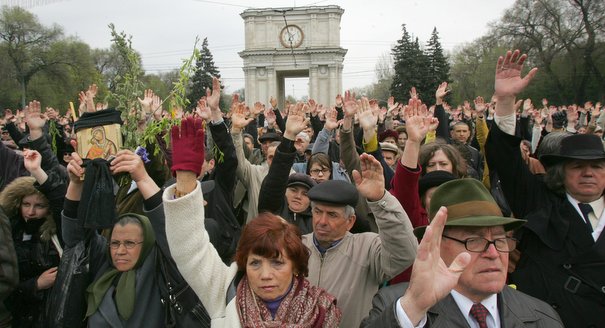
The recent protests in Moldova were sparked by allegations of rigged election results, but their roots lie in the Moldovan government's agreement with Russia to significantly slow down the process of Moldova's accession to the European Union.
Source: Deutsche Welle

For a lot of people, it is the first time that this complicated country has entered the modern consciousness. But for many centuries, the Republic of Moldova, to give its full name, has been at the center of numerous power struggles on Europe's eastern fringes.
Way back in the Middle Ages, the territory which is modern day Moldova was part of the Principality of Moldavia. It was then part of the Russian Empire from 1812 until the Russian Revolution in 1917 before becoming part of Romania. Its stewardship changed hands a number of times during World War II until it was absorbed by the Soviet Union in 1944.
It remained a part of the USSR until the fall of the Soviet Union and survived a short but bloody civil war before gaining its independence in 1991. Since then, Moldova has struggled to produce a stable economy and is currently one of the poorest nations in Europe. But despite its economic strife and its checkered history, Moldova has been relatively peaceful over the last 18 years.
All of which led to a certain amount of surprise when protesters ransacked Communist President Vladimir Voronin's office and the parliament building during demonstrations over allegedly rigged parliamentary elections on Tuesday.
The violence seemed to erupt from nowhere, but the protests that rocked Moldova reflected tensions that have long been simmering in a poor corner of Europe perched on the East-West fault line.
"The deeper causes go back to questions of identity and what Moldova's future is," Samuel Greene, deputy director at the Carnegie Center in Moscow, told Deutsche Welle. "Moldova is still suffering from the aftermath of a civil war and it doesn't have full sovereignty over its territory. In addition, in order to keep the peace Voronin has struck a compromise with Russia by which it promises basically not to move towards unification with Romania, which was being discussed at some point; it promises to really not look that seriously at European Union membership and certainly not to look at NATO membership." ...
Former Deputy Director for Operations, Moscow Center
Sam Greene was a deputy director for operations at the Moscow Center. He joined the Moscow Center in 2005. Previously, he was senior media program advisor for the New Eurasia Foundation, and a London and Moscow correspondent for FT Business.
Recent Work
Dmitri Trenin, Sergei Aleksashenko, Sam Greene, …
Sam Greene
Carnegie does not take institutional positions on public policy issues; the views represented herein are those of the author(s) and do not necessarily reflect the views of Carnegie, its staff, or its trustees.

Much has been said of the changes Brussels is trying to make to the EU enlargement process. Here’s why gradual integration might—or might not—be the answer.

Dimitar Bechev

Before the next wave of EU enlargement takes place, the union needs to grapple with thorny questions of how power is distributed among its members.


Emil Sondaj Hansen, Ditte Brasso Sørensen

A summer of escalation in the Black Sea has hurt Ukraine economically and is exacerbating world food security. A truce is needed—as is a broader reframing of Europe’s Ukraine strategy.

Thomas de Waal

Mounting economic strain and battlefield losses will not necessarily make the Kremlin less dangerous. They could instead push Moscow toward a more aggressive hybrid campaign designed to test NATO’s Eastern flank, exploit allied hesitation, and fracture European resolve.


Maksym Beznosiuk, Robert Benson

As the EU confronts profound challenges, several leaders have called for fundamental reform to the union’s model—but only modest, superficial changes have resulted. What if Europe really could be reimagined from zero today: What should such a redesigned European order look like?

Richard Youngs, ed.