

Commentary
Uri Dadush
{
  "authors": [
    "Uri Dadush"
  ],
  "type": "legacyinthemedia",
  "centerAffiliationAll": "",
  "centers": [
    "Carnegie Endowment for International Peace"
  ],
  "collections": [],
  "englishNewsletterAll": "",
  "nonEnglishNewsletterAll": "",
  "primaryCenter": "Carnegie Endowment for International Peace",
  "programAffiliation": "",
  "programs": [],
  "projects": [],
  "regions": [
    "North America",
    "United States"
  ],
  "topics": [
    "Economy"
  ]
}
Source: Getty
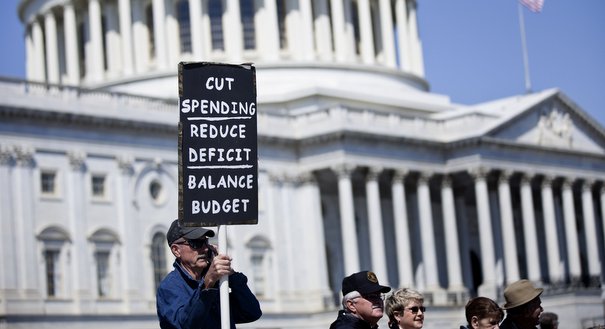
If the debt ceiling debate can help Americans begin to confront the country's fiscal anomalies—beginning with its huge healthcare costs, relatively low taxes, and defense budget—it is to be warmly welcomed.
Source: Financial Times

Whereas other advanced countries have been forced to raise taxes and cut spending by immediate financial market pressure or the fear of it, the US has been sheltered by its safe haven status and, in uncertain times, the world’s continued hunger for dollars – still the global reserve currency. Moreover, in contrast to the UK’s parliamentary system, America’s checks and balances would prevent strong executive action, even if there was stomach for it. Farcical (or tragic) as it may be, the political theatre featuring the debt ceiling is America’s way of confronting the problem before the market forces it to do so.
The rest of the world has a big stake in the outcome. With the eurozone in terrible trouble, and Japan in a quagmire, the risk of losing confidence in the world’s largest economy – still three times the size of China’s – is too dire to contemplate. Deep concerns about America’s fiscal deficits, and the Fed’s attempts to engineer lower long-term interest rates through quantitative easing, contribute massively to international tensions on currency levels (as the dollar comes under pressure), hot money flows and capital controls (as emerging markets overheat), and excessive reserve levels (as China and others amass Treasury Bills).
Finally, if done right, US tax reforms and expenditure cuts can help redress global imbalances. America’s structural current account deficit is not helped by China’s and Germany’s anti-consumption policies. But its deeper roots lie in US fiscal policy, with its comparatively low taxes (especially on corporations and and its top 1 per cent of earners who account for 17.6 per cent of total income), which directly and indirectly promotes consumption. Compared to other advanced countries, America under-taxes gasoline consumption and, indirectly, imported oil. Home building is artificially encouraged by its large mortgage interest rate reduction and many other tax incentives, diverting resources from the traded sectors. The US does not apply value added tax, a consumption tax, and another large potential source of revenues. It spends hugely more on healthcare than all other advanced countries without a pay-off in terms of improved health. And it still accounts for about half of global defence spending.
If the debt ceiling debate helps Americans begin to confront these anomalies, it is to be warmly welcomed.

Former Senior Associate, International Economics Program
Dadush was a senior associate at the Carnegie Endowment for International Peace. He focuses on trends in the global economy and is currently tracking developments in the eurozone crisis.
Recent Work
Uri Dadush
Uri Dadush
Carnegie does not take institutional positions on public policy issues; the views represented herein are those of the author(s) and do not necessarily reflect the views of Carnegie, its staff, or its trustees.

The EU can impose sanctions but struggles to enforce them without the United States. With Washington increasingly disinterested in backing European interests, the bloc must now fend for itself.


Nicu Popescu, Tiago Antunes

With its public finances in shambles, the far right polling at 35 percent ahead of the 2027 presidential election, and a growing protest movement, is France’s crisis a threat to the EU’s geopolitical awakening?

Rym Momtaz, ed.

Ahead of a tough winter for Ukraine, Donald Trump’s swing back toward Russia bodes ill. But instead of panicking, Kyiv’s European allies are focusing on action.
Rym Momtaz

While the EU and European governments are embracing the much-lauded middle-power moment, this entails three difficult conundrums.

Richard Youngs

Europe is facing rising populism internally as well as external pressures from Russia, China, Turkey, and the United States.

Dimitar Bechev