

Commentary
Nikolay Petrov
{
  "authors": [
    "Nikolay Petrov"
  ],
  "type": "legacyinthemedia",
  "centerAffiliationAll": "",
  "centers": [
    "Carnegie Endowment for International Peace",
    "Carnegie Russia Eurasia Center"
  ],
  "collections": [],
  "englishNewsletterAll": "",
  "nonEnglishNewsletterAll": "",
  "primaryCenter": "Carnegie Russia Eurasia Center",
  "programAffiliation": "",
  "programs": [],
  "projects": [],
  "regions": [
    "Caucasus",
    "Russia"
  ],
  "topics": []
}
Source: Getty
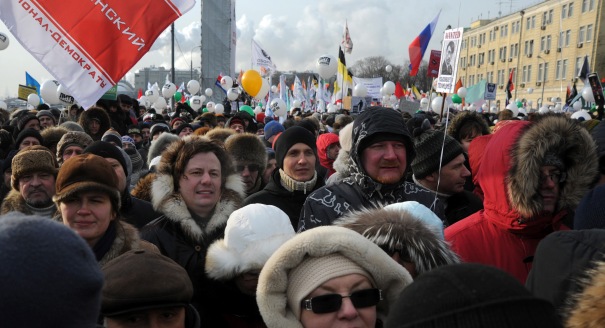
Recent protests have undermined the legitimacy of Russian authorities and significantly weakened Putin's hold on power. Even if the protests were to unexpectedly stop, the process of chipping away at Putin's regime has been set in motion.
Source: The Moscow Times

Besides Moscow, demonstrations were staged in Russia's regions. The reasons for the protests were varied. In Perm, the people were upset with the governor and his policies. In Krasnoyarsk, people protested against the increase in pollution from toxic plants in the region. In other cities, protesters focused on the increase in utility fees. These complaints are nothing new, but they have increased in intensity after the State Duma elections. Those elections triggered the release of pent-up anger over the corruption and the authorities' open disdain for the people.
The largest rallies outside of Moscow have been held in St. Petersburg and other cities with a million or more residents. In many of those cities, such as Novosibirsk, Yekaterinburg and Omsk, United Russia placed second to the Communist Party or A Just Russia, and in St. Petersburg it fared exceedingly badly.Now that Yabloko leader Grigory Yavlinsky has been denied the right to register as a candidate, the presidential election has been shorn of any trace of legitimacy. Putin's rivals are nothing more than hand-picked sparring partners with no chance of being elected president. All of them except Mikhail Prokhorov are experienced hands who have repeatedly proven their loyalty to Putin in past elections. As for Prokhorov, he only asks that his multibillion-dollar fortune be safeguarded in return for toeing the Kremlin line.
Why did Putin prefer Prokhorov over Yavlinsky? Many in the West consider Prokhorov to be an independent candidate because of his enormous wealth. But actually the opposite is true. The larger a Russian's wealth, the more he depends on the Kremlin to preserve that wealth.
In addition, Yavlinsky would probably have been less manageable as a presidential candidate than Prokhorov. Moreover, Yavlinsky could have attracted more protest votes than Prokhorov — from 5 percent or 7 percent — making it that much more difficult for Putin to win in the first round of voting.
Putin can't afford a second round. He needs to demonstrate to the political elite and the people that he is still the uncontested national leader and can win in the first round. Faced with the choice of having to falsify a certain percentage of the vote to win in the first round or face a second round, Putin would probably pick falsification as the "lesser of two evils."
Meanwhile, many analysts claim that the Kremlin has no plans to commit electoral fraud for the simple reason that Putin — with popularity ratings that exceed 50 percent, according to some polls — doesn't need to falsify results to win the first round.
But this argument doesn't hold water. In a system in which a governor's effectiveness is measured by his ability to secure votes for United Russia and Putin, electoral fraud is inevitable, even if the leader publicly calls for honest elections. The governors understand that their jobs depend on their ability to produce good results for Putin. So their main goal is to protect their own skins. This means that they will manipulate the vote when necessary to secure a victory for Putin in the regions — and, most important, not be caught at it. The big lesson from the Duma elections is to improve the "technology" of electoral fraud and not leave a trail for election monitors.
It has been said the internal bickering among protest leaders will discredit the movement and give victory to the authorities and that the protests will fade away without producing any positive results.
But this is unlikely for two reasons. First, the protest movement has grassroots appeal, and it is extremely unlikely that any of its leaders would discredit themselves by selling out to the authorities.
Second, the protests have already stripped the authorities of their thin veneer of legitimacy and have significantly weakened Putin's hold on power.
Even if the protests were to unexpectedly stop, the genie is already out of the bottle. The process of chipping away at Putin's regime has been set in motion, and this could conceivably lead to Putin's ouster within one or two years' time.
Former Scholar-in-Residence, Society and Regions Program, Moscow Center
Nikolay Petrov was the chair of the Carnegie Moscow Center’s Society and Regions Program. Until 2006, he also worked at the Institute of Geography at the Russian Academy of Sciences, where he started to work in 1982.
Recent Work
Nikolay Petrov
Nikolay Petrov
French President Emmanuel Macron has unveiled his country’s new nuclear doctrine. Are the changes he has made enough to reassure France’s European partners in the current geopolitical context?

Rym Momtaz, ed.
The EU lacks leadership and strategic planning in the South Caucasus, while the United States is leading the charge. To secure its geopolitical interests, Brussels must invest in new connectivity for the region.
Zaur Shiriyev
2026 has started in crisis, as the actions of unpredictable leaders shape an increasingly volatile global environment. To shift from crisis response to strategic foresight, what under-the-radar issues should the EU prepare for in the coming year?

Thomas de Waal
Europe is designing a new model of collective security that no longer relies on the United States. For this effort to succeed, solidarity between member states that have different threat perceptions is vital.

Erik Jones
Beset by an increasingly hostile United States, internal divisions, and the threat of Russian aggression, the EU finds itself in a make-or-break moment. U.S. President Donald Trump calls it a decaying group of nations headed by weak leaders. Is Europe able to prove him wrong?
Thomas de Waal