

In The Media
David Rothkopf
{
  "authors": [
    "David Rothkopf"
  ],
  "type": "legacyinthemedia",
  "centerAffiliationAll": "",
  "centers": [
    "Carnegie Endowment for International Peace"
  ],
  "collections": [],
  "englishNewsletterAll": "",
  "nonEnglishNewsletterAll": "",
  "primaryCenter": "Carnegie Endowment for International Peace",
  "programAffiliation": "",
  "programs": [],
  "projects": [],
  "regions": [
    "North America",
    "United States"
  ],
  "topics": [
    "Military"
  ]
}
Source: Getty
The idea that an affair involving the CIA director would trigger a national scandal when the daily activities of the agency do not could be perceived as ludicrous bordering on offensive.
Source: Foreign Policy

The real question is: Do we love Bond because of his yacht and fast-car propelled globe-trotting lifestyle (he seems to be the only one who can dependably find casinos that are glamorous rather than being full of fat old losers playing the slots), or because he is actually able to get away with blowing so much stuff up without having to pay for it?
It all seems like an escapist ideal, a parallel universe in which all morality has been suspended except for the bits that don't get in the way of fun and a good story. In fact, ennobling patriotism is fine because it seems to provide the free pass that in the end is Bond's license to kill, love ‘em and leave ‘em, and tear open passenger trains with a back-hoe. It is preposterous. Fiction. And so of course, the only thing more preposterous is real life.
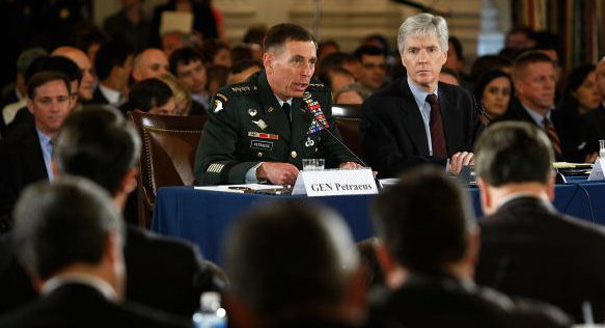
That was made clear when, in a tour de force of movie marketing that surpassed even this summer's stunt of having Bond and the Queen seemingly enter the Olympic stadium via parachute, America's real-life spy chief commanded the headlines with his own Bond-like behavior. David Petraeus, one of the most heralded American generals of the post-World War II period, was brought down as head of the CIA because, as everyone now knows, he had an affair with his glamorous biographer. (Glamour is relative. But the bar set by most biographers is fairly low and, Petraeus's lover, Paula Broadwell had extremely well-toned upper arms according to the assessments of every woman I have spoken with on the subject.) Citing his principles, Petraeus stepped down from his post rather than bring any further dishonor upon it.
Now, many people I know and respect greatly consider Petraeus to be an extremely admirable, capable, and intelligent guy. But the notion that the violation of anyone's "principles" led to his resignation is laughable. Further, the idea that an affair involving the CIA director would trigger a national scandal when the daily activities of the agency do not is ludicrous bordering on offensive.
What was at stake here was priggishness, not values. As others have pointed out, many of Petraeus's predecessors have had affairs as have many of their bosses and colleagues in the White House, on Capitol Hill, or elsewhere in public life. That periodically, as in the case of Petraeus or, before that Bill Clinton, some such private peccadilloes trigger scandal and many others do not, is one sign that something other than consistent application of national values is at work here. But the fact that recently the parade of public figures who have seen their careers brought to an end because of sexual misconduct has been so long—stretching from John Edwards to an airport men's room stall in the Upper Midwest—is a source of bewilderment and ridicule in other nations worldwide, where they hold the quaint notion that private behavior of public officials that does not affect the way they do their jobs should remain private.
It is not news that America has long been willing to chart a course quite different from that of other nations. We've always had a bit of a puritanical streak, which we have spun in our own minds into a sign of national character. But it is a different dimension of American exceptionalism that makes this whole Petraeus dust-up truly gross rather than merely ridiculous.
The real scandal here is that when the head of the CIA sleeps with someone who is not his wife, it causes a national scandal, but when the agency manages a drone program that serially violates the sovereignty of nations worldwide, that it helps formulate and then execute "kill lists" that make James Bond's most egregious sprees of violence look a kindergarten birthday party, it does not.
Our values are, it seems, even more twisted than Bond's. At least he is not so grotesquely hypocritical. It has long riled some among us that Congress thought it appropriate to impeach Bill Clinton over trivialities associated with his personal missteps, while never once challenging George W. Bush for the far greater misdeeds and very likely crimes associated with America's invasion of Iraq. We seem to be a nation that can tolerate the violation of the law, the deaths of innocents, and the gross misallocation of national assets without blinking an eye—provided that the architects of such egregious wrongs keep their flies zipped.
Who says it's Hollywood that's screwing up America's values? We seem to be outdoing the world's finest screenwriters on that front—and doing so without any of the charm or crisp one-liners that allow us to forgive movie wantons like James Bond.

Former Visiting Scholar
David Rothkopf was a visiting scholar at the Carnegie Endowment as well as the former CEO and editor in chief of the FP Group.
Recent Work
David Rothkopf
David Rothkopf
Carnegie does not take institutional positions on public policy issues; the views represented herein are those of the author(s) and do not necessarily reflect the views of Carnegie, its staff, or its trustees.

Canadian Prime Minister Mark Carney has twice inspired praise for standing up to U.S. President Donald Trump: at the 2026 World Economic Forum in Davos and on Canada-U.S. trade negotiations. Is Carney showing a third way better than the EU has in dealing with the Trump administration?

Rym Momtaz, ed.

European states control several Overseas Countries and Territories around the world that carry strategic, economic, and environmental weight. As great powers challenge the rules-based order, defending them is a geopolitical imperative for Europe.

Marc Pierini

In supporting Europe’s far-right, MAGA and Russia both want the same thing: a weaker EU. Europe must defend itself without abandoning the openness these forces exploit.

Armida van Rij

As we close out another season of Strategic Europe, it is worth taking stock of the deep shifts underway.
Rym Momtaz

The hybrid warfare landscape is evolving rapidly, leaving policymakers without clear strategies. To better inform their work in addressing emerging challenges, governments must dig deeper into the underlying dynamics at play.


Raluca Csernatoni, Alicia Wanless