Since 1967, three non-nuclear principles have guided Japan’s approach to nuclear weapons. They commit Japan to not (1) possess, (2) produce, or (3) allow nuclear weapons to enter into Japanese territory or territorial waters.
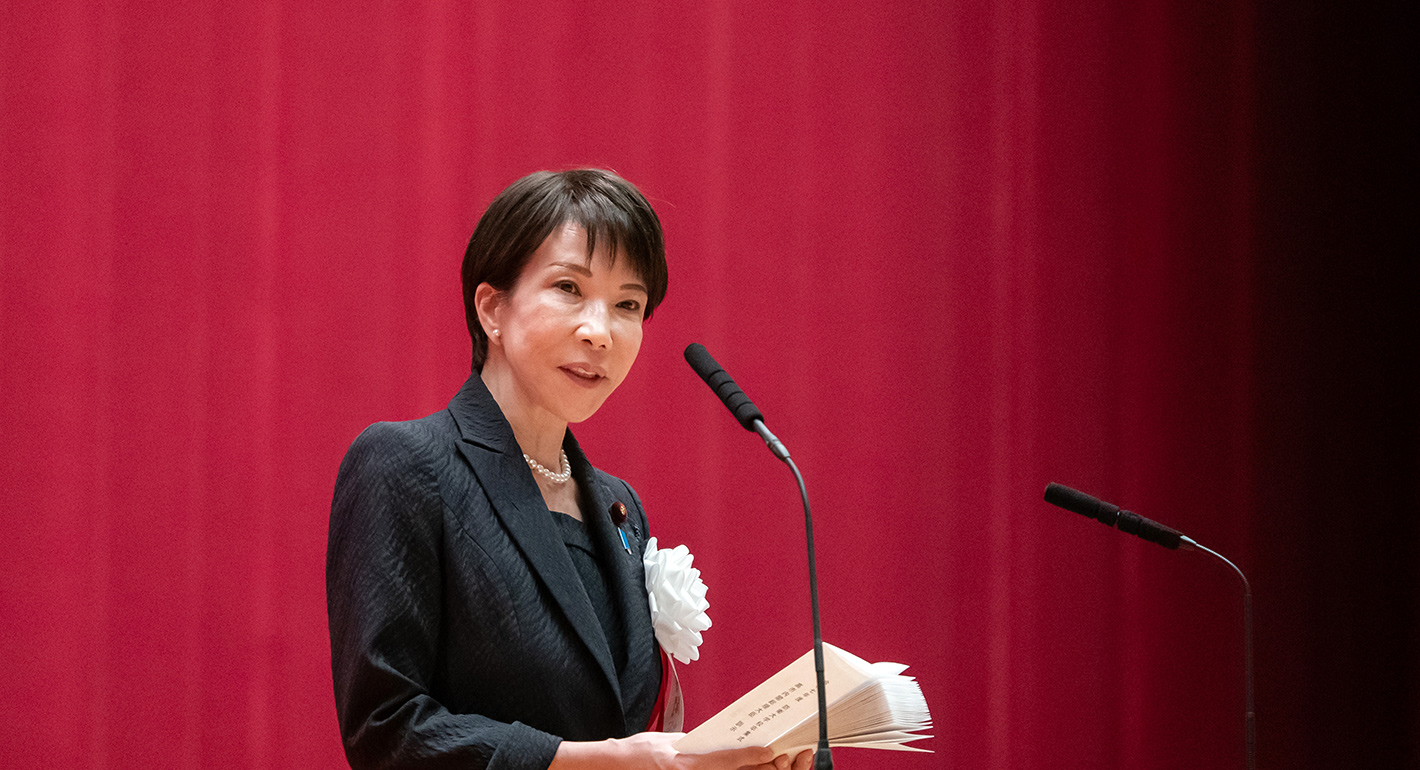
In November 2025, Prime Minister Takaichi Sanae sparked a debate when she avoided clarifying that these principles would remain in the strategic documents to be reviewed by early 2026. She referred to the principles as “a policy guideline at this stage.” The Nobel Peace Prize–winning atomic bomb survivors organization, Nihon Hidankyo, responded negatively that starting a conversation to revisit these principles would contradict the government’s traditional stance and would be contrary to survivors’ expectations. Yet, powerful voices such as former officials in Tokyo, Washington, and beyond welcome a more robust stance against China and North Korea, including reviewing these principles that otherwise could undermine projection of U.S. nuclear deterrent forces into the region in a crisis or conflict with China or North Korea.
After Takaichi led the majority party to a massive victory in a snap election in February 2026, she committed to making “important policy shifts” including amending the Japanese Constitution. The election result may have also boosted her confidence to revisit the three non-nuclear principles. This article explores the potential risks and benefits of doing so.
Origins of the Principles
Since 1967, Japan has followed the three non-nuclear principles to not possess, produce, or allow the introduction of nuclear weapons into Japanese territory or territorial waters.
Since 1967, Japan has followed the three non-nuclear principles to not possess, produce, or allow the introduction of nuclear weapons into its territory.
These principles were first declared by then prime minister Sato Eisaku in 1967 at the National Diet of Japan amid negotiations with the United States to return full sovereignty over Okinawa Prefecture to Japan. The United States had controlled the area since the end of the Pacific War in 1945, including the military bases and ports that hosted U.S. nuclear weapons.
While he was advocating for the three non-nuclear principles, Sato also secretly explored from 1968 to 1970 the feasibility and desirability of Japan developing the capabilities to produce its own nuclear weapons.
This exploration of the nuclear option reflected rapidly evolving nuclear circumstances. China had tested a nuclear bomb in 1964. The Nuclear Non-Proliferation Treaty had been negotiated, and Japan was being pressed to sign it and help bring it into force globally. The United States was reverting Okinawa to Japan while retaining naval facilities there, which made the question of U.S. basing or transiting nuclear weapons something both countries would have to agree on.
Upon the reversion of Okinawa to Japan, the United States was aware that “the nuclear weapons issue was the most difficult [for the U.S. military] in view of strong Japanese opposition.” The strong anti-nuclear sentiment of Japan won out and ensured that Okinawa was returned without continued stationing of U.S. nuclear weapons in 1972. However, military-security interests of the United States and the alliance left open the potential need for U.S. vessels to carry nuclear weapons through Japanese waters. Further, Sato and then U.S. president Richard Nixon had concluded a secret nuclear deal in 1969, which could permit a re-introduction of nuclear weapons under extreme circumstances.
Although the three principles were not enacted into law, the Diet adopted them as a resolution in 1971 and reaffirmed them repeatedly in subsequent years. A resolution adopted on April 27, 1976, by the House of Representatives Foreign Affairs Committee following the establishment of the Nuclear Non-Proliferation Treaty stated that “the government shall faithfully implement the three non-nuclear principles . . . as established national policy, under all circumstances.” The principles therefore became a foundational nuclear policy for Japan, solidifying Japan’s identity as a state that suffered nuclear attack in response to its wartime aggression and thereafter committed itself to a defensive-only military posture.
The Dissonant Non-Introduction Principle
Of the three principles, the non-introduction principle has been the most contested. (There has been no prospect of Japan building or possessing nuclear weapons since its ratification of the Nuclear Non-Proliferation Treaty in 1976.) The non-introduction principle has long been in tension with the 1960 U.S.-Japan Security Treaty, which provides extended deterrence to Japan by guaranteeing the use of U.S. military capabilities, including nuclear forces, to counter enemy threats. A strict interpretation of the non-introduction principle would have impacted U.S. nuclear operations and its ability to maintain an effective nuclear umbrella.
Through secret understandings and flexible interpretations about the introduction of nuclear weapons, however, Tokyo managed to reconcile its non-nuclear principles with the realities of the U.S. nuclear umbrella.
Japan regularly hosted U.S. nuclear-capable aircraft carriers and U.S. Navy vessels that might have carried nuclear-armed land-attack cruise missiles (TLAM-N) until mid-1992, and maintained the possibility for the re-introduction until 2013. Under the Presidential Nuclear Initiative announced by former U.S. president George H.W. Bush, the United States removed its nuclear weapons from surface ships, attack submarines, and land-based naval aircraft, including TLAM-N. After removal, these TLAM-N were put in storage until the weapon’s retirement in 2013. (A possibility was left open to redeploy this system since U.S. allies in Asia, including Japan, were concerned about completely eliminating it.)
The most notable example that allowed this delicate cooperation was the secret agreement reached during the 1960 treaty revision between then prime minister Kishi Nobusuke and then president Dwight Eisenhower. The United States had a long-standing policy of neither confirming nor denying whether ships or aircrafts were carrying nuclear weapons. During the 1960 U.S.-Japan Security Treaty renewal negotiations, Kishi and Eisenhower secretly agreed that the new, post-reversion system of consulting with Japan before making any major changes to U.S. military equipment should not apply to the transit of U.S. nuclear weapons through Japan, which had been occurring since 1953. This secret deal allowed the United States to continue its activities without prior consultation with Japan. Since the neither-confirmed-nor-denied transit of nuclear weapons was an old practice, Tokyo could claim that the United States was not asking for and receiving permission from Japan after the 1960 agreement. Therefore, they could claim the principle of non-introduction was not being violated after its declaration.
Political Developments
This is not the first time that one or more of the three non-nuclear principles has come under debate.
Increasing security threats in the region led some of Takaichi’s recent predecessors, such as Abe Shinzo and Ishiba Shigeru, to express interest in “nuclear sharing” options. In March 2022, after Russia’s full-scale invasion of Ukraine, Abe’s statement prompted the Liberal Democratic Party’s (LDP) national security group to hold a meeting to explore nuclear sharing options for Japan. The study group concluded, however, that hosting nuclear weapons “serves no national interests” and, instead, “increases risks,” and therefore is “unrealistic” for Japan.
On November 11, 2025, at a Diet session, Takaichi was asked by a member if her administration would maintain the reference to the principles in Japanese strategy documents. The question stemmed from the prime minister’s prior policy speech in October, in which she said she would accelerate the renewal of Japan’s three strategic documents by 2026—the National Security Strategy, the National Defense Strategy, and the Defense Buildup Program. She stated the government would maintain the principles “as a policy guideline at this stage,” but avoided clarifying that the principles will remain in the documents: “The review of the three documents will start from now. We are not yet at the stage where I can say what the descriptions will be,” she added.
On November 14, following this Diet conversation, Japanese newspapers reported that the ruling Liberal Democratic Party had started internal discussion on reviewing the nuclear principles. That reporting triggered a public reaction against possibly changing the principles.
Subsequent reports suggest that the ruling party commenced an initial discussion to review the strategic documents without excluding debate on the principles. Recommendations reportedly are to be made to the government before summer 2026. LDP policy chief Kobayashi Takayuki stated on November 20, “It’s our responsibility as the ruling party to hold talks without any sacred cows.” Japan’s history and public anti-nuclear sentiment have traditionally avoided such conversations.
In response to rising public unease, Japan’s Chief Cabinet Secretary Kihara Minoru, Foreign Minister Motegi Toshimitsu, and Defense Minister Koizumi Shinjiro all reiterated that the Japanese government continues to adhere to the principles and uphold the position articulated in 2010 by then foreign minister Okada Katsuya that emergency exceptions could be made regarding the non-introduction principle. “I don't think we should engage in too much hypothetical discussion,” Okada had said, “but if an emergency were to occur where Japan’s security could not be guaranteed without permitting a temporary nuclear port call, then the government of the day would have to stake its very survival on making that decision and explain it to the public.” On November 26, Takaichi reiterated in a Diet debate that Japan upholds the three non-nuclear principles “as a policy orientation” and said that she did not “explicitly order a re-evaluation of these principles.”
Both public and government commentators have repeatedly highlighted the ambiguity of the non-introduction principle and have suggested various approaches. Takaichi in her 2024 book wrote that “even if we continue to adhere to ‘not possessing’ and ‘not producing’ nuclear weapons, the ‘not permitting the introduction’ principle is not realistic if we expect the United States to provide extended deterrence.” She added, “I was concerned that in an ultimate crisis, the wording ‘adhere to the three non-nuclear principles’ would become an obstacle.”
Meanwhile, it is important to note that there are divided views on revisiting the principles even within the LDP. For example, former prime minister Kishida Fumio reaffirmed that Japan should uphold the principles, whereas former defense minister Nakatani Gen publicly spoke in support of a reevaluation.
What Drives the New Discussion?
One major factor behind this nascent discussion is likely the development of the new U.S. nuclear-armed sea-launched cruise missile (SLCM-N) and its planned deployment on Virginia-class attack submarines by around 2034. If the United States builds and deploys SLCM-Ns, submarines will likely carry them through Japanese waters and dock in Japanese ports. Another factor increasing pressure to update the non-introduction principle could be the growth of open-source analysis. Compared to the earlier periods when Japan might have hosted U.S. nuclear-armed vessels but kept it secret, the public and enterprising investigators (including from adversary states) can easily access clearer satellite imagery and information to raise questions about violations of the principle, which could be very awkward for Japanese politicians.
More broadly, worsening relationships with neighboring Russia, China, and North Korea, coupled with U.S. domestic politics leaning toward possible retrenchment from alliances and abandonment of allies, have increased demand for strengthening and upgrading U.S. extended deterrence. The National Security Strategy released by U.S. President Donald Trump’s administration emphasizes the need for allies to carry more burden in jointly deterring and defending against adversaries. If, in the future, this includes projecting SLCM-N or other similar-range systems into the region, pressure on Japan to enable such deployments will grow.
For all these reasons, Japan may need to clarify whether and how the principle of non-introduction will be applied in the future. Specifically, the government may need to explain the “emergency” exceptions that Okada referred to in 2010 under the non-introduction principle, or otherwise clarify whether and how the non-introduction principle will apply once U.S. naval vessels might be carrying the SLCM-N.
To the extent that the primary issue concerns nuclear weapons transit, especially of SLCM-Ns, the following questions may help guide discussion:
- Would the United States consult with Japan and would Japan allow transit of the U.S. vessels possibly loaded with the SLCM-Ns?
- How would those consultations be held, considering that the Japanese public is aware of the 1960 secret agreement and the ambiguity over introduction with interpretation differences?
- If Japan would allow such transit, would the government make it public or admit it when asked? In this case, as it would likely run into possible conflict with the United States’ policy to neither confirm nor deny details about nuclear weapons, how would or should Japan address it?
- If Japan makes the transit public, would the transit fall under the “emergency” exception that the traditional interpretation has provided?
- If so, how would Japan explain to the public the nature of the emergency that threatens national security? And what would be the political and policy implications of superseding the non-introduction principle?
- If such transits are not treated as emergencies, how would Japan adjust the non-introduction principle?
- If Japan decides not to allow transit of the U.S. vessels possibly loaded with the SLCM-Ns, how would the United States react? Are there alternative options?
Options to Reevaluate the Non-Introduction Principles After SLCM-N
There are several options the Japanese government could pursue were it to reevaluate the non-introduction principle to accommodate submarines loaded with SLCM-Ns.
The first is to simply abandon the non-introduction principle. One recommendation by some experts and by former Japanese and U.S. government officials suggests replacing the non-introduction principle with a non-strike principle. That is, instead of preventing the United States from introducing nuclear weapons into Japanese waters, the goal would be to deter China from striking Japan with nuclear weapons. This would strengthen the U.S. nuclear umbrella against increasing threats from China and North Korea.
A second option would be to reinterpret the non-introduction principle to align with the U.S. interpretation. The United States has traditionally interpreted “introduction” to mean placing or installing nuclear weapons on Japanese territory. This has not impeded the transit of the U.S. military vessel carrying nuclear weapons to a U.S. military base in Japan. Under this interpretation, port calls and passing through Japanese waters were not considered introduction. In contrast, hosting land-based nuclear weapons and homeporting submarine-based nuclear weapons would be more visible forms of introduction and more readily vulnerable to preemptive strikes than transiting submarine-based weapons.
Third, the government could uphold the current interpretation of the non-introduction principle, including Okada’s statement from 2010 permitting introduction in emergencies. To do this, Japan would need to explain to the public the nature of the emergency that allows port calls by vessels with SLCM-Ns, in accord with Okada’s “emergency” articulation made in 2010.
A fourth option would be to uphold the non-introduction principle and reject U.S. transit of SLCM-Ns into Japanese waters. Japanese affected communities and anti-nuclear civil society organizations, most prominently Hidankyo, have long proposed this idea, to legalize the three non-nuclear principles instead of retaining them as long-standing national policy.
The government of Japan will be challenged to reconcile domestic anti-nuclear sentiments with Japan’s perceived security needs.
In choosing any of the above options, the government of Japan will be challenged to reconcile domestic anti-nuclear sentiments with Japan’s perceived security needs, while reassuring partners and neighboring states that any changes do not mark a departure from its traditional pacifist posture.
Potential Risks and Benefits of Reevaluating the Non-Introduction Principle
Polls show that a majority continues to support maintaining the principles. The Asahi Shimbun poll from August 2025 shows that 69 percent of respondents “generally agree” and “agree” with upholding the three non-nuclear principles, and “approximately 60% of respondents agree upholding the Three Non-Nuclear Principles” in the University of Tokyo’s poll from September 2025. Thus, revising the principles itself could bring political risks to any Japanese administration.
However, a December 2025 Nikkei poll found that 46 percent of the population supports upholding the non-nuclear principles while 39 percent supports reviewing them, and that Takaichi’s approval rate remains high as shown in the February election.
It is therefore conceivable that political risks to the administration may not be so high. Anti-U.S. and anti-nuclear sentiments among the Japanese public today differ from the postwar period. That said, it is important to note that Sato’s non-nuclear posture emerged from the fallout of Kishi’s forcing the 1960 U.S.-Japan Defense Treaty renewal, which triggered massive opposition that ultimately led to his ouster.
Externally, neighboring states could perceive or at least exploit for political reasons a review of the principles—even if only the non-introduction principle—as a departure from Japan’s traditional pacifist posture. Seoul and Beijing have traditionally voiced concerns whenever Tokyo raised the possibility of revisiting the principles. Takaichi’s hint about revisiting the principles has already fueled Chinese criticism amid worsening tensions between Beijing and Tokyo. China may weaponize this as an opportunity to deflect criticism regarding its own opaque nuclear build-up, including at international forums such as the upcoming Eleventh Nuclear Non-Proliferation Treaty Review Conference. Officially recognizing the introduction of U.S. nuclear-capable vessels could also further harden China’s unwillingness to engage in nuclear arms control or transparency efforts.
Outside the region, proponents of the Treaty on the Prohibition of Nuclear Weapons are skeptical of nuclear umbrella states’ willingness to reduce the reliance on extended deterrence. Reviewing the long-standing non-introduction principle may pose a challenge to Japan because some states could question Japan’s credibility and capability to serve as a bridge builder between non-nuclear weapon states and nuclear weapon states. On the other hand, revisiting the non-introduction argument could remove the political barrier for operations associated with port calls or passage of future nuclear-armed Virginia-class attack submarines. As mentioned above, new operations involving SLCM-Ns raise many questions to be answered both domestically and within the U.S.-Japan bilateral relationship. Revisiting the principles provides an opportunity to give more clarity to the public, especially in contrast to negotiations during the postwar era.
Reviewing the non-introduction principle could also enable the Japanese government and its public to reconsider their nuclear posture, which could be invaluable for Japan’s future security.
Reviewing the principle could thus prompt more up-to-date thinking about nuclear weapons and the relative priority of nuclear deterrence and of nuclear disarmament. This could deepen the national and bilateral U.S.-Japan conversations about deterring aggression in the region as well as continued cooperation with the United States. Consequently, it could help Japan to strengthen deterrence against North Korea and China, therefore lowering its incentive to pursue a national nuclear weapons capability, which could benefit the global nonproliferation regime.
Unfolding the Discussion with Caution
As Japan moves toward updating its strategic documents by summer, with the possibility of reviewing the non-introduction principle, the discussion on the principles should not be a mere policy debate or made just for political appeal.
Clearly the government led by Takaichi perceives that the regional and global security environments are changing dramatically from the previous six decades. It is natural to ask, then, whether and how to update the country’s nuclear principles. However, for such questioning to serve the long-term interests of the Japanese people and the world, the potential risks and benefits of changes must be carefully articulated and debated. For an issue as historically, strategically, and politically charged as nuclear weapons in Japan, this will prove to be a challenge.