This episode is part of our special series on the India AI Impact Summit, examining the conversations, decisions, and debates that are shaping global AI governance.
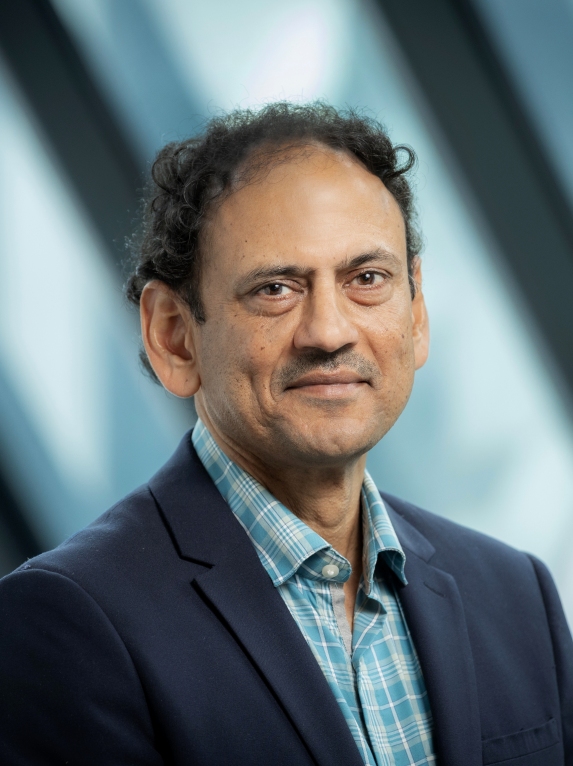
In this episode of Interpreting India, Nidhi Singh is joined by Raymond Ononiwu, founder and CEO of Horus Labs, for a conversation that cuts through the noise around compute, data centres, and AI infrastructure to ask a more fundamental question: who is this all actually being built for? Raymond brings the perspective of someone building AI infrastructure on the ground in Africa, and his account of what the global AI conversation is still getting wrong is both practical and pointed.
This episode explores:
What is compute, why has it become a strategic resource, and does every country actually need to be training frontier models? What does AI infrastructure really require on the ground, and why is building it in the Global South a fundamentally different challenge from building it in Shenzhen? If you are a country in sub-Saharan Africa trying to build an AI strategy, what should you invest in and what should you ignore entirely? Are the global conversations happening around AI, including at the India AI Impact Summit, actually reflecting what builders on the ground need?
Episode Notes
Raymond draws a distinction early in the conversation that shapes everything that follows: training and inference are not the same thing, and conflating them is leading a lot of countries to make expensive mistakes. Training, he says, is like building the engine. Inference is running the transport system every single day. Most countries do not need to build the engine. What they need is airports, roads, and reliable infrastructure that gets the technology into the hands of people. The global assumption that frontier model training is the only legitimate AI pathway is, in his view, one of the more consequential misreads of the moment.
On the ground realities of building in Africa, Raymond is specific about where the bottlenecks actually are. It is not ambition. It is power reliability, cost of connectivity, access to capital, and the kind of financing frameworks that have not yet caught up with what AI infrastructure actually requires. He points to genuinely interesting anomalies, such as Ethiopia's extremely low cost of power sitting alongside very limited terrestrial fiber diversity, as a reminder that building in the Global South is not about replicating Silicon Valley at a discount. It is about finding combinations of constraints that can actually be made to work, and optimizing for reliability, cost efficiency, and practical impact rather than scale and prestige.
His advice to governments is to start with problems, not hardware. Prestigious projects with no clear use case, over-regulation before a single GPU cluster exists, and attempts to rebuild sovereign versions of large compute clusters are all, in his view, things to ignore. What countries should actually invest in is reliable and clean power, public interest compute access, data governance frameworks, sector specific pilots in health, agriculture, and education, and talent development that works by getting the technology into the hands of people rather than running structured boot camps. For Raymond, the success metric for Africa in five years should not be the size of anyone's model. It should be whether AI has meaningfully improved economic productivity and public service delivery across the continent.
Transcript
Note: This is an AI-generated transcript and may contain errors.
Nidhi Singh: Hello and welcome to a new episode of Interpreting India. From geopolitical complexities to economic uncertainties, India faces critical challenges in its quest for a more prominent role on the world stage. This season, we at Carnegie India continue to bring voices from India and around the world to examine the role of technology, the economy, and international security in shaping India’s future.
I am Nidhi Singh, Associate Fellow at the Technology and Society Program at Carnegie India.
If you have been following the AI conversation at all, you have probably heard the word compute more times than you can count. It has become a shorthand for power, for capability, for who gets to participate in the AI revolution and who gets left out. But what does it actually mean? What does this infrastructure really look like on the ground? And what happens when you try to build it in the places where the global AI conversation has not quite reached?
Joining us today is Raymond Ononiwu, founder and CEO of Horus Labs.
Raymond Ononiwu: Thank you, Nidhi.
Nidhi Singh: I will get right into it. My first starting question is that our listeners hear the word compute thrown around constantly. At this point, I do not think most of us fully understand it. So, break it down for us. What is compute? And why has it become the resource that every country on Earth right now is scrambling to secure?
Raymond Ononiwu: Compute, at its core when it comes to AI, is essentially the physical processing power required to turn data and algorithms into useful intelligence. On the physical side, we are talking about electricity, chips, cooling. So, all of the physical components that are required to turn data, with algorithms, into some type of meaningful intelligence, that is what I would consider compute.
Unless you have been living under a rock, the AI conversation is everywhere. When you think about AI systems, part of what makes compute scarce is that these things, if we talk about training, for example, require an extraordinary amount of compute to train advanced models. And this can run for weeks, even sometimes months.
So compute itself has really turned into a strategic resource for countries. I think the last time OpenAI released numbers, if you look at GPT-3, for example, it is 1,000 to 2,000 GPUs. It takes almost two months, running continuously for about two months, to do a round of training. And you are looking at almost a megawatt of power per training run.
So, this is a non-trivial amount of resources that are required to transform data into intelligence. This is why it has become a necessary resource that countries are scrambling for.
For the countries that do get it right, compute determines whether you can train frontier models, whether you can deploy AI at scale, whether you can deploy this intelligence at scale. And of course, there is the national competitiveness aspect of it as well. If you look at what I described before, the amount of energy required, there is a very, very clear intersection with energy infrastructure.
So, it is really becoming something that has significant geopolitical implications as well. And then, for those who manufacture the GPUs, there are export controls, chip access, and all of that. That is what is fundamentally driving that scarcity. But the real question is: does everyone need to build frontier models? That is kind of what the big elephant in the room is. Some people say yes, some people say no, but it is neither here nor there.
Nidhi Singh: How would you define the current global race around compute?
Raymond Ononiwu: I think you defined the race very well. It is how many GPUs you can manufacture or acquire, what is the size of the data centers you can build, and securing the supply chain. There is quite a plethora of factors that are at play here.
But I think what is driving this, if you look at the core definition we spoke about, is that what we are trying to create here is intelligence. We are combining physical resources to create some level of useful intelligence. And it is the case that you are seeing scaling laws at play. Bigger models trained on more data historically have better performance, and of course, the commercial incentives. You want to be the first to develop a model that has better capabilities, which you can then sell. There is commercial gain.
But from a geopolitical perspective, these models are powerful enough that it is now a strategic asset, similar to energy or telecom. So, there is a little bit of a shift when it comes to how compute is now being looked at. This is actually what is driving this sort of GPU arms race.
But if you look at who the arms race is serving, it is a relatively small number of firms and governments who have the commercial resources to build the largest models and the whole nine yards. But the risk here is that there is now almost a global assumption that the narrative assumes that this is the only legitimate AI pathway. This is the only way to do AI. It has to be at massive scale and consume a ton of resources and a lot of money.
That is the thing that I think should be challenged moving into the future.
Nidhi Singh: Can you explain the difference between training compute and inference compute?
Raymond Ononiwu: I love analogies a lot, so let me see if I can find an analogy that works. Training compute is literally about inventing the engine. Inference, on the other hand, is about running the transport system every single day.
So, you now have multiple engines at play, but those engines need to move some sort of commodity or people from one place to another. You will have airplane engines, car engines, train engines, but functionally developing the engine is one thing. Developing the different kinds of engines is one aspect of the story. That is what is analogous to training. But having the airports and the air routes and air traffic control and the road systems and the rail systems, that is sort of what you would think of for inference.
Training compute is fundamentally used to build the model. It is extremely compute-intensive. You do not build models every day. It is not something you do on a regular basis. You sort of build a model, ship it, gather data, start building another model. So it is infrequent. It requires best-in-class equipment, top-tier chips, and massive GPU clusters. And typically, because of the data constraints and the resource constraints, you tend to do training in a singular location that has an ample amount of compute.
Like the example I gave before for GPT-3, you are looking at 1,000 to 2,000 GPUs. Inference, on the other hand, is used every time someone asks a question, every time someone queries the model. Inference happens. It can be less intensive than training, not always, but it can be, and it happens continuously. I mean, we are all asking ChatGPT a question 24/7 from every part of the globe.
It must be scalable and it must be cost-efficient. You can sort of do R&D and spend a large amount of money building an engine. When you build a Rolls-Royce engine for a jet, that is sort of the price point. However, the airline has to figure out a way to have a cost-efficient model for it to move passengers with that engine to and from, for it to be commercially viable.
So, for inference, it has got to be cost-efficient: tokens per dollar, tokens per watt. And in most cases, inference is geographically distributed. If a model lives in West Europe or in Mombasa that is closer to me, it makes more sense for me to query that model than one in East U.S. So geographical distribution is a function of inference.
If you think about why these two distinctions matter, it tells you that because training is infrequent, not everybody has to go train frontier models. But what they absolutely need is inference capacity. And in some cases, they might need some capacity to fine-tune smaller models. So, you take a model and you say, I want it to be function-specific. I want to give it data that is very contextual, and I want to train it in a specific domain.
Some of that training can happen, but frontier model training is not necessarily something everybody should be doing all the time. This is such an important distinction to make because if that distinction is not clearly articulated and it gets confusing, you might overinvest in infrastructure that gives you prestige but underinvest in actual deployment infrastructure.
You kind of look at it as: do I need to go build another Rolls-Royce factory to build a jumbo jet engine? Or should I be building airports and better air traffic control and better roads, for example, and just go get the engine from Rolls-Royce or go get a Caterpillar engine for something else? It is that same model where most people should be investing on the inference side because that is the actual infrastructure that touches people on a day-to-day basis.
Nidhi Singh: Is building AI infrastructure in Silicon Valley different from building it in Africa or the Global South?
Raymond Ononiwu: Yes-ish. If you look at Silicon Valley and, let us say, Africa in general, what are the core differences? It is a bit more stable power. Let us look at the U.S. in general and Africa. Very deep capital markets. Established cloud ecosystems. Large enterprise buyers.
If we walk one step back and look at what makes AI possible, if I go ask a question, what happens? Your request gets sent through the internet, gets to a data centre. And in this case, we are talking about public inference. It hits the GPUs. GPUs do billions of mathematical calculations and then package an answer and ship it back to you.
That entire supply chain requires quite a few things. There is the land on which the data center sits, buildings, cooling systems, power infrastructure, server racks, GPUs, networking layer, data, software. There is a whole bunch of stuff before you get there.
All of that costs money. So, when you look at these two places, in Silicon Valley, power: check. Deep capital markets: check. All these other things are in place. On the continent, that is not necessarily the case. You have more constrained power. Budgets are smaller. Connectivity is not fully there. It is variable.
For context, I will kind of walk my way back to India, but there is also more emphasis on public services versus private. Now, if you take a look at India, India and Africa are similar in that the populations are relatively about the same, but vastly different in that you are dealing with one country when it comes to India, and you are dealing with about 54 or 55, depending on who you ask, when it comes to Africa.
So, when you look at the 55 of them, different regulation, different cultures, it is so vastly different than what applies in one case does not necessarily apply in the other case. It is difficult to say, let us make this rule or regulation and then stamp it out across the board.
You end up in this situation where the markets that you are looking at are significantly different with different constraints. You look at models, for example, in the U.S., an English-language model is fine. You can capture a good chunk of the population. Look at a place like India or Africa. You need multiple languages performing at the same benchmarks. So, there are some significant differences.
If you look at what AI infrastructure is doing, it is really amplifying where the gaps are in some of the underlying requirements: energy, connectivity, capital, all of that. So, planning for AI infrastructure has now essentially become like development planning. If I want AI infrastructure, I have to figure out power, I have to figure out fiber or diversity, network diversity. I have to figure out what our capital systems can do to get this landed.
If you look at the Global South, Africa, India, the optimization should be for reliability, cost efficiency, and actual practical impact. It should not be: look, we built the largest maximum-scale data center or model. It should be very, very impact- and values-focused.
Nidhi Singh: What does the actual infrastructure stack look like, and where are the major bottlenecks?
Raymond Ononiwu: It goes back to what I mentioned earlier. If you send a query to ChatGPT, it traverses a network. It gets to some data center somewhere that has GPUs. The GPUs run calculations, package a response to you, and it traverses the network back to you. All of that requires quite a few different moving parts.
You have the network layer, which is the inland fiber, the fiber that traverses within a country. There are the subsea cables. There is sometimes satellite internet. There is the land on which the data center sits. There is the building. There are the cooling systems. All of this generates a ton of heat, so you have systems that run continuously to keep it at a decent temperature. You have the power infrastructure that supplies the power for all of this to happen.
Inside the data center, you have the server racks, how much power is going to them. There are the GPUs on the inside. Then you have the data. When I ask it a question, does the model have enough information to answer that question, or does it go find data somewhere, bring that in, and use that to answer the question? And then you have the software and the algorithms, intent detection. There is a whole plethora of algorithms that go into answering the question for you.
Then if you look at where the costs are, chips are very expensive. In a buildout for an AI data centre, this is most likely your largest capital expenditure. I will give you an example. A single rack of Nvidia GB200s will probably run you about $4 million. That is a very nice real estate project that you can make your money back on. These things are not cheap at all.
Then you look at operational expenses. Power is usually one of your largest line items when it comes to operational expenses. You look at cooling, you look at connectivity, the cost of connectivity, carrier rates, and all that. And then you sort all this out, you still need skilled engineers. When a GPU fails, who can replace it? Who can manage liquid-cooling systems? Who can be on call? So, the skill sets are also very relevant.
If you look at the African context, for example, there are quite a few bottlenecks. Reliable electricity. You cannot offer public-level inference if you are not available 24/7. It just does not work out that way.
Power, cost of power, is a thing, but it is interesting in the way Africa is structured. Most of Africa still is on par globally when it comes to the cost of power: 10 cents to somewhere in 28 to 30 U.S. cents per kilowatt hour. But you have some interesting places like Ethiopia, which is three cents per kilowatt hour. For comparison, Virginia, which is sort of the data center hub of the world, is at eight to nine cents. Angola is two cents. Rwanda, where we are building, is 15 cents. So, there is still a cost of power issue to make this work out.
Access to high-end chips. Export control is a thing. You might not necessarily get chips when you want them or the type of chips that you want. So, you sort of have to navigate that as well.
Connectivity. If you go back to the statement I made earlier, a place like Ethiopia, for example, has very cheap power. But when you talk about terrestrial fiber, the diversity is low. There is a single carrier, which is the national carrier. To build out meaningful carrier-neutral data centers, you need multiple options when it comes to terrestrial fiber. That is how you have your redundancy.
So, you might find places that have cheap power but no diversity in terrestrial fiber. You have places with that and no cheap power. So you kind of have to find the combination that works best for you. Talent concentration is also another challenge.
The key thing on the continent really is ambition is not the constraint. It is not for lack of ambition. It is really energy reliability and capital that you need to execute. That is where the challenge is for the African continent.
Nidhi Singh: I am hearing the challenges. There is, of course, the one around capital. There is the one around land, around power, around talent. Let us take this to a more policy dimension.
Assume that I am a country in sub-Saharan Africa, and I come to you tomorrow and say, I want to build my AI strategy now. I want to see where we can make the most impact. What would you say I should invest in? What do you think I should ignore?
Raymond Ononiwu: I am going to start on the ignore side. The first thing to ignore is just prestigious projects that have no clear use case. It should always be a problems-first approach. It should not be AI for the sake of AI. It should be: what clear problem are we solving with this? And then you work upward.
You cannot copy frontier labs. You simply cannot say, why can we not just go do our own GPT? If you do not have the talent concentration or the talent base, it is very difficult to, almost impossible to pull off.
And then regulation. There is a lot of AI regulation on the continent for countries that do not have a single GPU or GPU cluster. So, you are sort of regulating something you do not have your hands on. You are over-regulating before you even get started.
The idea of sovereignty is that sovereignty is sort of a spectrum. There is a stack. True sovereignty requires a fiscal reality that most of these countries do not have. So, the question just becomes: define on that stack where sovereignty lies for you. Which of these components are necessary? Which one of these actually has to be sovereign? If your thought process is, look, I am going to rebuild my version of AWS, good luck. It is almost a fool’s errand, to be honest.
Those are things I would say ignore. Focus on investing in reliable infrastructure: power, connectivity, available clean power. If you start with available clean power, there is a conversation. Cost is a function of turning multiple dials, but let there be power, let it be clean and available.
Talent development is also one of these interesting conversations where you get the, “We are going to do AI upskilling. We are going to do AI boot camps. We are going to capacity-build 200,000 people in the next 10 years.” But the question always is, when you look at some of the countries that build out the frontier labs, how do they build their talent? In order to build talent, you have to get the thing into the hands of people.
When you go to a place with car culture, where people love cars, fix cars, drive different cars, what is the key thing? They can buy cheap cars. They can buy the parts to fix them. They can find guides that allow them to know what to fix and when. They can find the tools they need at a very cheap price. I remember back in the day, we could go to AutoZone. I was a car person myself. I would go to AutoZone in the U.S., and you could get a book that says this is how to fix the transmission of a Nissan Eclipse. And by the way, this specific gasket you are looking for is on aisle number three, shelf number two.
There is a tool that costs maybe $50,000 that you do not have. Go to the counter, rent it for the next two days, and do the work in your garage. So, there are multiple things there that facilitate talent development. And the key thing is getting things into the hands of people. In most cases, talent development is not some structured program that says, here is AI, here is what you type. Get it into the hands of people. Let them start using it for the use cases that matter.
Another part of what I think Africa and most of the Global South should do is public interest compute access. It is one of the things that has really been on my mind as well. When we were in India last time, this was a conversation I was having with quite a few people at Carnegie. When you think about how mobile penetration happened for India, for Africa, it was a function of people being able to use this tool when they need it at the smallest possible price point ever. How do we do that for compute?
Most people can speak, but not everyone can write. So, speech is a very, very key component for AI access. How do we create the equivalent of 1-800 numbers, toll-free numbers for public interest where we say whoever has this phone line has 100, 200 free minutes of speech-to-text inference? Those are the rails that we need to start building to put this into the hands of people.
These rails need to transcend economic class as well. If you have a feature phone, you can make a call. If you have a smartphone, you can make a call. It should not necessarily be, well, ChatGPT has an app and let us get the whole country to ramp up to smartphones. From a cost perspective, in the long term, that does not quite work out.
Data governance frameworks is another thing I would say invest in. Where is the data? Who has access to it? Really robust frameworks around data.
And then sector-specific pilots. This is one of the things I would say most African countries are already doing and should continue doing. We have this use case in health. This is what we are going to use AI for in health, in agriculture, in education. So, there are actual true outcomes, not necessarily just a general picture of what we think AI should do.
From a supply chain perspective, I would say countries should negotiate capacity at a nation-state level. Do we need to buy GPUs at a nation-state level for the infrastructure we have? And saying this, I am not saying that the state should go run the infrastructure or state enterprises should run the infrastructure. It becomes a function of, for example, if I am a private operator and there are three, four private operators and we are running GPU clusters, it is one thing for me to say, I am going to go ask for 100 GPUs. It is another thing for the state to say, we need 1,000 GPUs across these three entities, and we are going to go negotiate for them on behalf of the state and then sort of distribute down, but with, of course, technical due diligence.
I think this is one of the things that states should start doing. Memory, the key things that are critical in that supply chain for chips, just negotiate that at a nation-state level.
Those would be the things I would focus on. The strategy of countries should start with problems first and not what hardware do we buy. It should be: what problem are we solving? And is AI the right tool to solve it? Versus how many GPUs can we buy? Or how many data centres can we build?
Nidhi Singh: That makes a lot of sense. It is interesting that we want to start with telling states: do not focus on sovereignty, do not focus on being the leader in this space. Because while that may functionally make sense, I am not entirely certain that the geopolitics currently really support that.
But the question that I have, just because you have touched on sovereignty, is that you can see that conversation sort of coming back around.
Raymond Ononiwu: You are absolutely right in that. From a sovereignty perspective, it is not that they should not have sovereign concerns. Sovereignty is a stack, right? And it is really how far up on this stack can I operate at a price point that makes sense?
One of the things I think most African countries should focus on is the data sovereignty itself. Is the data in my lockout, within my jurisdiction, and operating within the boundary of my laws? Is the compute there as well? Those are the key things. The orchestration layer that says, do I store the data for Raymond or for Nidhi? That is universally accessible stuff.
How far in the sovereignty stack are you going to go? Are you going to rebuild operating systems? It now becomes a question of what is your definition of sovereignty?
And of course, sovereignty is going to drive a need for infrastructure to be built. Now, it goes back to what I said earlier. There is a problem that we are trying to solve, and we are now going to go solve that problem using technology, versus, well, let us go build these data centers. Have you really even considered what sovereignty looks like in your case? That is where that difference is.
Nidhi Singh: So if you can fine-tune a smaller model locally instead of paying for APIs to a frontier model that is hosted out of Virginia, it will be very different economics. When you are building AI in Africa, how much does this change the equation for you?
Raymond Ononiwu: I am a fan of open source, so I am definitely biased toward open source. I think one of the things that has brought technology where it is today is really open source. And I think it still has a very strong role to play in the future of AI.
Open-source models in general can reduce training costs. I just have to do fine-tuning, get it to where I want it to be. It also allows me to fine-tune locally. So now you have the sovereign bubble wrapped around it. I want it to do something specific. I want it to lower dependence on external parties, again, sovereignty. And from a commercial perspective, it shifts the economics from training more toward inference.
It is like, let us get this model, let us get it into the hands of people very quickly. If you can fine-tune a model locally, you do not need to reinvent the engine. You just need the garage. I need the garage, I need to make the engine perform better, I need it to do something specific. But you are still going to need compute, the skills, the energy, but it reduces the price point.
I think this is where Africa and the Global South should focus: open source, smaller, context-specific, and get it into the hands of people fairly quickly.
Nidhi Singh: I think that sounds great. Before we let you go, I want to get to one last question, and that is about the global conversations that are happening around this.
Conversations around open source, context-specific models, were a large cornerstone of the Impact Summit that we just had. You were, of course, part of the Impact Summit. You came down for the GTS Innovation Dialogue in December, you came down to the actual summit and our side events in February, and you have done countless conversations on data, compute, and infrastructure, what they should look like for the Global South, for India, for Africa.
So, from the inside, from your perspective, tell me honestly, are these conversations actually evolving to reflect what builders would actually need to build it? Is there this sort of focus on building AI for the sake of the solutions that it can provide? Or do you still see a disconnect that on stage we are talking about purpose?
Raymond Ononiwu: I think there are a couple of things that are being missed and a couple of things that people are talking about.
Energy infrastructure realities. We still talk about energy at a very high level. It is like, Stargate is a one-gigawatt being built in Texas, and all of a sudden everyone thinks they need one gigawatt. The most abundant resource in Africa is the sun. How do we align our policies to allow us to harness the power of the sun to go deploy these things?
It should not be the case that, I mean, again, this is a conversation at a nation-state level, power purchase laws. States generally thrive on, we have a currency, we have the right to hold the military and generate energy. So, once you start touching the energy conversation, it is a no-go. But I think it is something that we really need to revisit.
In this age, when you have infrastructure challenges, look, a lot of the power we are talking about here, I will give you an example in our case. We are going to build a solar farm with a battery storage system that supplements the power for the DC. This should be the model in places where the demand is not at hyperscale yet. So those realities need to be put into consideration.
And then inference economics. Everyone talks about getting GPUs. Getting GPUs is not the issue. Getting one GPU or two GPUs is not public inference. There are still quite a lot of things attached to it, failure rates when you have a cluster, how do you tune for your key-value cache, for your memory. All these things, there is a little bit more nuance to it than just: I want GPUs, and if I get GPUs, I have solved my AI problem.
Public interest compute. We are still at the very early stages where everyone is trying to squeeze out every last dollar from any infrastructure they deploy. And rightly so, these things are terribly expensive. So, commerce is usually at the forefront of that conversation. But at the nation-scale level, the benefit that governments have is that they can create policy and do things that have a longer time horizon.
They are the only entity that can collect money from everybody via taxes. So, if I make a change here on the energy side, I could pick up the balance on the compute or cloud service side over time. And I have the longevity to wait for a longer horizon to get my returns. So, I think nation-states should do a lot more investment in public interest compute, public AI, AI for the masses, that sort of scenario.
Local language ecosystems as well. The frontier models might account for two or three languages, but if you are a person from a community of 5,000 people that speaks a language, what story is there for you? This is, again, where open source and smaller models come into play. But I think that is something that the conversation is still missing.
One of the biggest things I realized in all our conversations in India and Nairobi, on the finance side, is that in as much as AI is innovating and pushing forward, finance is lagging behind. I have had this conversation with multiple people in the finance space, and there is not a clear structure yet. Not even for the major markets, not to talk of the emerging markets.
If you look at Africa, for example, the majority of our data centers have been colocation. People generally do not go buy the hardware and put it in there. So, when you go to an investor and you are saying, yeah, I am going to spend $4 million on a single rack of GPUs, it is like, whoa, hold on. The last guy I gave $4 million to built me out an entire colocation facility. So, the finance models have not quite snapped into what is happening.
And also, the conversation, especially for the Global South, needs to focus a bit more on deployment and not training. Most of AI value will come from deployment, when people use it, not necessarily directly from the training side. That is something that I saw was missing.
The global conversation is sort of dominated by the people building frontier models. But the experiences of most of the world will be in inference. The majority of the world will run inference at some point, will query a model at some point. But not a lot of the world is going to train a model. So, the conversation needs to align a bit to what the realities are.
In general, there are a couple of things I think are salient points that I personally always carry in mind when I think or talk about AI. What do we need and how do we build it sustainably? Scale versus relevance. Prestige and pride versus practicality. Ownership and sovereignty versus access. There should be a fine balance between all of these. It should not skew to the left where it is like, we are doing this for scale and for prestige and we want to own our own thing. It is like, well, if people cannot get access to it, who it is intended for, there is actually no value that you have attained.
Compute is not the goal. The goal is not how many GPUs do I have or how many data centers do I have. It is a function of the goal, which is capability. What capabilities can I surface and give people access to, give the populace access to? That is what drives the amount of compute that you have. The success metric should be capabilities.
Nidhi Singh: I will ask you one last question just to close it out, because I am really curious about this last one.
When you look at frontier models and you see what that conversation is, it is a very direct sort of road, right? You win when you get to AGI. So, you put in all of the money, and then the aim is to get to AGI, and whoever gets to AGI sort of wins the race. But when you envision AI in such a different way, where you are looking at deployment and building context-specific models, what does success look like?
Raymond Ononiwu: If I look at Africa again, I think the key things for me would be, first of all, local language AI systems. My grandma should be able to use AI. The average person who does not speak English should be able to use AI.
Reliable regional data centers. One of the biggest conversations on the continent today is everybody sort of wants to build theirs. Getting together and creating a framework where the cost is shared, where we find a place with the cheapest electricity, strike agreements around data embassies, and get to the utilization, the capability, and the access versus the ownership.
So really strong frameworks that allow for regional data centers. Hybrid cloud strategies. I should be able to go train on AWS. I should be able to go do training or fine-tuning on AWS and shift the model back locally where I can do inference.
There should be, especially on the continent, very close linkage with academia, university-linked compute clusters. A lot of this research comes, like determining what happens in the African space is not a one-person job. There are private players like myself, there is academia who can do research, and there is government. Ensuring that academia is also part of this, and from a skills development or talent pipeline perspective, schools are very directly behind getting this into the hands of people. So, universities and academia should be part of this.
The outcomes we should see should not be, look, Kenya, Rwanda has this really large model. It should be, Rwanda has solved this problem in agriculture using AI. Rwanda has solved this problem in health using AI. That is what our conversation should look like.
Back to what I had said earlier, in order for this to happen, we need to make sure we get the power right. We need to make sure there is regional cooperation on infrastructure and the frameworks around it. It should not be everyone sitting at the table with the intent to put a wall around their thing and say, it is mine. It should be more so, look, let us get into this together and figure out a solution that allows us to deploy capabilities and provide access.
And talent retention. Those frameworks should also allow for talent retention within the continent. It is very, very important.
On the financing side, sustainable financing. We need to rethink how we look at the financing bit and what we choose to spend money on.
For the continent, I mean, the world has benefited significantly from open source. One of the things I really look forward to as an African in the next five years is we cannot just consume AI. We need to be active participants. What that looks like is contributing back to open source, developing things that we put back out to the world for public benefit. It should be a win-win and a give-and-take, both ways. It should not be us consuming. It should also be us contributing back.
How do you build these things in a sustainable way? How do you build these data centers in a sustainable way? Success for us will not mean Africa has the largest model in the world. It is things like economic productivity and public service delivery across the continent have to be improved. That is what our five-year goal should be.
Nidhi Singh: Thank you so much, Raymond, for joining us today and for sharing your insights. Thank you to our listeners. We will be back in two weeks with a new episode. To make sure you do not miss it, subscribe on Apple Podcasts, Spotify, YouTube Music, or wherever you get your podcasts from. To learn more about our research and team, you can visit us at CarnegieIndia.org. You can also find us on social media on X, Facebook, LinkedIn, and Instagram. Thank you for listening, and see you next time.
Raymond Ononiwu: Thank you so much, Nidhi. Thank you for your time.