Ahmadinejad's threat to external security and internal freedoms is bringing forth an opposition coalition that sees more clearly the dangers of confrontation with the West. A nimble U.S. policy, one that plots a strategy beyond the next Security Council vote, can help these forces inside Iran succeed.
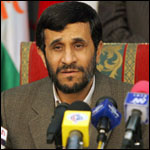
President Mahmoud AhmadinejadIn response to Tehran's foolish decision to restart its nuclear enrichment program, the U.N. Security Council finally got serious about dealing with the Iranian threat. If Tehran does not accept Moscow's offer to enrich uranium for Iran on Russian soil, a U.N. censure of Iran seems likely. Anything less will affirm the assessment of hard-liners in Tehran that the United States is too weak to achieve its basic foreign policy objectives regarding Iran.
But then what? Passing a Security Council resolution is a necessary but far from sufficient step for addressing the threat from the Islamic republic. New sanctions, even if they included oil, would not undermine the Iranian regime. A more farsighted, comprehensive strategy for reducing the Iranian menace to international security must include the development of an alliance with those inside Iran who also see the dangers of the regime's adventurism. Ironically, President Mahmoud Ahmadinejad and his dangerous foreign policy initiatives abroad, combined with his bankrupt and increasingly oppressive policies at home, have helped create favorable conditions for forging such an alliance.
On the surface, the regime in Tehran seems to stand together in supporting Iran's more confrontational foreign policy stances. Behind the scenes, however, a fierce struggle is underway. In one camp is Ahmadinejad, his supporters in the Revolutionary Guards and the paramilitary force known as the Basijis, and messianic fundamentalists inspired by the teachings of Ayatollah Mesbah-Yazdi. In the other camp is not only Iran's embattled democratic movement but also an array of forces that benefited from the status quo before Ahmadinejad came to power, including the head of the Expediency Council: Ali Akbar Hashemi Rafsanjani.
Unexpectedly, Ahmadinejad has pushed hard to remove from power many experienced high- and mid-level government officials, including those previously handling the nuclear negotiations, and to replace them with unqualified loyalists from the security services and the Basijis. Not surprisingly, these fired professionals have quietly begun to regroup to push back, and, significantly, their efforts have not been checked by the supreme leader, Ayatollah Ali Khamenei. Until recently Khamenei had backed Ahmadinejad as a way to restrain the powers of Rafsanjani, but now Khamenei is gently seeking ways to rein in the new president and those spiritual zealots close to him, such as Mesbah-Yazdi, who threaten the supreme leader's authority.
If this split in the regime deepens, Ahmadinejad will not be able to rely on widespread support in Iranian society. In last year's presidential election, Ahmadinejad ran a clever campaign as an outsider and critic of the status quo. He rallied electoral support not by promising to remove Israel from the face of the earth but by pledging to fight corruption and support the poor. In power, however, Ahmadinejad quickly undermined his anti-corruption credentials by appointing his relatives to government positions, and then tried to change the subject by launching repressive policies at home and exacerbating tensions abroad. Economic woes, new restrictions on social freedoms and disappointed expectations mean that popular support for his Khomeini renaissance is shallow.
These developments create opportunities for Western leaders well beyond U.N. votes. First, and most obviously, the United States must take advantage of the current climate to further isolate and marginalize Ahmadinejad and his cabal and hold them responsible for the crisis. Calls for constructive engagement with Iran's president are wrong; such overtures would only confirm Ahmadinejad's contention that confrontational policies reap rewards.
Second, U.S. and European leaders must do more to stimulate a serious discussion in Iranian society about the country's security interests, and articulate policies and arguments that will strengthen an Iranian political coalition against nuclear weapons. So far the Tehran regime has monopolized the discussion. Though disguised in assertions about Iran's right to nuclear energy, the strategic thinking of the regime has been quite simple: The United States invaded Iraq because Iraq did not have nuclear weapons; the United States has not invaded North Korea because North Korea has nuclear weapons.
The flaws in this logic must be exposed. In a major public address, President Bush should pledge that the United States will never attack a nonnuclear Iran, while also underscoring that the Iranian process of acquiring nuclear weapons capabilities actually increases the likelihood of military confrontation with the United States. Western leaders should remind Iranian society that a nuclear Iran would also trigger a nuclear arms race in the region, as Egypt and Saudi Arabia would move quickly to develop their own arsenals.
Third, Bush should endorse the idea of creating a regional security organization in the Middle East, which would include Iran. Like the Conference on Security and Cooperation in Europe during the Cold War, this new organization could begin to provide security guarantees between Middle East states as well as those outside the region. A more secure Iran would create better conditions for the reemergence of a pro-Western, peaceful, democratic movement inside the country. The specter of armed conflict with the United States only helps Ahmadinejad consolidate his power.
Ahmadinejad's threat to external security and internal freedoms is bringing forth an opposition coalition that sees more clearly the dangers of confrontation with the West. A nimble U.S. policy, one that plots a strategy beyond the next Security Council vote, can help these forces inside Iran succeed.
The writers are research fellows and co-directors of the Iran Democracy Project at the Hoover Institution.
In addition to his role at Carnegie, McFaul is Peter and Helen Bing Senior Fellow at the Hoover Institution and associate professor of political science at Stanford University.
Carnegie India does not take institutional positions on public policy issues; the views represented herein are those of the author(s) and do not necessarily reflect the views of Carnegie, its staff, or its trustees.
In any defense establishment, change is an ongoing process. However, despite the best of intentions, existing bureaucracies, bound by habit and years of socialization, have their limits in implementing transformative change.
After the chill in ties between 2020 and 2024 that brought India–China relations to their lowest point in several decades, the two countries have engaged each other afresh. This paper argues that there are predominantly four imperatives guiding India’s approach to China, and they exist in an order of priority.
This piece argues that India’s central challenge is not managing a single flashpoint but resolving the underlying tension between expansion and institutional coherency of the BRICS grouping.
A partnership between India, a country of subcontinental size, and Africa, a continent of fifty-four countries, may seem asymmetric until one notes that both are home to nearly the same number of people—1.4 billion. This essay spells out the existing challenges to the partnership, its optimal potential, and the possible pathways to realize it over the next quarter-century.