

Article
This piece argues that India’s central challenge is not managing a single flashpoint but resolving the underlying tension between expansion and institutional coherency of the BRICS grouping.
Vrinda Sahai
{
  "authors": [
    "Douglas H. Paal",
    "Jeffrey A. Bader"
  ],
  "type": "legacyinthemedia",
  "centerAffiliationAll": "dc",
  "centers": [
    "Carnegie Endowment for International Peace",
    "Carnegie China"
  ],
  "collections": [],
  "englishNewsletterAll": "asia",
  "nonEnglishNewsletterAll": "",
  "primaryCenter": "Carnegie China",
  "programAffiliation": "AP",
  "programs": [
    "Asia",
    "Russia and Eurasia"
  ],
  "projects": [],
  "regions": [
    "East Asia",
    "China",
    "Taiwan",
    "Caucasus",
    "Russia"
  ],
  "topics": [
    "Political Reform",
    "Foreign Policy"
  ]
}
Source: Getty
There are six lessons of the Russia–Georgia crisis for Taiwan: (1) Be careful about security commitments; (2) Don’t provoke an antagonist and expect to be rescued; (3) A constructive relationship between America and major powers is essential to the security of vulnerable states; (4) Geography matters; (5) Speak softly when you don’t plan to carry a big stick; and (6) Credibility is global.
Source: Far Eastern Economic Review

Americans and Europeans are not the only ones who have been watching with interest. In Asia—particularly Taiwan—people are wondering what events in the Caucasus may portend about their own security.
Like Georgia, Taiwan lies on the periphery of a major power, in this case China, growing in strength in recent years. Russia’s designs for Georgia are not absolutely clear, but with regard to Taiwan, China is unambiguous in its assertion of sovereignty and its intention to absorb it in the long-run.
In both cases, the policy of the United States is central to the calculations of all the players. The United States leads plans to bring Georgia into NATO. With respect to Taiwan, U.S. security interests are of much longer standing, and the assumption of a U.S. commitment to defend Taiwan in case of attack is one of the foundations of security and stability in Asia. It is no wonder that many Taiwanese watched the events in Georgia with deep concern about their own future, and what these events say about the reliability of U.S. defense assurances.
What are the lessons of the Russia–Georgia crisis for Taiwan, and for U.S. policy toward Taiwan? We would point to six:
1) Be careful about security commitments. They mean something. Don’t make them unless you mean it. NATO is not a feel-good organization designed to increase the self-esteem of its members. It is a solemn commitment by its members to treat an attack upon one as an attack upon all. There should be no consideration of bringing Georgia into NATO unless the United States and the rest of the European members intend to bring the full force of NATO power to its defense. We do not believe in fact that the United States or the Europeans have any such intention. To provide a security commitment to Georgia and then not back it up is to send a message to all potential adversaries, including China in the Taiwan Strait, that the United States is not serious. On the other hand, we need to continue to make clear to China, including through military planning and deployments, the U.S. security interest in a peaceful resolution of cross-Strait issues and the unacceptability of a Chinese attack, so that Beijing will not be tempted to see in the Georgia crisis a model for resolution of its own irredentist aims.
2) Don’t provoke the bear, or the dragon, expecting the eagle to fly to the rescue. Georgia’s President Saakashvili has shown a propensity for statements and actions that seems to say to the United States and Russia, “Let the two of you fight over me.” His goal has seemed to be to encourage the United States and Russia to see Georgia as the target of a zero-sum security game and to appeal to the U.S. conscience to back him up. Taiwan’s former president Chen Shui-bian took the same approach to the triangular relationship among Taiwan, the United States, and China. The result in Saakashvili’s case has been to leave his troops alone to face an angered Russian military. In Chen’s case, it led to heightened cross-Strait tensions, but in Taiwan’s case, the United States showed wisdom and took issue with Chen and his provocative behavior and withdrew its support.
3) A constructive relationship between the United States and major powers is an essential component of security for vulnerable states. The United States has enjoyed a positive and constructive relationship with China for most of the past 36 years. Taiwan’s security has greatly benefited from this, as the PRC has understood that an attack on Taiwan would profoundly damage its relationship with the United States and its place in the world. On the other hand, the deterioration of U.S.–Russian relations and a disdainful attitude toward Russian security interests for the last decade led us to a situation where Russia seems to see little risk to its interests, and much to gain, in redefining its relationship with the United States.
4) Geography matters. Small nations near large powers should not forget who their neighbors are. Cuba has not prospered through its 50 years of defiance of the United States. Taiwan’s newly elected President Ma Ying-jeou seems to understand well that an improved relationship between Taiwan and China is essential to Taiwan’s future security. In the absence of unambiguous security commitments from the United States, such as those enjoyed by countries like Japan, small states might best seek a balance?the strongest possible U.S. commitment to their defense and survival, hedged by a non-hostile relationship with their big power neighbor. Taiwan’s example shows that prosperity and full-blown democracy can find their way in a tyrannical shadow.
5) It’s wise to speak softly when you don’t plan to carry a big stick. U.S. statements and actions implying that we would defend Georgia when we had neither the will nor the intention to do so, not to mention an adequate understanding of the region’s internal conflicts, sent all the wrong signals. They encouraged Saakashivili to provoke the Russians and face their response alone. The Russians saw the U.S. warnings as a bluff. And they sent a message to our allies, including those in Asia, that our real commitments might prove as empty as our casual verbal ones.
6) Credibility is global. There are no purely local crises. U.S. commitments, even in the post-Cold War era, remain critical for the stability of the international system. Potential adversaries and potential friends alike draw conclusions from our behavior. We want them to understand we will act to defend friends where we have declared security interests. We need to be careful about when and where we declare those interests to be engaged, but once we do we need to act in ways that sends a message to potential aggressors that reinforces their restraint.
This piece originally appeared in The Far Eastern Economic Review.

Distinguished Fellow, Asia Program
Paal previously served as vice chairman of JPMorgan Chase International and as unofficial U.S. representative to Taiwan as director of the American Institute in Taiwan.
Jeffrey A. Bader
Brookings Institution
Carnegie India does not take institutional positions on public policy issues; the views represented herein are those of the author(s) and do not necessarily reflect the views of Carnegie, its staff, or its trustees.

This piece argues that India’s central challenge is not managing a single flashpoint but resolving the underlying tension between expansion and institutional coherency of the BRICS grouping.

Vrinda Sahai

A partnership between India, a country of subcontinental size, and Africa, a continent of fifty-four countries, may seem asymmetric until one notes that both are home to nearly the same number of people—1.4 billion. This essay spells out the existing challenges to the partnership, its optimal potential, and the possible pathways to realize it over the next quarter-century.

Rajiv Bhatia

The India–EU Free Trade Agreement (FTA) is shaping up to be one of the most consequential trade negotiations, both economically and strategically. But, what’s in the agreement, what’s missing, and what will determine its success in the years ahead
Vrinda Sahai, Nicolas Köhler-Suzuki
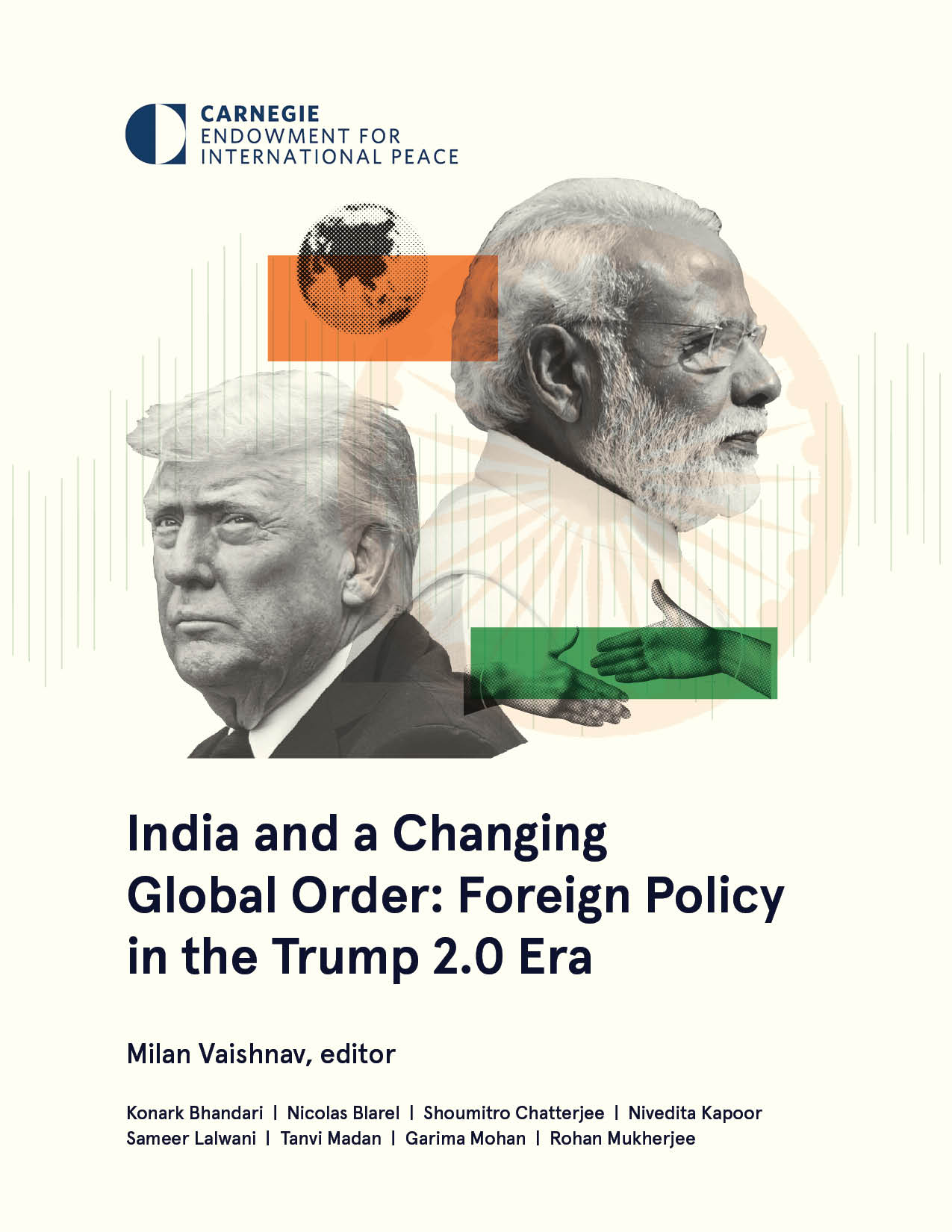
Trump 2.0 has unsettled India’s external environment—but has not overturned its foreign policy strategy, which continues to rely on diversification, hedging, and calibrated partnerships across a fractured order.



Milan Vaishnav, ed., Sameer Lalwani, Tanvi Madan, …

This piece examines India’s response to U.S. sanctions and tariffs, specifically assessing the immediate market consequences, such as alterations in import costs, and the broader strategic implications for India’s energy security and foreign policy orientation.
Vrinda Sahai