

Paper
Richard Youngs, Thomas Carothers
{
  "authors": [
    "Thomas Carothers"
  ],
  "type": "legacyinthemedia",
  "centerAffiliationAll": "dc",
  "centers": [
    "Carnegie Endowment for International Peace"
  ],
  "collections": [
    "Democracy and Governance"
  ],
  "englishNewsletterAll": "democracy",
  "nonEnglishNewsletterAll": "",
  "primaryCenter": "Carnegie Endowment for International Peace",
  "programAffiliation": "DCG",
  "programs": [
    "Democracy, Conflict, and Governance"
  ],
  "projects": [],
  "regions": [
    "North America",
    "United States",
    "Western Europe",
    "United Kingdom",
    "France",
    "Germany"
  ],
  "topics": [
    "Political Reform",
    "Democracy"
  ]
}
Source: Getty
The divide between the political and developmental approaches to assisting democracy starts from contrasting ideas about both democracy and democratization and leads to very different configurations of assistance programs. Yet this division need not represent a rift in the world of democracy aid. Both have a significant place in U.S. and European efforts in supporting democracy around the world.
Source: Journal of Democracy

The political approach proceeds from a relatively narrow conception of democracy—focused, above all, on elections and political liberties — and a view of democratization as a process of political struggle in which democrats work to gain the upper hand in society over nondemocrats. It directs aid at core political processes and institutions — especially elections, political parties, and politically oriented civil society groups — often at important conjunctural moments and with the hope of catalytic effects. The developmental approach rests on a broader notion of democracy, one that encompasses concerns about equality and justice and the concept of democratization as a slow, iterative process of change involving an interrelated set of political and socioeconomic developments. It favors democracy aid that pursues incremental, long-term change in a wide range of political and socioeconomic sectors, frequently emphasizing governance and the building of a well-functioning state.
This basic division between the political and developmental approaches has existed inchoately in the field of democracy support for many years.It has come into sharper relief during this decade, as democracy-aid providers face a world increasingly populated by countries not conforming to clear or coherent political transitional paths. Such a context impels greater attention to choices of strategy and method. Moreover, with the overall enterprise of democracy promotion now coming under stress—as evidenced by the growing backlash against both democracy promotion and democracy more generally—the democracy-aid community is more actively debating the relative merits of different approaches. Some adherents of the developmental approach criticize the political approach as too easily turning confrontational vis-`a-vis “host” governments and producing unhelpful counterreactions. Some adherents of the political approach, meanwhile, fault the developmental approach for being too vague and unassertive in a world where many leaders have learned to play a reform game with the international community, absorbing significant amounts of external political aid while avoiding genuine democratization..

Harvey V. Fineberg Chair for Democracy Studies; Director, Democracy, Conflict, and Governance Program
Thomas Carothers, director of the Carnegie Endowment for International Peace’s Democracy, Conflict, and Governance Program, is a leading expert on comparative democratization and international support for democracy.
Recent Work

Richard Youngs, Thomas Carothers

Thomas Carothers, McKenzie Carrier
Carnegie India does not take institutional positions on public policy issues; the views represented herein are those of the author(s) and do not necessarily reflect the views of Carnegie, its staff, or its trustees.

The U.S.–India semiconductor cooperation story is well-stocked with top-level strategic intent. What remains unresolved, however, are some underlying challenges that will determine whether the cooperation actually functions. Three such friction points stand out.

Shruti Mittal

India and the United States are close to concluding a Reciprocal Defense Procurement Agreement (RDPA) that will allow firms from the two countries to sell to each other’s defense establishments more easily. While this may not remedy the specific grievances both sides may have regarding larger bilateral issues, an RDPA could restore some momentum, following the trade deal announcement.

Konark Bhandari

On the last day of the India AI Impact Summit, India signed Pax Silica, a U.S.-led declaration seemingly focused on semiconductors. While India’s accession to the same was not entirely unforeseen, becoming a signatory nation this quickly was not on the cards either.
Konark Bhandari

This piece examines India’s response to U.S. sanctions and tariffs, specifically assessing the immediate market consequences, such as alterations in import costs, and the broader strategic implications for India’s energy security and foreign policy orientation.

Vrinda Sahai
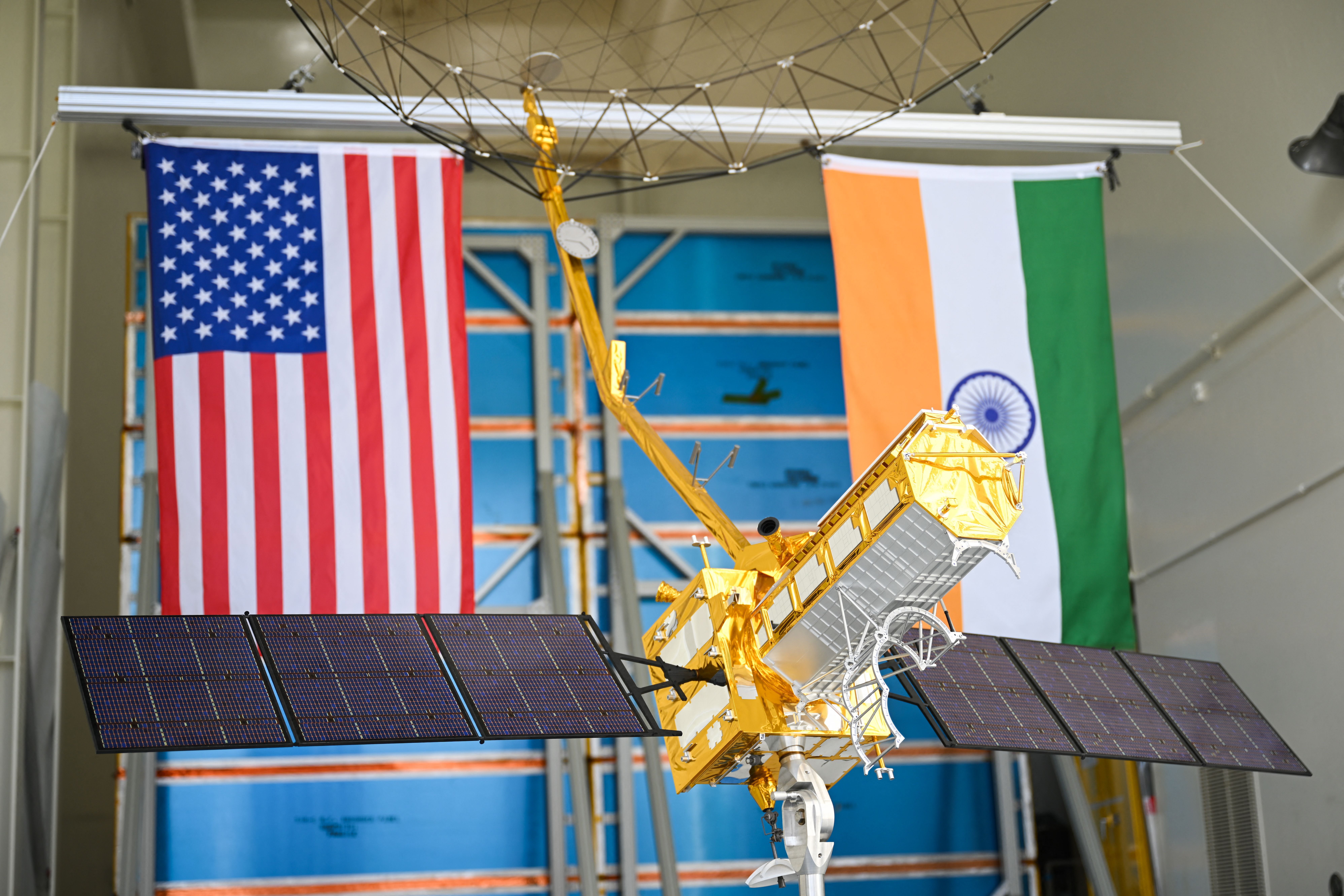
On July 30, 2025, the United States announced 25 percent tariffs on Indian goods. While diplomatic tensions simmered on the trade front, a cosmic calm prevailed at the Sriharikota launch range. Officials from NASA and ISRO were preparing to launch an engineering marvel into space—the NASA-ISRO Synthetic Aperture Radar (NISAR), marking a significant milestone in the India-U.S. bilateral partnership.

Tejas Bharadwaj