• Research
  • About
  • Experts
Carnegie India logoCarnegie lettermark logo
AI
{
  "authors": [
    "Nikolay Petrov"
  ],
  "type": "legacyinthemedia",
  "centerAffiliationAll": "",
  "centers": [
    "Carnegie Endowment for International Peace",
    "Carnegie Russia Eurasia Center"
  ],
  "collections": [],
  "englishNewsletterAll": "",
  "nonEnglishNewsletterAll": "",
  "primaryCenter": "Carnegie Russia Eurasia Center",
  "programAffiliation": "",
  "programs": [],
  "projects": [],
  "regions": [
    "Caucasus",
    "Russia",
    "Eastern Europe"
  ],
  "topics": [
    "Political Reform",
    "Security",
    "Foreign Policy"
  ]
}
Source: Getty

In The Media
Carnegie Russia Eurasia Center

The Children of Stalin

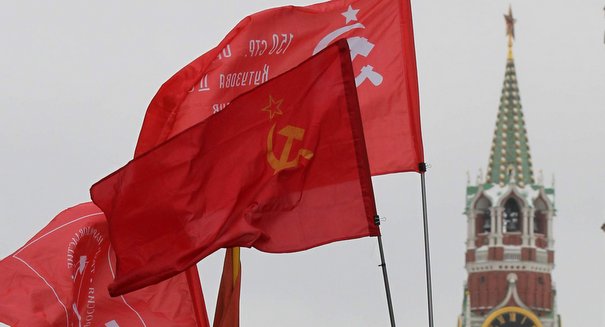
Stalin’s growing popularity in Russia is less a function of an organized state propaganda effort to promote him than it is a result of the government’s lack of interest in setting the historical record straight on Stalin. Attention is increasingly focused on the greatness of the country and its achievements under Stalin’s rule.

Link Copied
By Nikolay Petrov
Published on Sep 1, 2009

Source: the Moscow Times

The Children of StalinTwo significant events occurred last week. The first was the holding of the first session of the presidential commission “for counteracting attempts to falsify history to the detriment of Russia’s interests.”

The second was the opening of Moscow’s newly renovated Kurskaya metro station, whose walls once again bear a verse from the 1944 version of the Soviet anthem: “Stalin raised us to be loyal to the nation; He inspired us to work and be heroic.”
 
This phrase had been plastered over during Soviet leader Nikita Khrushchev’s campaign against Stalin’s personality cult. On the eve of commemorations marking the 70th anniversary of the start of World War II, both events can be viewed as elements of Russia’s domestic and foreign policies.
 
Praising Stalin on the walls of the Kurskaya metro station can be seen as an excellent test. But it is not so much a test for the public as it is a test for the political elite. It is telling that so far not a single official has taken personal responsibility for allowing the public praise of Stalin. Politicians are biding their time. They are in no rush to touch this hot potato. This especially applies to members of the main political parties who are currently engaged in an election campaign for seats in the Moscow City Duma. Only the Yabloko party has come out with a clearly defined position. It issued a harsh evaluation of Stalin and condemned the decision to by the Moscow authorities to adorn the Kurskaya station with words of praise for Stalin.
 
It is no secret that Stalin enjoys enormous popularity in Russia, as was demonstrated a year ago by the television project titled “The Name of Russia.” The fact that he is so popular is less a function of an organized state propaganda effort to promote Stalin than it is a result of the government’s lack of interest in setting the historical record straight on Stalin.
 
It is also a manifestation of the primacy of state interests over the interests of individuals — even when those individuals number in the millions. In recent years, the authorities have persistently cultivated the Stalinist myth in the public mind. Attention is increasingly focused on the greatness of the country and its achievements under Stalin’s rule — primarily the rapid modernization of the economy and the Soviet victory in World War II.
 
Even the occasional harsh criticism of Stalin refer only to his crimes and repressions in domestic affairs, while foreign policy was always viewed as peaceful. The cornerstone of post-Soviet ideology is the myth of the Soviet people — liberators who through their colossal sacrifices brought the world salvation from the “brown plague” of Nazism.
 
During his visit to Poland on Tuesday, Prime Minister Vladimir Putin — who in many ways propagates the spirit of the Stalin myth — is expected to articulate the latest version of the role the Soviet Union and Stalin played in World War II. Putin’s account of the Soviet role in World War II runs counter to that of all other leaders of countries that participated in the war.
 
History has given Putin a new chance to offer a more balanced and honest picture of Moscow’s role in World War II. On Tuesday, let’s hope he takes advantage of this opportunity.
 

About the Author

Nikolay Petrov

Former Scholar-in-Residence, Society and Regions Program, Moscow Center

Nikolay Petrov was the chair of the Carnegie Moscow Center’s Society and Regions Program. Until 2006, he also worked at the Institute of Geography at the Russian Academy of Sciences, where he started to work in 1982.

    Recent Work

  • Commentary
    Moscow Elections: Winners and Losers

      Nikolay Petrov

  • Commentary
    September 8 Election As a New Phase of the Society and Authorities' Coevolution

      Nikolay Petrov

Nikolay Petrov
Former Scholar-in-Residence, Society and Regions Program, Moscow Center
Nikolay Petrov
Political ReformSecurityForeign PolicyCaucasusRussiaEastern Europe

Carnegie India does not take institutional positions on public policy issues; the views represented herein are those of the author(s) and do not necessarily reflect the views of Carnegie, its staff, or its trustees.

More Work from Carnegie India

  • Article
    India–Africa Strategic Partnership: Challenges, Potential, and Possible Pathways

    A partnership between India, a country of subcontinental size, and Africa, a continent of fifty-four countries, may seem asymmetric until one notes that both are home to nearly the same number of people—1.4 billion. This essay spells out the existing challenges to the partnership, its optimal potential, and the possible pathways to realize it over the next quarter-century.

      Rajiv Bhatia

  • Commentary
    Emerging From the “Zombie State” of Trade Agreements: The India-EU FTA

    The India–EU Free Trade Agreement (FTA) is shaping up to be one of the most consequential trade negotiations, both economically and strategically. But, what’s in the agreement, what’s missing, and what will determine its success in the years ahead

      Vrinda Sahai, Nicolas Köhler-Suzuki

  • Article
    India’s Oil Security Strategy: Structural Vulnerabilities and Strategic Choices

    This piece argues that the present Indian strategy, based on opportunistic diversification and utilization of limited strategic reserves, remains inadequate when confronting supply disruptions. It evaluates India’s options in the short, medium, and long terms.

      Vrinda Sahai
  • India and a Changing Global Order: Foreign Policy in the Trump 2.0 Era
    Research
    India and a Changing Global Order: Foreign Policy in the Trump 2.0 Era

    Trump 2.0 has unsettled India’s external environment—but has not overturned its foreign policy strategy, which continues to rely on diversification, hedging, and calibrated partnerships across a fractured order.

      • Sameer Lalwani
      • +6

      Milan Vaishnav, ed., Sameer Lalwani, Tanvi Madan, …

  • Commentary
    The Impact of U.S. Sanctions and Tariffs on India’s Russian Oil Imports

    This piece examines India’s response to U.S. sanctions and tariffs, specifically assessing the immediate market consequences, such as alterations in import costs, and the broader strategic implications for India’s energy security and foreign policy orientation.

      Vrinda Sahai

Get more news and analysis from
Carnegie India
Carnegie India logo, white
Unit C-4, 5, 6, EdenparkShaheed Jeet Singh MargNew Delhi – 110016, IndiaPhone: 011-40078687
  • Research
  • About
  • Experts
  • Projects
  • Events
  • Contact
  • Careers
  • Privacy
  • For Media
Get more news and analysis from
Carnegie India
© 2026 Carnegie Endowment for International Peace. All rights reserved.