

Paper
Adam Baczko, Gilles Dorronsoro, Arthur Quesnay
{
  "authors": [
    "Gilles Dorronsoro"
  ],
  "type": "legacyinthemedia",
  "centerAffiliationAll": "dc",
  "centers": [
    "Carnegie Endowment for International Peace"
  ],
  "collections": [],
  "englishNewsletterAll": "ctw",
  "nonEnglishNewsletterAll": "",
  "primaryCenter": "Carnegie Endowment for International Peace",
  "programAffiliation": "SAP",
  "programs": [
    "South Asia"
  ],
  "projects": [],
  "regions": [
    "North America",
    "United States",
    "South Asia",
    "Afghanistan"
  ],
  "topics": [
    "Security",
    "Military",
    "Foreign Policy"
  ]
}
Source: Getty
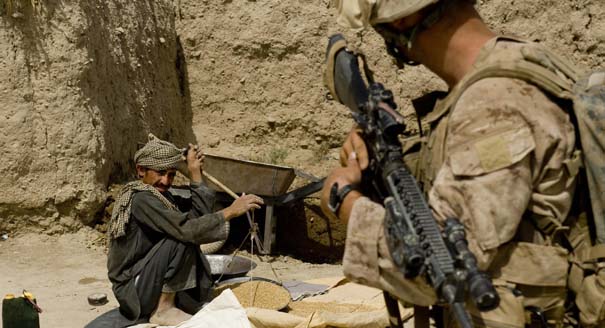
Former U.S. marine and foreign service officer Matthew Hoh's letter of resignation raises a number of important questions about the value of a continued American combat presence in Afghanistan.
Source: The Guardian

With Tuesday's attacks making October the bloodiest month for US troops in the country in the eight years since the war began, Hoh's letter is an expression of deep moral conviction, and senior US officials, from ambassador Karl Eikenberry to vice-president Joe Biden, are taking it seriously. But the statement is more than a cri du coeur. It presents several arguments that are worthy of discussion.
"If honest," Hoh writes, "our strategy of securing Afghanistan to prevent al-Qaida resurgence or regrouping would require us to additionally invade and occupy Pakistan, Somalia, Sudan, Yemen, etc."
Hoh's argument here is weak on two accounts. First, in the other countries mentioned, the US has a degree of co-operation with the local governments, even if they cannot completely control their own territories. Afghanistan is a special case, in that its government cannot survive without western assistance. And if the Taliban succeeds in retaking Afghanistan's cities, al-Qaida could find there a perfect sanctuary, where it would be impervious to counter-terrorism operations. In the other countries Hoh mentions, that is not the case.
"Our presence in Afghanistan has only increased destabilisation and insurgency in Pakistan," Hoh asserts.
This is absolutely correct, the only caveat being that the Pakistani government also supports the Taliban and other radical groups that are destabilising the country. As the Afghan Taliban show with their persistent practice of attacking Indian targets in Kabul, the Pakistani military support them as a weapon against India, and it offers no indication of a new policy. (The offensive in Waziristan is directed against the Pakistan Taliban, not the Afghan Taliban). Nonetheless, even an American withdrawal from Afghanistan would not give the US or Pakistan any insurance about the future behaviour of these radical groups, Afghan or Pakistani. Afghanistan could still become a sanctuary for groups fighting in Pakistan.
"The threat is not tied to geographic or political boundaries," Hoh says.
Hoh is right. The September 11 attacks were planned mostly in Germany, and the war in Afghanistan does not make the US more secure. At the same time, al-Qaida needs a sanctuary in order to escape from the police and counterterrorism forces. Even a loose network of individuals is vulnerable when it has no protection from police or military strikes. Afghanistan was once instrumental in lending a certain level of security to al-Qaida and similar groups, just as Waziristan is today. Al-Qaida can always move from Pakistan to another base, like Yemen, if the situation there becomes too dangerous, but that will affect its ability to operate, since Pakistan is still the best base they can hope for.
US troops, Hoh writes, were "inadequately prepared and resourced".
This point is also completely accurate, and little has changed. Western troops are not prepared to fight a counter-insurgency. They spend too little time in country, undergo no appreciable linguistic training and the Pashtuns fear their presence and reject their cultures. By contrast, the Iraq surge worked not because of counter-insurgency, but because the local tribes chose to join the US, and the insurgents they were fighting were mostly urban. So the US did not learn how to fight a rural counterinsurgency in Iraq.
Hoh writes that the war could continue for "decades and generations".
If the objective is to crush the Taliban, not to pursue the more realistic goal of leaving an Afghan government that can survive on its own, this is true. The Obama administration has made clear that its objectives are mostly limited to security, and John Kerry's speech on Monday delivered exactly that line.
But Hoh has nevertheless a point here, because the strategy General Stanley McChrystal proposes is more ambitious: it aims for total military victory against the Taliban. To accomplish that, McChrystal will need a lot more than the 20,000 to 60,000 troops for which he is asking. The Taliban can continue to strike from Pakistan, and, as the US operation in Helmand showed this summer, even 20,000 soldiers cannot secure the centre of a single province in southern Afghanistan.
To what end, as Hoh asks, are we asking our young men and women to sacrifice? That is the question the White House has to answer.
Former Nonresident Scholar, South Asia Program
Dorronsoro’s research focuses on security and political development in Afghanistan. He was a professor of political science at the Sorbonne in Paris and the Institute of Political Studies of Rennes.
Recent Work
Adam Baczko, Gilles Dorronsoro, Arthur Quesnay
Gilles Dorronsoro
Carnegie India does not take institutional positions on public policy issues; the views represented herein are those of the author(s) and do not necessarily reflect the views of Carnegie, its staff, or its trustees.

In any defense establishment, change is an ongoing process. However, despite the best of intentions, existing bureaucracies, bound by habit and years of socialization, have their limits in implementing transformative change.

Anit Mukherjee

How is AI reshaping space security, creating governance challenges, and where does international diplomacy stand today?


Tejas Bharadwaj, Almudena Azcárate Ortega

After the chill in ties between 2020 and 2024 that brought India–China relations to their lowest point in several decades, the two countries have engaged each other afresh. This paper argues that there are predominantly four imperatives guiding India’s approach to China, and they exist in an order of priority.

Saheb Singh Chadha

This piece argues that India’s central challenge is not managing a single flashpoint but resolving the underlying tension between expansion and institutional coherency of the BRICS grouping.

Vrinda Sahai

A partnership between India, a country of subcontinental size, and Africa, a continent of fifty-four countries, may seem asymmetric until one notes that both are home to nearly the same number of people—1.4 billion. This essay spells out the existing challenges to the partnership, its optimal potential, and the possible pathways to realize it over the next quarter-century.

Rajiv Bhatia