

Commentary
Amr Hamzawy
{
  "authors": [
    "Amr Hamzawy"
  ],
  "type": "legacyinthemedia",
  "centerAffiliationAll": "dc",
  "centers": [
    "Carnegie Endowment for International Peace"
  ],
  "collections": [],
  "englishNewsletterAll": "menaTransitions",
  "nonEnglishNewsletterAll": "",
  "primaryCenter": "Carnegie Endowment for International Peace",
  "programAffiliation": "MEP",
  "programs": [
    "Middle East"
  ],
  "projects": [],
  "regions": [
    "Middle East",
    "North Africa"
  ],
  "topics": [
    "Political Reform",
    "Democracy",
    "Economy"
  ]
}
Source: Getty
Scholars are stuck asking the same questions, calling for democratization and human rights in the Arab world without effectively explaining their absence.
Source: Al-Ahram Weekly

In the course of their efforts, scholars have studied the bonds regulating the relationship between ruling elites and opposition movements, whether partisan or non- partisan and religious or secular, only to rediscover what they already knew: that the elites held a tight grip and had little or no desire for reform, and that opposition forces were ineffectual in propelling the state towards the peaceful and regular rotation of power. We studied the evolution of public institutions and the formation of civil society organisations, fully convinced that the further along Arab societies moved towards institutionalisation and voluntary political participation, the more they would be able to promote such essential modernising tasks as the imposition of the rule of law and the principle of equal citizenship, and simultaneous marginalisation of the forces of primary sectarian, tribal, regional and factional allegiances.
But eventually we reached the conclusion that the public institutions and civil society organisations that came into being failed to perform those tasks and, instead, merely served to furnish a fragile veneer over the ongoing clientelism stemming from the dominance of organic bodies based on primal allegiances. We studied the state of human rights and civic freedoms across the length and breadth of the Arab world and some research centres and human rights organisations issued periodic reports that documented some positive inroads but simultaneously ascertained that the Arabs continued to lag behind international standards as laid out in UN human rights instruments. Yet in our attempts to explain the ongoing deficiency in human rights we either tended to hone in on the authoritarianism of ruling establishments and their security apparatuses, thereby ignoring the weakness of the rights movement in most Arab societies, or we tended to fall back on pat generalisations on the poor human rights culture in Arab society, as though such a culture might descend whole and complete from heaven as opposed to being something that evolves gradually over time.
Yes, scholastic efforts have accumulated a great deal of detailed knowledge on how ruling elites and opposition movements -- especially the Islamist opposition -- work, and have come a long way in explaining the mechanisms through which sectarian, ethnic and tribal allegiances have permeated public institutions and civil society organisations, divesting them of their modernising functions. They have also acquired a deeper understanding of many of the components that shape the political scene in the Arab world, such as the weakness of legislative and judicial authorities with respect to the executive and the ways electoral processes are managed in order to keep the balances between ruling parties and opposition parties exactly the same. However, the accumulation of details and partial insights have yet to yield a significant perceptual and conceptual breakthrough enabling us to go beyond the theories formulated in the 1990s regarding the failure of democratisation, sound government and human rights in the Arab world. Without new horizons for enquiry, therefore, research output in both the West and the Middle East continues to fall under worn, almost hackneyed headings, such as "Obstacles to democracy in the Arab world", "The crisis in the transition to plurality in Arab countries", and "Challenges facing civil society in the Arab region". This problem is not, as some would argue, due to the restricted room for change in the current political scene in the Arab world, rendering it inevitable that scholars pose the same questions and assume the same headings for their work. Rather, it is due to the cognitive and conceptual shortcomings in the investigative approaches of research, for which reason scholars have failed to observe and analyse many important transformations.
I am convinced that there are two alternative and supplementary avenues of enquiry that should be put to the test and that could fill the cognitive/conceptual gap we see today. The first avenue is to return to the study of the nation state, its modernising project and the efficacy of its chief institutions. The failure of democratisation as a consequence of dominant ruling elites with no desire for reform and facing a weak opposition is only one facet of the present state of Arab politics; the other is the mounting fragility of the Arab nation-state and the dangerous erosion in its legitimacy in society. The existence of the nation state is under threat in Sudan and Yemen; it has practically lost its meaning and substance in present-day Lebanon and in Iraq since 2003; and its modernising project has faded in Morocco, Algeria and Egypt, or been hijacked by tribal interests, as is the case in Jordan. In many instances, the Arab nation-state either failed to assimilate social forces or entities into the framework of the rule of law and equal citizenship and to ensure any degree of equitableness in the distribution of wealth, and/or it failed to achieve the goals of economic and social development and to furnish such essential services as education, healthcare, and providing job opportunities.
Many of the problems and challenges Arab countries face today are directly and organically linked to this failure of the nation state, whether it is on the verge of collapse due to insurgent forces battling the central government (Sudan and Yemen), or a façade for systematised sectarianism (Lebanon), or facing crumbling legitimacy due to its unprecedented inability to perform the tasks society expects of it (Egypt, Morocco, Algeria). Scholars' narrow focus on democratisation and the opportunities for reform does not answer questions regarding the failure of the nation state and overlooks the prior necessity of safeguarding its existence and searching for ways to revive its social legitimacy and enhance the efficacy of its institutions. Although some scholastic circles concerned with the Arab world maintain that the nation-state project is originally alien to this region's social and political history and that little harm would come from the collapse of this project, I continue to take the view that the nation-state is an indispensable prerequisite for the real modernisation of Arab societies.
The second approach is to conduct deeper and more extensive political-economic investigations into the ruling elites and opposition forces and the organisations of civil society. This alternative essentially compliments and expands upon the study of these groups and their power relations within the narrower focus of democratisation, good governance and human rights. Indeed one of the major shortcomings in contemporary research on Arab regimes is that its attempts to explain their perpetuity shirk a systematic exploration of the economic interests of their component groups and how they pursue and preserve them in societies that, for the most part, have limited resources and are characterised by a high degree of concentration in wealth. By the same token, research into opposition forces in these countries has rarely gone beyond attributing their structural weakness to legal and security restrictions on their activities and their attempts to build grassroots bases, to the lack of internal democratic mechanisms and to their organisational rigidity and calcified leaderships.
What this research has overlooked are the shared economic interests that have created a form of organic alliance between some opposition forces and ruling elites, thereby effectively neutralising them as serious lobbyists for democratic reform. It has also ignored consideration of the extent to which the poor economic base of other opposition forces deprives them of their ability to compete with the socio-politically dominant elites that make up the establishment. The political-economic approach has also been flagrantly absent in the study of civil society organisations. For example, it is impossible to account for the inefficacy of civil society without taking into account the decline and ongoing deterioration of the middle class in most Arab societies, given that the middle class is the natural incubator for such organisations. In like manner, the fact that primary allegiances now intersect civil society in the way they do can only be understood, at least at some levels, through an examination of the economic interests that influence entities based on sectarian, ethnic or tribal allegiances and that have enabled these entities to use civil society as an arena to promote their agendas in exchange, perhaps, for some minor services.

Director, Middle East Program
Amr Hamzawy is a senior fellow and the director of the Carnegie Middle East Program. His research and writings focus on Egypt’s and other middle powers’ involvement in regional security in the Middle East, particularly through collective diplomacy and multilateral conflict resolution
Recent Work
Amr Hamzawy
Amr Hamzawy
Carnegie India does not take institutional positions on public policy issues; the views represented herein are those of the author(s) and do not necessarily reflect the views of Carnegie, its staff, or its trustees.

A partnership between India, a country of subcontinental size, and Africa, a continent of fifty-four countries, may seem asymmetric until one notes that both are home to nearly the same number of people—1.4 billion. This essay spells out the existing challenges to the partnership, its optimal potential, and the possible pathways to realize it over the next quarter-century.

Rajiv Bhatia

On March 10, 2026, India’s Union Cabinet approved amendments to Press Note 3, a regulation that mandated government approval on all foreign direct investment (FDI) from countries sharing a land border with India. This amendment raises questions primarily about whether its stated benefits will materialize and if the risks have been adequately weighed. This piece will address the same.

Konark Bhandari

This piece examines India’s response to U.S. sanctions and tariffs, specifically assessing the immediate market consequences, such as alterations in import costs, and the broader strategic implications for India’s energy security and foreign policy orientation.

Vrinda Sahai

This paper examines the evolution of India-China economic ties from 2005 to 2025. It explores the impact of global events, bilateral political ties, and domestic policies on distinct spheres of the economic relationship.

Santosh Pai
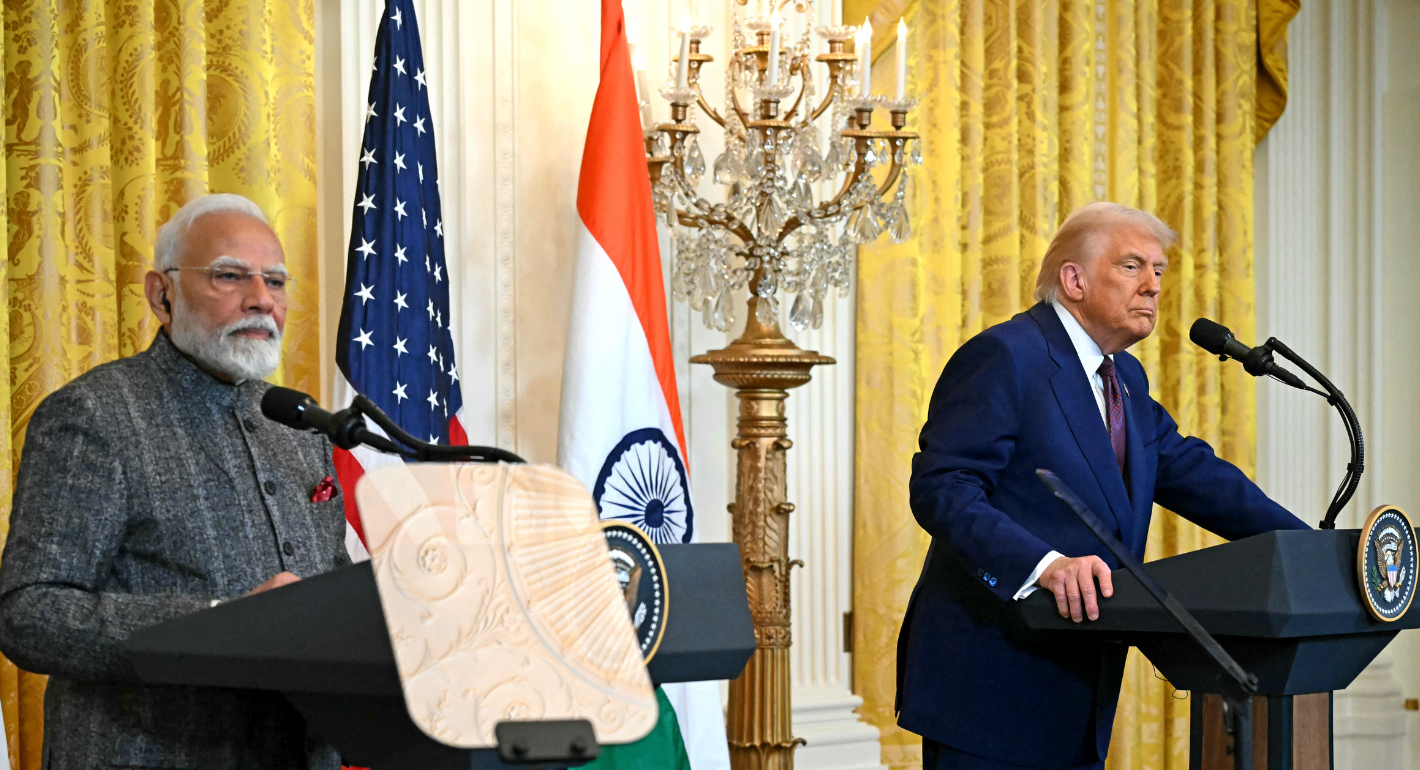
The India-U.S. relationship currently appears buffeted between three “Ts”—TRUST, Tariffs, and Trump.
Arun K. Singh