

In The Media
Minxin Pei
{
  "authors": [
    "Minxin Pei"
  ],
  "type": "legacyinthemedia",
  "centerAffiliationAll": "dc",
  "centers": [
    "Carnegie Endowment for International Peace",
    "Carnegie China"
  ],
  "collections": [],
  "englishNewsletterAll": "asia",
  "nonEnglishNewsletterAll": "",
  "primaryCenter": "Carnegie China",
  "programAffiliation": "AP",
  "programs": [
    "Asia"
  ],
  "projects": [],
  "regions": [
    "North America",
    "United States",
    "East Asia",
    "China",
    "Southeast Asia"
  ],
  "topics": [
    "Foreign Policy"
  ]
}
Source: Getty
China’s most effective response to Secretary Clinton’s unexpected declaration in Hanoi regarding the South China Sea disputes would be calm diplomacy rather than outrage.
Source: The Diplomat

Then, Beijing made public its displeasure over the large-scale joint naval exercise conducted by the 7th Fleet and the South Korean Navy in the Sea of Japan, saying it viewed such a display of military power as ‘destabilizing.’
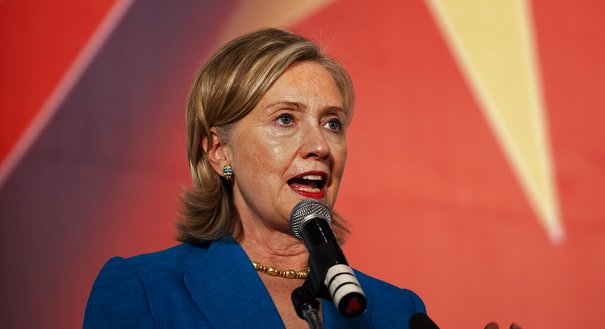
But it was US Secretary of State Hillary Clinton’s declaration on July 23 at the ASEAN Regional Forum (ARF) in Hanoi that ‘The United States supports a collaborative diplomatic process by all claimants for resolving the various territorial disputes without coercion,’ and announcement that the United States ‘oppose[s] the use or threat of force by any claimant,’ that sent China into a rage, with officials accusing the Americans of attempting to ‘internationalize’ the South China Sea disputes.
On the surface, Beijing seems to be fully justified in being upset about Clinton’s remarks. First, she clearly caught the Chinese by surprise. Apparently, no hint had been given to the Chinese that Clinton would make a momentous announcement at this year’s ARF, which is known chiefly as an uneventful talk-shop.
Second, the symbolism carried by the venue itself, Hanoi, must deeply trouble the Chinese. Vietnam is one of the principal claimants in the dispute and Clinton’s remarks, although taken alone sounding neutral, actually are closer to the Association of South-east Asian Nations’ positions than to China’s.
So in Beijing’s eyes, Washington has now taken sides. China believes that, despite the long-simmering territorial disputes in the South China Sea, that it has taken serious steps to address its neighbors’ concerns. In 2002, for example, China and ASEAN signed a historic Declaration on the Conduct of Parties in the South China Sea that pledges to seek a peaceful resolution to the territorial disputes. Meanwhile, some ASEAN officials expect that China will sign a code of conduct at the end of this year.
However, Beijing shouldn’t allow fury to muddle its judgment. To be sure, no US secretary of state has ever publicly declared a US position on the South China Sea disputes (making this perhaps the most significant aspect of the Clinton statement). But on the other hand, the substance of her remarks don’t depart from the long-standing US position on the South China Sea disputes. So in reality there’s been no policy change.
Indeed, although the Clinton statement seems to have come as a nasty shock, Chinese officials should really have been paying more attention to recent statements coming from Washington on the South China Sea dispute—in February this year, Deputy Assistant Secretary of Defense Robert Scher stated essentially the same positions in his testimony to the US-China Economic and Security Review Commission, a Congressional-chartered body.
And if Scher failed to get Beijing’s attention, the remarks by US Secretary of Defense Robert Gates on June 5 should have. Addressing the Shangri-la Dialogue in Singapore, Gates declared that ‘the South China Sea is an area of growing concern…Our policy is clear: it is essential that stability, freedom of navigation, and free and unhindered economic development be maintained. We don’t take sides on any competing sovereignty claims, but we do oppose the use of force and actions that hinder freedom of navigation. We object to any effort to intimidate US corporations or those of any nation engaged in legitimate economic activity. All parties must work together to resolve differences through peaceful, multilateral efforts consistent with customary international law.’
Curiously, Gates’ remarks, more pointed than Clinton’s, elicited no howls of protest from China.
So Chinese officials needn’t read too much into Clinton’s recent remarks on the South China Sea, and they certainly shouldn’t overreact and pick a fight with Washington over a non-issue like this.
The best response from China instead would be to turn on their charm as a counter-offensive against Washington’s (belated) diplomatic efforts to restore its influence and prestige in South-east Asia. For the past decade, China has achieved great success in leveraging its economic influence and plying its diplomatic skills to reassure South-east Asian countries and improve its image in the region.
In fact, to quell this little diplomatic storm—and shut the Americans up—all Beijing has to do is to sign the South China Sea of Code of Conduct with ASEAN.

Former Adjunct Senior Associate, Asia Program
Pei is Tom and Margot Pritzker ‘72 Professor of Government and the director of the Keck Center for International and Strategic Studies at Claremont McKenna College.
Recent Work
Minxin Pei
Minxin Pei
Carnegie India does not take institutional positions on public policy issues; the views represented herein are those of the author(s) and do not necessarily reflect the views of Carnegie, its staff, or its trustees.

How is AI reshaping space security, creating governance challenges, and where does international diplomacy stand today?


Tejas Bharadwaj, Almudena Azcárate Ortega

After the chill in ties between 2020 and 2024 that brought India–China relations to their lowest point in several decades, the two countries have engaged each other afresh. This paper argues that there are predominantly four imperatives guiding India’s approach to China, and they exist in an order of priority.

Saheb Singh Chadha

This piece argues that India’s central challenge is not managing a single flashpoint but resolving the underlying tension between expansion and institutional coherency of the BRICS grouping.

Vrinda Sahai

A partnership between India, a country of subcontinental size, and Africa, a continent of fifty-four countries, may seem asymmetric until one notes that both are home to nearly the same number of people—1.4 billion. This essay spells out the existing challenges to the partnership, its optimal potential, and the possible pathways to realize it over the next quarter-century.

Rajiv Bhatia

The U.S.–India semiconductor cooperation story is well-stocked with top-level strategic intent. What remains unresolved, however, are some underlying challenges that will determine whether the cooperation actually functions. Three such friction points stand out.

Shruti Mittal