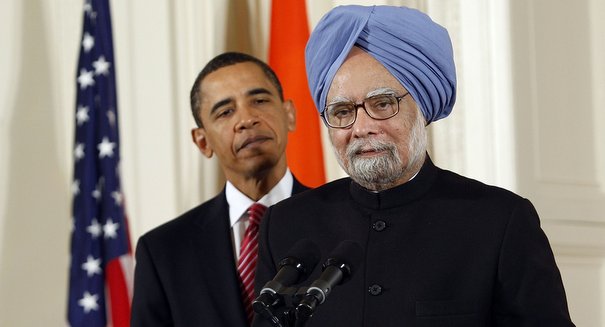
Both Washington and New Delhi seek a prosperous, powerful, and successful India, but the two countries must be realistic about addressing their numerous short-term differences.
U.S. & India: Dangers of Wishful ThinkingAs President Obama prepares to visit India, critics argue that he has not adequately favored the world's largest democracy. The problem, however, is that the India-first expectations created before Obama came into office were unrealistic and therefore unsustainable. The United States and India do not share the same interests on key issues and their politicians will irritate each other when they let electoral pressures impede compromise. Building a lasting, productive relationship will thus require both countries to better balance their parochial priorities with the need to meet bigger global challenges.
The United States wants India to team with it and lend credibility to democracy promotion around the world. But Indian leaders reject democracy-proselytization as missionary and insensitive to state sovereignty. India's own ongoing domestic struggles to protect minority rights and correct injustices in Kashmir and elsewhere make it vulnerable to political counter-attacks if it were to join with Washington in, say, critiquing Iranian repression. The United States cannot count on India's admirable democracy to make it more receptive to American policy objectives.
The U.S.-India nuclear deal begun in 2005 was supposed to "transform" the bilateral relationship, but it has failed to do so. The Bush administration spent political capital to persuade Congress, the 45-nation Nuclear Suppliers Group, and the International Atomic Energy Agency to exempt India from longstanding nonproliferation rules. Five years later, U.S. nuclear companies still cannot sell reactors in India, due to inadequate liability protections. New Delhi doesn't come close to Washington's positions on sanctioning Iran or banning nuclear weapons testing.
Meanwhile, non-nuclear-weapon states around the world-including Brazil, China, Pakistan, Egypt, South Korea, Turkey, and South Africa-continue to cite the bending of rules for India as justification for resisting efforts to strengthen inspections by the International Atomic Energy Agency, control the spread of uranium enrichment and plutonium reprocessing, and sanction Iran. This exemplifies the real cost of privileging India in policy domains that go to the core of global governance.
Climate change is perhaps the most globally important environmental threat to economic development and security. India has joined China in demanding that the United States change its own policies before demanding major changes in the carbon-emitting activities and monitoring policies of others. Critics of the Obama administration deride its efforts to push India on climate change as "henpecking," but here again the global good requires changes in both U.S. and Indian policies.
Regarding South Asia, the United States and India share an interest in devising a mixture of inducements and pressures to persuade Pakistan's government and military to cooperate in rooting out sources of violent extremism. This requires a profound change in Pakistani psychology, and a genuine shift to civilian rule. Long-term, firm U.S. cooperation with Pakistan will be necessary. It's neither wise nor realistic for India to criticize U.S. leaders for words and deeds that do not always and exclusively favor India over Pakistan.
In Afghanistan, the United States is caught in the middle between Pakistan and India. Pakistan is willing to fight to the last Taliban or coalition soldier in order to pursue its interests in Afghanistan, while India is willing to fight to the last American to keep Pakistan from exerting indirect control over a future Afghan government. Washington will ultimately need to collude in negotiations with the Taliban in ways that neither Pakistan nor India will welcome.
Critics of the administration argue that the highest priority of U.S. policy should be to band together to militarily balance China's rising power. Clearly, American and Indian interests are both served by channeling China away from bellicosity, yet China and India have more convergent interests than the critics realize. In the areas of global trade and climate change China and India share similar positions, and China is now India's largest trading partner. There is little reason to believe that Chinese leaders would jettison the non-combative strategy that has enabled China to gain power through economic growth and diplomacy, and instead commit aggression against India.
Rather than trumpeting military competition with China, the United States and India will be more effective if they concentrate on strengthening economic development and democratic governance in countries around China and enhancing the soft power of the states that wish to balance China. Security is understructured in Asia-from Afghanistan through Central and South Asia to Northeast Asia. Before resorting to militarized rhetoric and mobilization against China, the United States and India should exhaust diplomatic possibilities to clarify intentions and structure the growth and deployment of military capabilities.
The United States wants India to become prosperous and powerful. But Washington can only contribute marginally to India's rise. India's domestic policies and actions will be the decisive factors. The United States will have much more influence on vital global issues such as international finance and trade, security cooperation in Asia, nuclear proliferation, and climate change. President Obama is therefore wise to balance Indian interests with other U.S. and global priorities. This may not win applause in the short run, but it is necessary to build international confidence that the biggest challenges of the 21st century must be met through cooperation.
Japan Chair for a World Without Nuclear Weapons, Senior Fellow
George Perkovich is the Japan Chair for a World Without Nuclear Weapons and a senior fellow in the Carnegie Endowment for International Peace’s Nuclear Policy Program. He works primarily on nuclear deterrence, nonproliferation, and disarmament issues.
Peter Austin
Former Junior Fellow, South Asia Program, US Role in the World Program
Carnegie India does not take institutional positions on public policy issues; the views represented herein are those of the author(s) and do not necessarily reflect the views of Carnegie, its staff, or its trustees.
In any defense establishment, change is an ongoing process. However, despite the best of intentions, existing bureaucracies, bound by habit and years of socialization, have their limits in implementing transformative change.
As AI grows more sophisticated, as the supply chains that power it become more contested, and as access to frontier models becomes geopolitically charged, India must begin to ask a different set of questions. Not what applications it can build on someone else’s infrastructure but what the world needs.
The Indian Ocean Region hosts one of the densest concentrations of subsea cables in the world. Yet, despite accounting for a significant share of global internet traffic, India’s participation remains limited.
After the chill in ties between 2020 and 2024 that brought India–China relations to their lowest point in several decades, the two countries have engaged each other afresh. This paper argues that there are predominantly four imperatives guiding India’s approach to China, and they exist in an order of priority.