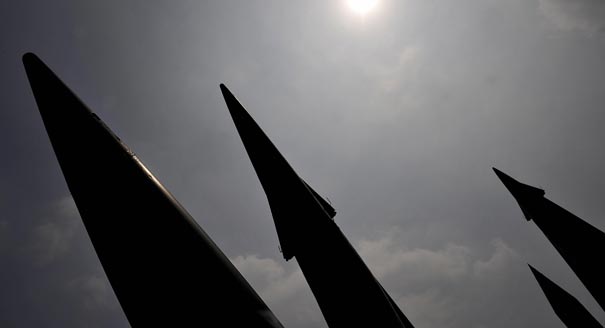
Achieving a genuinely collaborative approach to missile defense would address a common threat to the Euro-Atlantic region and help remove the misgivings that are blocking progress toward a common security space.
Link Copied
By Sam Nunn, Igor Ivanov, Wolfgang Ischinger
Published on Dec 14, 2010
Source: Project Syndicate
A Post-Nuclear Euro-Atlantic Security OrderAs we enter 2011, the Euro-Atlantic region is a study in strategic contrasts. Over the past 20 years, no geo-political space has undergone as dramatic a transformation as that between the Atlantic and the Urals. In our lifetimes, we have seen a welcome change from the darkest days of the Cold War, when a devastating conventional and nuclear war in Europe was a real possibility, to a new era in which no state faces this type of existential threat.
But, despite these positive developments, the two largest powers in the region – the United States and Russia – each still possesses thousands of nuclear weapons, accounting for more than 90% of the world’s nuclear inventory. Many of these weapons remain deployed or designed for use within the Euro-Atlantic region.
Reduction and elimination of this Cold War-era nuclear infrastructure is the largest piece of unfinished business from that bygone time. The continuing existence of large strategic nuclear forces deployed on high alert, and of tactical nuclear weapons deployed in certain NATO states and Russia, creates a risk of accidental, unauthorized, or mistaken use, and of terrorist groups acquiring these assets. So security vigilance is essential.
To meet this challenge, the three of us – building on the action plan adopted by consensus at the 2010 Non-Proliferation Treaty (NPT) Review Conference – have endorsed a series of urgent, practical steps towards the long-term goal of a world free of nuclear weapons. These include:
increasing assured warning and decision times for the launch of nuclear-armed ballistic missiles;
developing cooperative missile-defense and early-warning systems;
ensuring the highest possible standards of security for nuclear weapons and materials;
beginning a dialogue on tactical nuclear weapons involving Russia, the US, and NATO;
adopting a process to bring the Comprehensive Test Ban Treaty into effect;
developing international and multilateral approaches to manage the risks of fuel production for civilian nuclear power; and
further reductions in US and Russian nuclear forces.
As former US Secretary of State George P. Shultz, former US Secretary of Defense William J. Perry, former US Secretary of State Henry A. Kissinger, and former US Senator Sam Nunn put it in 2007, “Without the bold vision [of a nuclear weapons-free world], the actions will not be perceived as fair or urgent. Without the actions, the vision will not be perceived as realistic or possible.”
Perhaps the most crucial step toward realizing this vision is to redouble our efforts to resolve regional confrontations and conflicts that give rise to new nuclear powers. The great swath of states stretching from North America across Europe through Russia has a vital role to play in stabilizing an increasingly fragmented and stressed international order.
These states can play this role, however, only if first they transform this geographic space into a genuinely inclusive and vibrant security community. Failing that (and we are failing today) the Euro-Atlantic states and their organizations will settle for suboptimal – and too often utterly inadequate – responses to the twenty-first century’s security challenges, including the threat of nuclear proliferation.
Lately, several national leaders, including the Russian and US presidents and NATO secretary-general, have embraced the idea of a Euro-Atlantic security community, and begun stressing the importance of fashioning a stronger and more inclusive European security order.
The timing could not be better, as the Euro-Atlantic family has entered a critical period. On November 19-20, NATO heads of states approved a new “strategic concept” to guide the organization for the next decade At the same time Russian President D. Medvedev and his NATO counterparts issued a joint statement, endorsing the first Joint Review of 21st Century Common Security Challenges and deciding to resume Threat Missile Defence Cooperation. Two weeks later, the Organization for Security and Cooperation in Europe (OSCE) heads of state assembled in Astana, Kazakhstan, to help shape the OSCE’s next stage of development.
Joint action on nuclear-threat reduction must be a critical element in moving the Euro-Atlantic nations toward a level of stability and strength and allow them to exercise badly needed global leadership. Achieving a genuinely collaborative approach to missile-defense matters will address a common threat and help remove misgivings that are blocking progress toward a common security space.
Similarly, the Euro-Atlantic states can mobilize behind efforts to strengthen the International Atomic Energy Agency’s safeguards system, which ensures the non-diversion of peaceful nuclear programs, in order to foster cooperation on countering the threat of nuclear terrorism, and to develop new mechanisms to protect jointly critical infrastructure from cyber attack. Such actions are crucial to these states’ national security and global efforts to mitigate threats.
Pursuing arrangements that increase warning and decision-making time for all countries in the Euro-Atlantic region would introduce stability into the NATO-Russia relationship. Adjustments in operational doctrine, as applied to strategic, tactical, and conventional forces, would constitute a giant step toward ending the relationship’s militarized framework.
This is only a partial list of what must be done if governments are serious about building a stronger, inclusive European security order, one where the roles and risks of nuclear weapons are reduced, and ultimately eliminated. The three of us are working with a distinguished group from all corners of the Euro-Atlantic region to develop these and other concrete steps that are essential to creating a genuine security community, including its economic, energy, and environmental dimensions. NATO, OSCE, and other key regional institutions must give this concept and process their essential support.
About the Authors
Sam Nunn
Igor Ivanov
Igor Ivanov is president of the Russian International Affairs Council and a former foreign minister (1998–2004).
Wolfgang Ischinger
Munich Conference on Security Policy
Wolfgang Ischinger is the chairman of the Munich Security Conference. He was the German ambassador to the United States from 2001 to 2006 after serving as German deputy foreign minister for three years.
Carnegie India does not take institutional positions on public policy issues; the views represented herein are those of the author(s) and do not necessarily reflect the views of Carnegie, its staff, or its trustees.
In any defense establishment, change is an ongoing process. However, despite the best of intentions, existing bureaucracies, bound by habit and years of socialization, have their limits in implementing transformative change.
After the chill in ties between 2020 and 2024 that brought India–China relations to their lowest point in several decades, the two countries have engaged each other afresh. This paper argues that there are predominantly four imperatives guiding India’s approach to China, and they exist in an order of priority.
This piece argues that India’s central challenge is not managing a single flashpoint but resolving the underlying tension between expansion and institutional coherency of the BRICS grouping.
The ASML MoU with Tata Electronics is an indicator of how far the Indian semiconductor ecosystem has come. This ecosystem has been years in the making and represents real commercial logic.