

Article
Thomas Carothers
{
  "authors": [
    "Thomas Carothers"
  ],
  "type": "questionAnswer",
  "centerAffiliationAll": "dc",
  "centers": [
    "Carnegie Endowment for International Peace",
    "Malcolm H. Kerr Carnegie Middle East Center",
    "Carnegie Russia Eurasia Center"
  ],
  "collections": [
    "Arab Awakening",
    "Democracy and Governance"
  ],
  "englishNewsletterAll": "democracy",
  "nonEnglishNewsletterAll": "",
  "primaryCenter": "Carnegie Endowment for International Peace",
  "programAffiliation": "DCG",
  "programs": [
    "Democracy, Conflict, and Governance",
    "Middle East"
  ],
  "projects": [
    "Eurasia in Transition"
  ],
  "regions": [
    "North America",
    "United States",
    "North Africa",
    "Libya",
    "Western Europe",
    "Maghreb"
  ],
  "topics": [
    "Political Reform",
    "Security",
    "Democracy",
    "Foreign Policy"
  ]
}
Source: Getty
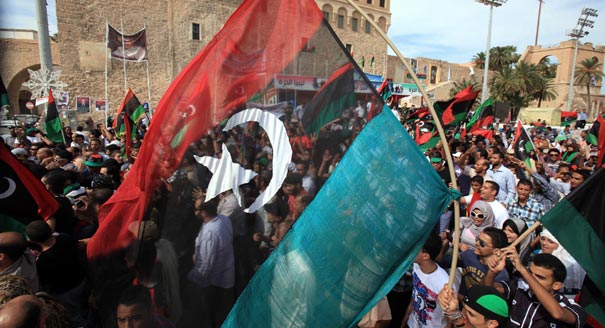
As Libya's new leaders look to consolidate control, domestic and international attention is turning to the process of building a government that is more democratic, representative, and stable.
Although Muammar Qaddafi remains at large, the war in Libya appears to be coming to a close. As new leaders look to consolidate control, attention is turning to building a government that is more democratic, representative, and stable. In a new video Q&A, Thomas Carothers analyzes what it will take for Libya to transition smoothly in the post-Qaddafi era and the role international actors will play in the development of the political system.
Here in Washington, and probably more generally in U.S. society, there’s an almost minor neuralgia about the fear that the United States is going to be embroiled in yet another major state building endeavor after the experiences of Afghanistan and Iraq. But I don’t think this is going to be similar.
The United States was not involved in such an extensive way with the overthrow of the old government. There is a force of people on the ground who are going to take primary responsibility for state building. The United States will play some role, but it will be very much a background role. The Unites States will give some assistance, some advice, some diplomatic support, but nothing like what we’ve seen in Iraq and Afghanistan.
One of the fundamental lessons is that you really need to focus full attention on a couple of things early on and then also in a sustained way. One is finding a way to foster the inclusion of old actors to the extent possible. You get rid of the regime, but you want to make sure the security forces are not marginalized and then become rebels working against the new government.
So finding the sweet spot between persecuting and prosecuting those who have committed the wrongs in the past versus giving room in the new order for those who would like to take part in a constructive way is crucial. That didn’t happen in Iraq and has led to tremendous problems.
Secondly, this needs to be, in a sense, an ongoing negotiation process; obviously some kind of caretaker government will need to rule, but there will need to be an ongoing negotiation process of building some consensus around a new political settlement. If you don’t get such a consensus forged within the first year or two, then you don’t really have the basis for creating the state.
Elections come much later, only once you have a consensus and rules of the game. So there should be no rush to elections in Libya—elections need to be down the road after you’ve had a caretaker government come into place, a process of negotiation, and building that political settlement. This then provides you the blueprint or framework for having elections, the multiplication of political actors, and so forth.
So we have learned some important lessons and I think it will be possible for the international community to encourage the main actors on the ground in Libya to at least pay attention to them.
There have been a number of countries with very weak institutions that have come out of civil war and built states, fragile though they are. Look at Liberia today. You have a talented, serious president who is doing good for the country in Ellen Johnson Sirleaf, and she comes out of a legacy of tremendous institutional destruction and weakness in Liberia.
So it’s true that Qaddafi’s rule was quixotic and unusually free of institutions, but a number of other countries have faced the problem of devastated institutions and managed to come back. So Libya’s got big, big challenges, but they’re not unique.
There is a fair amount of international capacity that can be drawn upon, not just the European Union but a number of European states also have capacity. The British government through its aid agency and other parts of the government has real capacity to offer—so does the German government, so does the French government, so does the Italian government, and so do the EU structures.
Then you have the different parts of the United Nations, whether it’s the electoral assistance unit, the United Nations Development Programme, or other parts that have capacity to offer here.
The United States also has important capacities and probably will be called on, but it’s not alone here. There has grown up over the last twenty years quite a bit of experience, resources, and a learning curve about building states out of fragmented, chaotic, post-civil war situations.

Harvey V. Fineberg Chair for Democracy Studies; Senior Fellow, Democracy, Conflict, and Governance Program
Thomas Carothers, a senior fellow in the Carnegie Endowment for International Peace’s Democracy, Conflict, and Governance Program, is a leading expert on comparative democratization and international support for democracy.
Recent Work
Thomas Carothers
Thomas Carothers
Carnegie India does not take institutional positions on public policy issues; the views represented herein are those of the author(s) and do not necessarily reflect the views of Carnegie, its staff, or its trustees.

In any defense establishment, change is an ongoing process. However, despite the best of intentions, existing bureaucracies, bound by habit and years of socialization, have their limits in implementing transformative change.

Anit Mukherjee

How is AI reshaping space security, creating governance challenges, and where does international diplomacy stand today?


Tejas Bharadwaj, Almudena Azcárate Ortega

After the chill in ties between 2020 and 2024 that brought India–China relations to their lowest point in several decades, the two countries have engaged each other afresh. This paper argues that there are predominantly four imperatives guiding India’s approach to China, and they exist in an order of priority.

Saheb Singh Chadha

This piece argues that India’s central challenge is not managing a single flashpoint but resolving the underlying tension between expansion and institutional coherency of the BRICS grouping.

Vrinda Sahai

A partnership between India, a country of subcontinental size, and Africa, a continent of fifty-four countries, may seem asymmetric until one notes that both are home to nearly the same number of people—1.4 billion. This essay spells out the existing challenges to the partnership, its optimal potential, and the possible pathways to realize it over the next quarter-century.

Rajiv Bhatia