

Paper
Christopher S. Chivvis, Rohan Mukherjee, Milan Vaishnav
{
  "authors": [
    "Milan Vaishnav"
  ],
  "type": "legacyinthemedia",
  "centerAffiliationAll": "dc",
  "centers": [
    "Carnegie Endowment for International Peace"
  ],
  "collections": [],
  "englishNewsletterAll": "ctw",
  "nonEnglishNewsletterAll": "",
  "primaryCenter": "Carnegie Endowment for International Peace",
  "programAffiliation": "SAP",
  "programs": [
    "South Asia"
  ],
  "projects": [],
  "regions": [
    "South Asia",
    "India"
  ],
  "topics": [
    "Climate Change"
  ]
}
Source: Getty
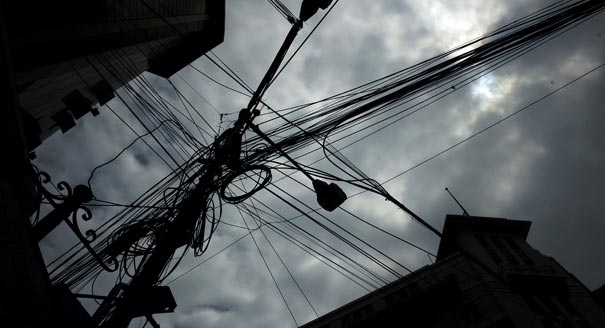
The willingness of India's politicians to trade cheap electricity for votes explains why the governance of India’s power sector, and electricity in particular, is in such dire straits.
Source: CNN

India’s rail system, one of the largest in the world, ground to a halt. Mine workers were trapped underground when the outages struck. Government offices across northern and eastern India were shuttered. And the fallout from the blackout could have been even worse except for the fact that millions of Indians, long frustrated by the country’s endemic power cuts, have invested in their own diesel-operated generators to keep the lights on when the grid fails.
While it’s easy to dwell on the crisis at hand, Indians across the country face an endemic power crisis on a daily basis: one third of India’s 1.2 billion lack access to electricity even at the best of times. This prompted the satirical newspaper, The Onion, to run with the headline: “300 Million without Electricity in India after Restoration of Power Grid.”Yet as the blame game between the center, the states, and India’s citizens plays out over the proximate cause of the crisis, we shouldn’t lose sight of the big picture. There are deep roots to the current crisis – and there can be little doubt that India’s politics deserve a share of the blame.
The formula is simple. Indian voters, 70 percent of whom live in rural areas and half of whom are engaged in agrarian pursuits, have a healthy (and growing) appetite for energy. Politicians, in turn, have an enduring appetite for winning elections. For decades, politicians have been all too happy to provide free or heavily subsidized electricity to farmers with the hope of reaping the rewards at the ballot box. This also happens in urban areas where local politicians have showered vote banks with free electricity in exchange for political support.
Once we acknowledge this underlying reality of India’s power dilemma—cheap electricity for votes—it becomes easy to understand why the governance of India’s power sector, and electricity in particular, is in such dire straits.
Subsidized (or free) electricity means consumer prices are below market rates, and firms involved in the distribution of energy are forced to operate at a loss, disincentivizing private investment. On the production side, India remains heavily reliant on coal for fueling its power supply and the state-owned enterprise, Coal India, dominates the marketplace. With a virtual monopoly on coal supply, and faced with high prices for imported coal, private firms are reluctant to engage on the production side. Coal India itself is required to sell coal at a heavily discounted price, so it too has very little liquidity to invest in new capacity or technology.
Politics, however, plays out in even more perverse ways than this. Take, for instance, the fact that India regularly loses around 30 percent of the power it produces due to “line loss”—the technical term for waste, fraud, and abuse. While line loss is in part due to systemic inefficiencies, poor infrastructure, and illegal power connections, many believe that politicians engage in “politically-motivated theft.” A recent study by researchers at the University of California, Los Angeles and University of Michigan shows that line losses operate on an electoral cycle in Uttar Pradesh, the country’s most populous state, with more than 200 million residents. Put simply, politicians condone more electricity theft around elections.
Politics also plays a role in allowing states to draw more electricity than they are entitled to. In an era of coalition government, the center is powerless to discipline states that violate “grid discipline”—punishing wayward state politicians whose support you rely on is a surefire way of sending them into the arms of your rivals.
While problems with India’s electricity infrastructure are clearly not new, the timing of the “Great Power Outage of 2012” couldn’t be worse. The Indian economy is reeling from a marked slowdown in the pace of economic growth, falling from an average of over 8 percent between 2004 and 2011 to 5.3 percent in the first quarter of 2012. While most advanced industrial countries can only dream of 5 percent growth, India needs faster rates to keep up with population growth and to continue lifting citizens out of poverty. Fading economic growth coupled with a declining rupee, stubborn inflation, and widening deficits, prompted Standard & Poor to warn in June that India could soon lose its investment grade rating.
India’s economic malaise has led to a growing crisis of confidence in the government. Prime Minister Manmohan Singh had promised weeks before the blackouts to redouble his government’s efforts to kick start the economy, unleashing its “animal spirits.” The current power crisis threatens to further undermine his government’s credibility. To add insult to injury, the power minister Sushilkumar Shinde was promoted amid the current crisis to the position of home minister (although it should be noted that this move was reportedly already in the works). Nevertheless, it has many Indians fuming at a government promising to press the reset button on its economic agenda.
India’s endemic power crisis is, of course, directly linked to the current economic situation. Private investors, both domestic and foreign, have repeatedly voiced their concerns about the state of India’s infrastructure, with many singling out India’s power sector as a leading factor inhibiting new investment.
Looking ahead, the agenda for reforming India’s power sector reads like a laundry list: upgrade outmoded infrastructure, privatize coal production, and reduce distributional inefficiencies. But all of these fixes won’t be truly effective unless politicians take steps to undo the bargain of cheap electricity in exchange for political support.
It’s easy to be pessimistic about the prospects for changing this fundamental dynamic, but there are at least two reasons for hope. First, the political payoffs of the current quid pro quo aren’t immediately obvious. Unlike the United States, India’s elected politicians are actually faced with an incumbency disadvantage—that is, elected representatives are just as likely to lose elections as they are to get re-elected. If politicians perceive the provision of free power to voters as yielding massive political pay-offs, it certainly hasn’t worked out that way in practice. Second, India’s federal system provides ample opportunity for states to engage in their own methods of experimentation if the central government is unwilling or unable to act. The western state of Gujarat, for instance, has recently experimented with providing rural farmers with the option of paying for electricity in exchange for guaranteeing quality connections without service interruptions.
It’s too soon to know whether this and similar experiments will ultimately prove successful, but they offer a potential path for politicians in India looking to break with the shackles of the past.

Director and Senior Fellow, South Asia Program
Milan Vaishnav is a senior fellow and director of the South Asia Program and the host of the Grand Tamasha podcast at the Carnegie Endowment for International Peace. His primary research focus is the political economy of India, and he examines issues such as corruption and governance, state capacity, federalism, and electoral behavior. He also conducts research on the Indian diaspora.
Recent Work


Christopher S. Chivvis, Rohan Mukherjee, Milan Vaishnav



Sophia Besch, Eric Ciaramella, Steve Feldstein, …
Carnegie India does not take institutional positions on public policy issues; the views represented herein are those of the author(s) and do not necessarily reflect the views of Carnegie, its staff, or its trustees.

In any defense establishment, change is an ongoing process. However, despite the best of intentions, existing bureaucracies, bound by habit and years of socialization, have their limits in implementing transformative change.

Anit Mukherjee

As AI grows more sophisticated, as the supply chains that power it become more contested, and as access to frontier models becomes geopolitically charged, India must begin to ask a different set of questions. Not what applications it can build on someone else’s infrastructure but what the world needs.

Konark Bhandari

The Indian Ocean Region hosts one of the densest concentrations of subsea cables in the world. Yet, despite accounting for a significant share of global internet traffic, India’s participation remains limited.

Charukeshi Bhatt

How is AI reshaping space security, creating governance challenges, and where does international diplomacy stand today?


Tejas Bharadwaj, Almudena Azcárate Ortega

After the chill in ties between 2020 and 2024 that brought India–China relations to their lowest point in several decades, the two countries have engaged each other afresh. This paper argues that there are predominantly four imperatives guiding India’s approach to China, and they exist in an order of priority.

Saheb Singh Chadha