

Article
Frederic Wehrey, Charles H. Johnson
{
  "authors": [
    "Frederic Wehrey"
  ],
  "type": "legacyinthemedia",
  "centerAffiliationAll": "dc",
  "centers": [
    "Carnegie Endowment for International Peace"
  ],
  "collections": [
    "Arab Awakening"
  ],
  "englishNewsletterAll": "menaTransitions",
  "nonEnglishNewsletterAll": "",
  "primaryCenter": "Carnegie Endowment for International Peace",
  "programAffiliation": "MEP",
  "programs": [
    "Middle East"
  ],
  "projects": [],
  "regions": [
    "North Africa",
    "Libya"
  ],
  "topics": [
    "Political Reform",
    "Security"
  ]
}
Source: Getty
The ultimate solution to the security challenges in Libya resides in improved governance and the construction of a cohesive national army.
Source: CNN International
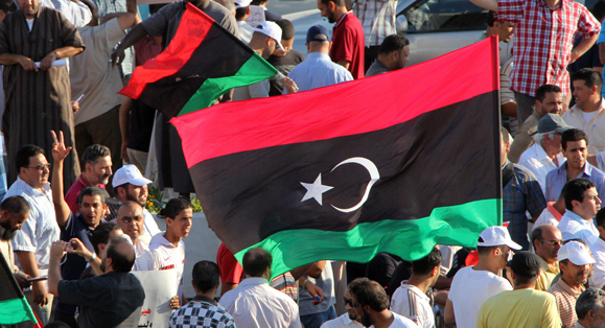
In the wake of the attack on the U.S. consulate and the killing of four American citizens, including Ambassador Chris Stevens, the Libyan government has ordered all militias within the country to disband. Appearing on CNN International, Frederic Wehrey noted that this decision is “a positive signal, but will be a very long process.” In a sort of devil’s bargain, the Libyan government has subsidized these militias in the absence of a cohesive police force or army. “It is difficult to imagine these militias simply disarming or demobilizing and they should not be incorporated into the army and allowed to maintain their cohesion and identity,” asserted Wehrey. Indeed, the most effective mechanisms for ensuring these militias disband is to incentivize the young men that went to war against Qaddafi to go to school, receive vocational training or join the army as individuals. With the dust hardly settled and little answers, any linkages between the Salafi militias suspected in taking part in the attacks and al-Qaeda remain tenuous. Ultimately, Wehrey said, “This is a Libyan problem that needs to be addressed through government reform and the building of an army. The solution is better governance.”

Senior Fellow, Middle East Program
Frederic Wehrey is a senior fellow in the Middle East Program at the Carnegie Endowment for International Peace, where his research focuses on governance, conflict, and security in Libya, North Africa, and the Persian Gulf.
Recent Work
Frederic Wehrey, Charles H. Johnson
Frederic Wehrey, Charles H. Johnson
Carnegie India does not take institutional positions on public policy issues; the views represented herein are those of the author(s) and do not necessarily reflect the views of Carnegie, its staff, or its trustees.

A partnership between India, a country of subcontinental size, and Africa, a continent of fifty-four countries, may seem asymmetric until one notes that both are home to nearly the same number of people—1.4 billion. This essay spells out the existing challenges to the partnership, its optimal potential, and the possible pathways to realize it over the next quarter-century.

Rajiv Bhatia

This piece argues that the present Indian strategy, based on opportunistic diversification and utilization of limited strategic reserves, remains inadequate when confronting supply disruptions. It evaluates India’s options in the short, medium, and long terms.

Vrinda Sahai

This piece examines India’s response to U.S. sanctions and tariffs, specifically assessing the immediate market consequences, such as alterations in import costs, and the broader strategic implications for India’s energy security and foreign policy orientation.
Vrinda Sahai

The India-Pakistan conflict that played out between May 6 and May 10, 2025, offers several military lessons. This article presents key takeaways from Operation Sindoor and breaks down how India’s preparations shaped the outcome and what more is needed to strengthen future readiness.

Dinakar Peri
This book offers a comprehensive analysis of India's evolving relationship with sovereignty in a complex global order. Moving beyond conventional narratives, it examines how the sovereignty principle shapes India's behavior across four critical domains—from traditional military power to contemporary data governance.

Rudra Chaudhuri, Nabarun Roy