

Research
- +10
Rosa Balfour, Frances Z. Brown, Yasmine Farouk, …
{
  "authors": [
    "Moisés Naím"
  ],
  "type": "legacyinthemedia",
  "centerAffiliationAll": "",
  "centers": [
    "Carnegie Endowment for International Peace"
  ],
  "collections": [],
  "englishNewsletterAll": "",
  "nonEnglishNewsletterAll": "",
  "primaryCenter": "Carnegie Endowment for International Peace",
  "programAffiliation": "",
  "programs": [],
  "projects": [],
  "regions": [
    "North America",
    "United States",
    "South America"
  ],
  "topics": [
    "Political Reform",
    "Climate Change"
  ]
}
Source: Getty
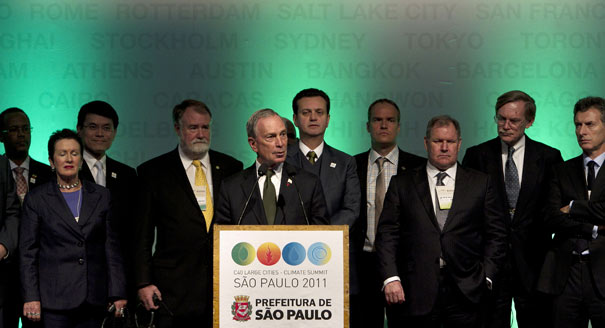
The ascent of regional and local leaders can be seen not only in the environmental initiatives of the C40 in Brazil, but in many other fields.
Source: El País

This last lesson is just one more manifestation of a global trend that transcends catastrophes. There is a flight of power from the national government toward state and local authorities. Presidentialism is giving way to local leadership. The decentralization of authority, and of budgets and decisions that most directly affect people, is a trend that can be seen from China to Colombia, India to Italy, and Indonesia to Spain. Everywhere, the heads of regions and provinces, governors and mayors, are enjoying growing autonomy, which allows them to be the leading voices in ever more diverse matters.
Luis Alberto Moreno, the president of the Inter-American Development Bank (IDB), gave me an illustrative example of this trend. In June, Moreno, representing his institution, participated in the third international summit on the environment. This meeting, attended by representatives from 192 countries, including 88 heads of state, was called Rio+20 in reference to the fact that it is 20 years since the first world conference, held in Rio, took place, to address the urgent need to deal with the effects of environmental damage. As is common in these multilateral meetings, the agreements reached at Rio+20 reflected some progress, but were also the source of great frustration. Nobody was happy because, to reach consensus between so many countries, it is necessary to water down the agreements in order to make them acceptable to all: rich countries, those of middle income and the poorest; exporters of hydrocarbons, and importers; the industrialized and the agricultural; those with stagnant economies and those with booming ones; those whose centuries of industrialization have already polluted the planet, and those who are just beginning to industrialize and pollute. To approve agreements built around the lowest common denominator is, then, the norm at these international summits. And these agreements are woefully insufficient, given the need for intervention in what is already a global emergency.
But what do decentralization and the flight of power have to do with all this? The answer is C40. Some days before the great summit of heads of state in Rio de Janeiro, a group called C40 met in São Paulo. It was made up of the mayors of 40 big cities who have decided to act effectively, immediately and together to reduce carbon dioxide emissions. The steering committee of C40, is now presided by the mayor of New York, and made up of his colleagues the mayors of Berlin, Hong Kong, Jakarta, Johannesburg, Los Angeles, London, São Paulo, Seoul and Tokyo. Cities have a determining weight in the pollution that causes climate change, and thus, a crucial role in mitigating its consequences. For the first time in history, more than half the planet’s population lives in cities, which consume 75 percent of the energy and produce 80 percent of the greenhouse-effect gases that contribute to global warming.
“I was impressed by the contrast between the action of the C40 mayors, based on practical initiatives, concrete and ambitious goals, and the vague intentions which are typically agreed upon in large gatherings of heads of state,” Moreno, the IDB president, told me.
This ascent of regional and local leaders can be seen not only in their environmental initiatives, but in many other fields. And while there is much to celebrate in this trend, there is also much to fear. In Europe for example the newfound power of local and regional leaders can easily nurture separatist ambitions driven more by political opportunism than by efforts to find solutions to people's concrete problems.

Distinguished Fellow
Moisés Naím is a distinguished fellow at the Carnegie Endowment for International Peace, a best-selling author, and an internationally syndicated columnist.
Recent Work



Rosa Balfour, Frances Z. Brown, Yasmine Farouk, …
Moisés Naím
Carnegie India does not take institutional positions on public policy issues; the views represented herein are those of the author(s) and do not necessarily reflect the views of Carnegie, its staff, or its trustees.

How is AI reshaping space security, creating governance challenges, and where does international diplomacy stand today?


Tejas Bharadwaj, Almudena Azcárate Ortega

The U.S.–India semiconductor cooperation story is well-stocked with top-level strategic intent. What remains unresolved, however, are some underlying challenges that will determine whether the cooperation actually functions. Three such friction points stand out.

Shruti Mittal

India and the United States are close to concluding a Reciprocal Defense Procurement Agreement (RDPA) that will allow firms from the two countries to sell to each other’s defense establishments more easily. While this may not remedy the specific grievances both sides may have regarding larger bilateral issues, an RDPA could restore some momentum, following the trade deal announcement.

Konark Bhandari

On the last day of the India AI Impact Summit, India signed Pax Silica, a U.S.-led declaration seemingly focused on semiconductors. While India’s accession to the same was not entirely unforeseen, becoming a signatory nation this quickly was not on the cards either.
Konark Bhandari

This piece examines India’s response to U.S. sanctions and tariffs, specifically assessing the immediate market consequences, such as alterations in import costs, and the broader strategic implications for India’s energy security and foreign policy orientation.

Vrinda Sahai