

Article
Frederic Wehrey, Charles H. Johnson
{
  "authors": [
    "Frederic Wehrey"
  ],
  "type": "legacyinthemedia",
  "centerAffiliationAll": "dc",
  "centers": [
    "Carnegie Endowment for International Peace",
    "Malcolm H. Kerr Carnegie Middle East Center"
  ],
  "collections": [
    "Arab Awakening"
  ],
  "englishNewsletterAll": "menaTransitions",
  "nonEnglishNewsletterAll": "",
  "primaryCenter": "Carnegie Endowment for International Peace",
  "programAffiliation": "MEP",
  "programs": [
    "Middle East"
  ],
  "projects": [],
  "regions": [
    "North Africa",
    "Libya",
    "Maghreb"
  ],
  "topics": [
    "Political Reform",
    "Security",
    "Democracy"
  ]
}
Source: Getty
The establishment of lasting security in Libya will hinge on an effective and inclusive constitution process that clearly delineates local and central powers.
Source: National Interest

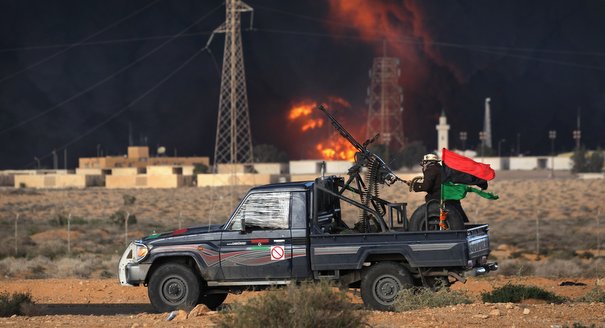
Since the attack the situation has become more unstable. Local militias known as revolutionary brigades and affiliated with towns, tribes or Islamist factions still rule the streets. The national army and police are hollow shells—ill-equipped, understaffed, and tainted by their association with the former regime. Assassinations remain routine and groups from rival towns continue to wage violent vendettas against one another. The country's newly elected parliament was unable to hold a recent session because armed militiamen blocked them from doing so.
Even worse, the organizations that the transitional government set up to provide security are part of the problem. The Supreme Security Committees and the Libya Shield Forces—coalitions of militias nominally under government supervision—have become a law unto themselves. Some have hardline Islamist leanings and others are involved in criminal activity. Most recently, these units started fighting between themselves—as clear an indication as any that the country is teetering on the brink.For close observers of Libya, the country's descent over the past year was like watching a slow-motion train wreck. Handwringing over how this happened is pointless; it is now time for U.S. action to build up the country's security and defense institutions. Much of this must been done behind the scenes, with no boots on the ground and the recognition that Libyans themselves must carry most of the burden.
First, the United States must help resuscitate an existing program to disarm, demobilize and reintegrate members of the revolutionary brigades. Developed under the transitional government, the program was a step in the right direction, but it fell victim to ministerial infighting. With a newly elected and more legitimate government, that can change. The goal of the program is to wean young men away from the grip of militias by offering job training, scholarships, or entry into the regular police and army. "We have to show them that their future is not with the militias, that they honor the Revolution by putting down their guns," one Libyan official told me.
There are also purportedly plans under way to convert the brigades into a sort of reserve or national guard-type force, styled after the American model. While there is nothing inherently wrong with the concept of a citizen-soldier, the Libyan government must take great care that this force does not become a means for the militias to preserve their power and regional power base, albeit under an official name.
Second, the U.S. and its partners must breathe life into the Ministry of Defense—an institution that was gutted under the personalized, hyper-centralized reign of Qaddafi. Helping this institution with basic staffing, organizational and planning functions is crucial to preserving civilian oversight of the army and ensuring that the country does not fall prey to a military junta.
The existence of an effectively functioning Ministry of Defense would also make it possible to train and equip the army, the third key task. On this front, the United States and its allies must help train a new generation of Libyan military leaders, focusing on junior- and mid-ranking officers, as well as senior non-commissioned officers. This is the cadre that forms the backbone of any fighting force but is largely absent in the case of the top-heavy Libyan army.
Much of the recent focus has been on quickly creating an elite force to tackle terrorism. While this is urgently needed for security, it fails to address the important institution-building challenges that are critical to the future of the Libyan security sector. Washington must think in broader terms about setting up an army that can control the country's porous borders and is respectful of human rights.
Perhaps even more important than the army is building the police force—a key institution where the state engages with citizens. Libyans have demanded that the militias leave the streets and police take their place, but the police lack training, discipline, credibility and numbers. In the past year close allies of the U.S. including Jordan and Turkey have provided police training in Libya. These countries, along with the United Nations, should be reengaged in this effort. Ending Libya's current malaise will require the restoration of trust between the center, Tripoli, and the periphery—Libya's towns and provinces. The Libyan Revolution, after all, was a grassroots revolt, and there is still widespread suspicion about attempts to impose authority from above. The establishment of lasting security will therefore hinge on an effective and inclusive constitution process that clearly delineates local and central powers. This is an area where the U.S. can offer advice from its own experience.

Senior Fellow, Middle East Program
Frederic Wehrey is a senior fellow in the Middle East Program at the Carnegie Endowment for International Peace, where his research focuses on governance, conflict, and security in Libya, North Africa, and the Persian Gulf.
Recent Work
Frederic Wehrey, Charles H. Johnson
Frederic Wehrey, Charles H. Johnson
Carnegie India does not take institutional positions on public policy issues; the views represented herein are those of the author(s) and do not necessarily reflect the views of Carnegie, its staff, or its trustees.

In any defense establishment, change is an ongoing process. However, despite the best of intentions, existing bureaucracies, bound by habit and years of socialization, have their limits in implementing transformative change.

Anit Mukherjee

After the chill in ties between 2020 and 2024 that brought India–China relations to their lowest point in several decades, the two countries have engaged each other afresh. This paper argues that there are predominantly four imperatives guiding India’s approach to China, and they exist in an order of priority.

Saheb Singh Chadha

A partnership between India, a country of subcontinental size, and Africa, a continent of fifty-four countries, may seem asymmetric until one notes that both are home to nearly the same number of people—1.4 billion. This essay spells out the existing challenges to the partnership, its optimal potential, and the possible pathways to realize it over the next quarter-century.

Rajiv Bhatia

This piece argues that the present Indian strategy, based on opportunistic diversification and utilization of limited strategic reserves, remains inadequate when confronting supply disruptions. It evaluates India’s options in the short, medium, and long terms.

Vrinda Sahai

This piece examines India’s response to U.S. sanctions and tariffs, specifically assessing the immediate market consequences, such as alterations in import costs, and the broader strategic implications for India’s energy security and foreign policy orientation.
Vrinda Sahai