

Article
C. Raja Mohan, Darshana M. Baruah
{
  "authors": [
    "C. Raja Mohan"
  ],
  "type": "legacyinthemedia",
  "centerAffiliationAll": "dc",
  "centers": [
    "Carnegie Endowment for International Peace",
    "Carnegie China",
    "Carnegie India"
  ],
  "collections": [
    "China’s Foreign Relations",
    "China and the Developing World"
  ],
  "englishNewsletterAll": "ctw",
  "nonEnglishNewsletterAll": "",
  "primaryCenter": "Carnegie India",
  "programAffiliation": "SAP",
  "programs": [
    "South Asia"
  ],
  "projects": [],
  "regions": [
    "South Asia",
    "India",
    "East Asia",
    "China",
    "Southeast Asia"
  ],
  "topics": [
    "Security",
    "Foreign Policy",
    "Economy"
  ]
}
Source: Getty
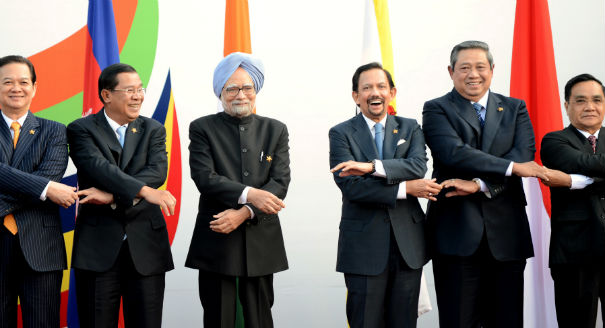
India's relations with Southeast Asia are booming, but Beijing's increased presence in the region looms large in New Delhi's thinking.
Source: Indian Express

All these catch-phrases are meant to convey India’s diplomatic support to the current security concerns of ASEAN members, especially their worries about the growing military capabilities of China and Beijing’s increasing political assertiveness in its territorial disputes in the South China Sea.
But is Delhi really prepared to go beyond the diplomatic and meet the growing ASEAN expectations for a stronger Indian contribution to the regional balance of power? No one at the summit is likely to mention the “C” word, but there is no denying the dragon in the room. It is not that either India or ASEAN want to define their partnership in terms of China. But both are aware that most of the emerging security challenges in Southeast Asia are about the geopolitical consequences for China’s rise.
But, let’s return for a moment to the celebrations of India’s ties with Southeast Asia. A century ago, the discovery of historic civilizational links with Southeast Asia was a booster shot for Indian nationalism and helped it reclaim its natural place in Asia. A little over two decades ago, when India was down and out — its economic model in a shambles and its international isolation stark — it was Southeast Asia that extended valuable solidarity.
ASEAN provided the most acceptable international benchmarks for India’s own economic liberalization. It was also ASEAN that helped Delhi cope with the new imperatives of regionalism in Asia. It was with ASEAN member states that India negotiated some of its early free trade agreements at a bilateral level. Nearly three years ago, India implemented its first free trade agreement in goods with ASEAN as a whole.
This week India and ASEAN will finalize a new agreement that liberalizes trade in services and investments. India has already agreed last month to join the ambitious negotiations for a free trade agreement, the Regional Comprehensive Economic Partnership, with ASEAN and its other economic partners — China, Japan, Korea, Australia and New Zealand.
India’s ASEAN partnership has been emblematic of the country’s own economic transformation — internal and external — since it began the reforms at the turn of the 1990s. ASEAN is also becoming the test-bed for India’s potential role as a provider of security to other nations and as a swing state in the Asian balance of power.
After more than three decades of peace and tranquility, Southeast Asia now confronts a period of great turbulence, marked by mounting tensions among the major powers and the deepening regional conflicts. China’s deepening territorial conflict with Japan and its new rivalry with the United States have injected fluidity into Asia’s great power relations.
Beijing’s relations with some of its Southeast Asian neighbors, especially Vietnam and the Philippines, have headed south amid competing territorial claims in the South China Sea. The coherence of ASEAN itself is under question as member states take divergent approaches to dealing with a rising China. The hope that the region can devise a collective security framework has been dashed amid these new developments.
Individually and collectively, then, ASEAN members are looking to restore the balance of power in the region. Some of them are turning to the U.S. to strengthen their security and others are deeply wary about the dangers of being caught up in a new Cold War between Beijing and Washington. All of them are importing advanced weapons systems and paving the way for an arms race in Southeast Asia.
In seeking a larger role from India in regional security, ASEAN has no illusion that India is the white knight that will ride to the rescue of the region threatened by China. Southeast Asia’s expectations from India in the defense arena are limited and three-fold.
One, an end to India’s current passive participation in the multilateral security mechanisms, such as ASEAN Regional Forum and the annual defense-ministerial meetings of ASEAN and its partner nations. Second, ASEAN wants Delhi to inject some life into the many bilateral defense agreements it has signed with its member states. Although India provides some military training and other support to many Southeast Asian countries, there is much more it can do enhance the material capacities of ASEAN defense establishments. Finally, ASEAN would like to see a more purposeful Indian defense policy in Southeast Asia, which can stabilize the regional security environment in collaboration with other major powers.
India has indeed sounded the trumpet of defense diplomacy as part of its engagement with ASEAN over the last two decades. The notes of India’s trumpet, however, must become a lot more certain. If Delhi does not help promote a stable balance of power in Southeast Asia now, India’s own security challenges in the future could get a lot more daunting.
This article first appeared in the Indian Express on December 20, 2012.
Former Nonresident Senior Fellow, Carnegie India
A leading analyst of India’s foreign policy, Mohan is also an expert on South Asian security, great-power relations in Asia, and arms control.
Recent Work

C. Raja Mohan, Darshana M. Baruah


Alexander Gabuev, Paul Haenle, C. Raja Mohan, …
Carnegie India does not take institutional positions on public policy issues; the views represented herein are those of the author(s) and do not necessarily reflect the views of Carnegie, its staff, or its trustees.

In any defense establishment, change is an ongoing process. However, despite the best of intentions, existing bureaucracies, bound by habit and years of socialization, have their limits in implementing transformative change.

Anit Mukherjee

As AI grows more sophisticated, as the supply chains that power it become more contested, and as access to frontier models becomes geopolitically charged, India must begin to ask a different set of questions. Not what applications it can build on someone else’s infrastructure but what the world needs.

Konark Bhandari

The Indian Ocean Region hosts one of the densest concentrations of subsea cables in the world. Yet, despite accounting for a significant share of global internet traffic, India’s participation remains limited.

Charukeshi Bhatt

How is AI reshaping space security, creating governance challenges, and where does international diplomacy stand today?


Tejas Bharadwaj, Almudena Azcárate Ortega

After the chill in ties between 2020 and 2024 that brought India–China relations to their lowest point in several decades, the two countries have engaged each other afresh. This paper argues that there are predominantly four imperatives guiding India’s approach to China, and they exist in an order of priority.

Saheb Singh Chadha