

Article
C. Raja Mohan, Darshana M. Baruah
{
  "authors": [
    "C. Raja Mohan"
  ],
  "type": "legacyinthemedia",
  "centerAffiliationAll": "dc",
  "centers": [
    "Carnegie Endowment for International Peace",
    "Carnegie India"
  ],
  "collections": [],
  "englishNewsletterAll": "ctw",
  "nonEnglishNewsletterAll": "",
  "primaryCenter": "Carnegie India",
  "programAffiliation": "SAP",
  "programs": [
    "South Asia"
  ],
  "projects": [],
  "regions": [
    "South Asia",
    "India",
    "East Asia",
    "Southeast Asia"
  ],
  "topics": [
    "Security"
  ]
}
Source: Getty
While India's naval diplomacy with Myanmar is headed in the right direction, Delhi needs to step up the pace of cooperation and take bolder steps in assisting Yangon build its naval and maritime capabilities.
Source: Indian Express
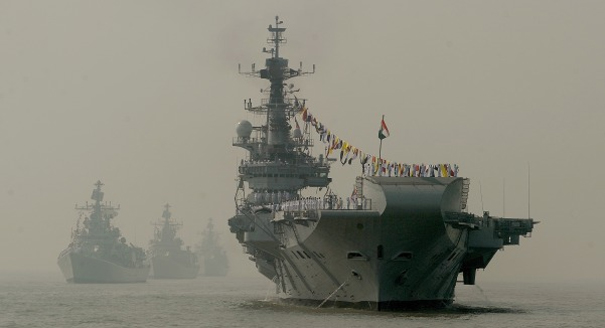
In an important advance in the bilateral security cooperation between Delhi and Yangon, two naval vessels from Myanmar have arrived over the weekend in Vishakhapatnam for joint exercises. This important step follows the visit of Defence Minister AK Antony to Myanmar earlier this year and the agreement to boost bilateral defence cooperation.
Until now the military cooperation between the two neighbors has been limited essentially to the armies. Confronting restiveness on their remote frontiers—in India's North East and Myanmar's North—the security forces of the two countries have over the last two decades deepened their counter-insurgency cooperation.
Preoccupied for decades with its vast land frontiers, India has turned to the seas in the early 1990s. As it launched naval diplomacy two decades, Delhi inevitably looked to Myanmar with which it shares a long maritime frontier.
For nearly a decade, India's naval ships frequently called at Myanmar's ports that were on the way to the east. Delhi was also pleased to see Myanmar's participation in the biennial 'Milan' exercises that its navy holds in the Bay of Bengal off the Andaman and Nicobar Islands.This is the first time though that Myanmar's ships—a frigate and a corvette-- have come to a port on India's mainland. Form there the ships of the two countries will conduct an exercise in joint patrolling in Southern Bay of Bengal.
Slowly but surely, Myanmar is becoming increasingly conscious of its strategic location at the confluence of the Indian and Pacific Oceans.
Although Myanmar does not face the Western Pacific, it sits right on top of the Malacca Straits that connects the two oceans.
Given its growing interests in the Indian Ocean, Beijing too is paying greater attention to maritime engagement with Myanmar. In the past there was much speculation about Chinese presence in Myanmar's Cocos Islands in the Andaman Sea.
That speculation turned out to be false. Yangon went out of the way to reassure Delhi that it has no intention to provide naval facilities to any foreign power. But there is no denying China's growing interest in naval cooperation with Myanmar.
Chinese naval ships traveling back and forth to the Arabian Sea, where it has been conducting anti-piracy operations since the end of 2008, have occasionally called on the Myanmar's ports.
Given its long coastline, Yangon is bound to pay greater attention to its maritime security in the coming years. While India's naval diplomacy with Myanmar is headed in the right direction, Delhi needs to step up the pace of cooperation and take bolder steps in assisting Yangon build its naval and maritime capabilities.
This article was originally published in the Indian Express.
Former Nonresident Senior Fellow, Carnegie India
A leading analyst of India’s foreign policy, Mohan is also an expert on South Asian security, great-power relations in Asia, and arms control.
Recent Work

C. Raja Mohan, Darshana M. Baruah


Alexander Gabuev, Paul Haenle, C. Raja Mohan, …
Carnegie India does not take institutional positions on public policy issues; the views represented herein are those of the author(s) and do not necessarily reflect the views of Carnegie, its staff, or its trustees.

In any defense establishment, change is an ongoing process. However, despite the best of intentions, existing bureaucracies, bound by habit and years of socialization, have their limits in implementing transformative change.

Anit Mukherjee

As AI grows more sophisticated, as the supply chains that power it become more contested, and as access to frontier models becomes geopolitically charged, India must begin to ask a different set of questions. Not what applications it can build on someone else’s infrastructure but what the world needs.

Konark Bhandari

The Indian Ocean Region hosts one of the densest concentrations of subsea cables in the world. Yet, despite accounting for a significant share of global internet traffic, India’s participation remains limited.

Charukeshi Bhatt

How is AI reshaping space security, creating governance challenges, and where does international diplomacy stand today?


Tejas Bharadwaj, Almudena Azcárate Ortega

After the chill in ties between 2020 and 2024 that brought India–China relations to their lowest point in several decades, the two countries have engaged each other afresh. This paper argues that there are predominantly four imperatives guiding India’s approach to China, and they exist in an order of priority.

Saheb Singh Chadha