

Commentary
Judy Dempsey
{
  "authors": [
    "Judy Dempsey"
  ],
  "type": "legacyinthemedia",
  "centerAffiliationAll": "",
  "centers": [
    "Carnegie Endowment for International Peace",
    "Carnegie Europe"
  ],
  "collections": [
    "Transatlantic Cooperation"
  ],
  "englishNewsletterAll": "",
  "nonEnglishNewsletterAll": "",
  "primaryCenter": "Carnegie Europe",
  "programAffiliation": "",
  "programs": [],
  "projects": [],
  "regions": [
    "Europe",
    "North America",
    "United States",
    "Eastern Europe",
    "Western Europe"
  ],
  "topics": [
    "Foreign Policy",
    "Security"
  ]
}
Source: Getty
With Europe no longer a strategic priority for the United States, and radical constraints on the U.S. defense budget, now is the time for Europe to take more ownership of its defense and security.
Source: New York Times
When the former U.S. defense secretary Donald Rumsfeld referred in 2003 to France and Germany as “old Europe” and to the East Europeans as “new Europe,” he sparked off a debate about the trans-Atlantic relationships.
According to Mr. Rumsfeld, the new members of the European Union, especially Poland, supported the U.S. invasion of Iraq because they shared the American belief in freedom. They were also committed Atlanticists.
Several of the older member states, Mr. Rumsfeld implied, were more interested in driving a wedge between Europe and the United States, even wanting to establish European defense structures independent of NATO.Now, 10 years after his memorable speech, the trans-Atlantic relationship has changed fundamentally on two counts.
One is America’s shift to the Asia-Pacific region. The other is the realignment that is taking place inside the European Union, blurring the distinction between Old and New Europe. Poland is one of the countries that are crucial to the Union’s changing contours.
“Poland is one of the few E.U. member states that understands the implications the U.S. shift has for Europe,” said Tomas Valasek, president of the Central European Policy Institute in Bratislava, Slovakia. “It has been pushing the E.U. to respond strategically.”
When Poland’s center-right government under Prime Minister Donald Tusk and Foreign Minister Radoslaw Sikorski came to power in 2007, it moved from being staunchly Atlanticist to strong advocacy of an integrated Europe.
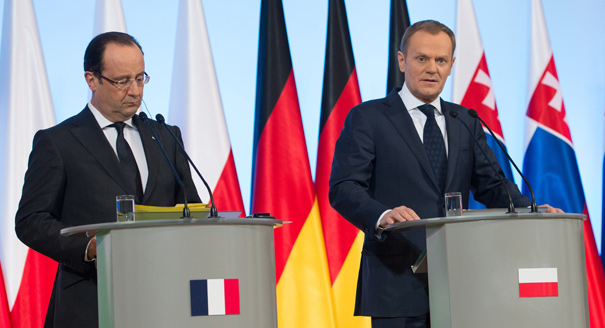
This was especially clear last month when Mr. Tusk played host to two summit meetings in Warsaw on the same day. One was the Weimar Triangle, which consists of France, Germany and Poland. The other was the Visegrad summit of Czech, Hungarian, Slovak and Polish leaders. All six leaders then held a joint summit meeting, the first ever by these two regional groupings.
That meeting went beyond symbolism. “This was about Poland showing that it did not want a two-speed Europe that would exclude noneuro-zone countries,” said Marcin Zaborowski, director of the Polish Institute of International Relations.
Poland fears it would be marginalized because it has not yet adopted the euro. “During the talks in Warsaw, Chancellor Angela Merkel went out of her way to reassure Poland that its voice would be heard,” he added.
The presence in Warsaw of François Hollande, the French president, was important, too, for Poland.
Nicolas Sarkozy, his predecessor, had paid only lip service to relations with Poland. Mr. Hollande, in contrast, was making his second visit to the country since taking office a year ago.
“His visits would have been unthinkable under Sarkozy,” said Aleksander Smolar, president of the Stefan Batory Foundation in Warsaw.
On economic issues, France and Poland are still far apart. Warsaw is much closer to Germany and other North European countries. Unlike France, these countries support structural reforms in order to bolster Europe’s competitiveness.
In the political realm, though, Mr. Hollande expects substantial gains from closer ties to Poland. The Tusk government shares France’s interest in developing a strong European security and defense policy. Both countries recognize that Europe is no longer a strategic priority for the United States.
Warsaw needs France’s support to force the issue onto the E.U. agenda. The main reason is that Poland is not yet a member of the euro zone, which constitutes the heart of power in Europe these days. Nor do its Visegrad allies help much. Hungary, Slovakia and the Czech Republic are either too inward-looking or too euro-skeptic to give Warsaw much support, according to Mr. Valasek.
What is true of Visegrad is true for most other E.U. countries, too. The realities of a new U.S. defense policy that is suddenly placed under radical budget constraints have not yet sunk in, say analysts.
This was reaffirmed last Friday when Chuck Hagel, the new U.S. defense secretary, announced that the Pentagon would reduce its missile defense plans for Europe. Instead, it would put those resources toward a missile shield planned in Alaska that could protect the United States against any attack from North Korea.
The onus, meanwhile, is increasingly being placed on Europe to strengthen its own defense capabilities.
What a change from 10 years ago when Mr. Rumsfeld did his best to discourage any initiative within the European Union to build an independent European defense policy.
Today, the Obama administration would like nothing better than a Europe strong enough to take care of its own defense and security, say analysts. But apart from France and Poland, analysts say that most European leaders simply have not yet understood how much the trans-Atlantic relationship is changing in front of their eyes.
This article was originally published in the New York Times.

Nonresident Senior Fellow, Carnegie Europe
Judy Dempsey is a nonresident senior fellow at Carnegie Europe
Recent Work
Judy Dempsey
Judy Dempsey
Carnegie India does not take institutional positions on public policy issues; the views represented herein are those of the author(s) and do not necessarily reflect the views of Carnegie, its staff, or its trustees.

This piece argues that the present Indian strategy, based on opportunistic diversification and utilization of limited strategic reserves, remains inadequate when confronting supply disruptions. It evaluates India’s options in the short, medium, and long terms.

Vrinda Sahai
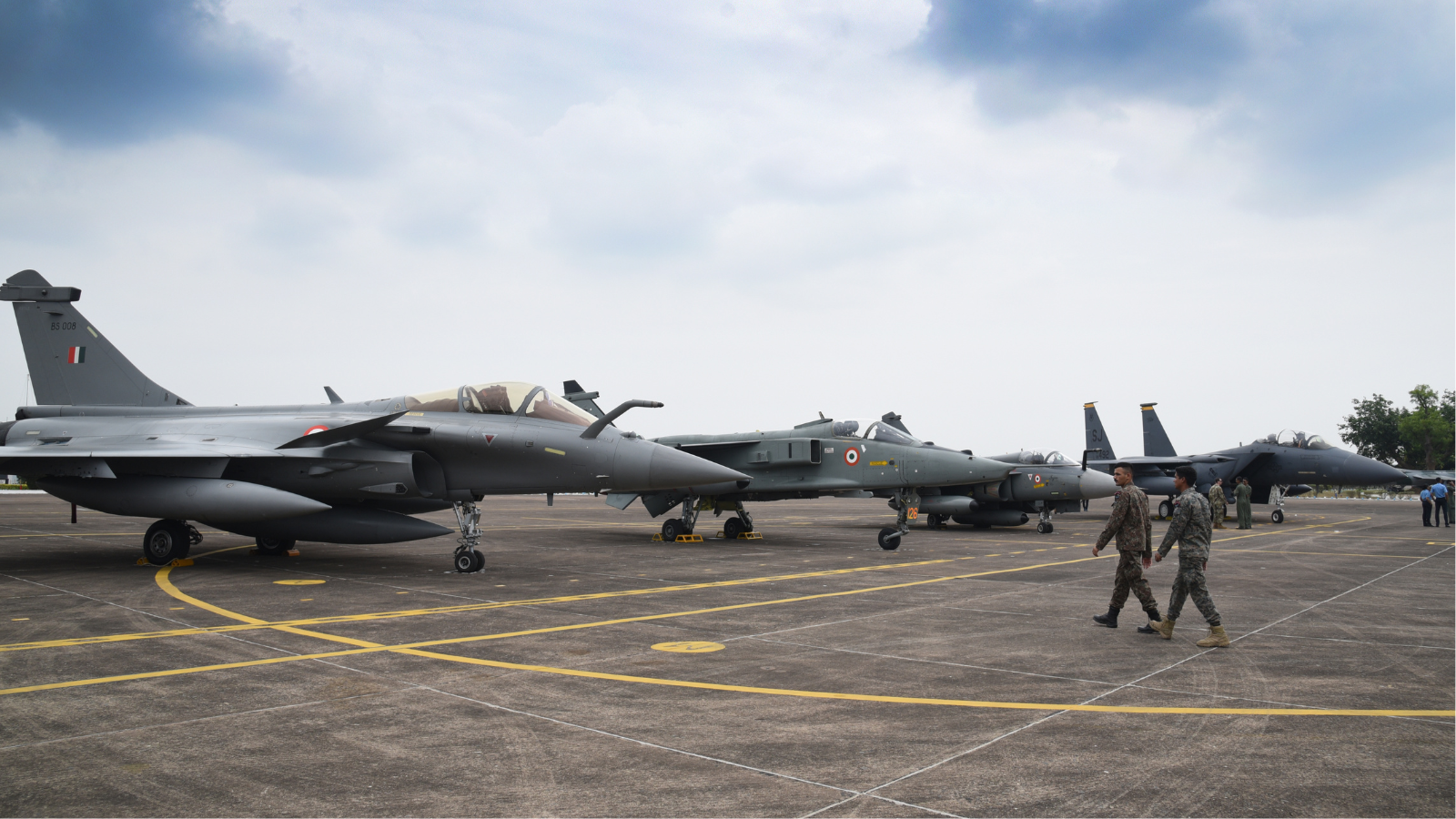
India and the United States are close to concluding a Reciprocal Defense Procurement Agreement (RDPA) that will allow firms from the two countries to sell to each other’s defense establishments more easily. While this may not remedy the specific grievances both sides may have regarding larger bilateral issues, an RDPA could restore some momentum, following the trade deal announcement.

Konark Bhandari
On the last day of the India AI Impact Summit, India signed Pax Silica, a U.S.-led declaration seemingly focused on semiconductors. While India’s accession to the same was not entirely unforeseen, becoming a signatory nation this quickly was not on the cards either.
Konark Bhandari

This piece examines India’s response to U.S. sanctions and tariffs, specifically assessing the immediate market consequences, such as alterations in import costs, and the broader strategic implications for India’s energy security and foreign policy orientation.
Vrinda Sahai
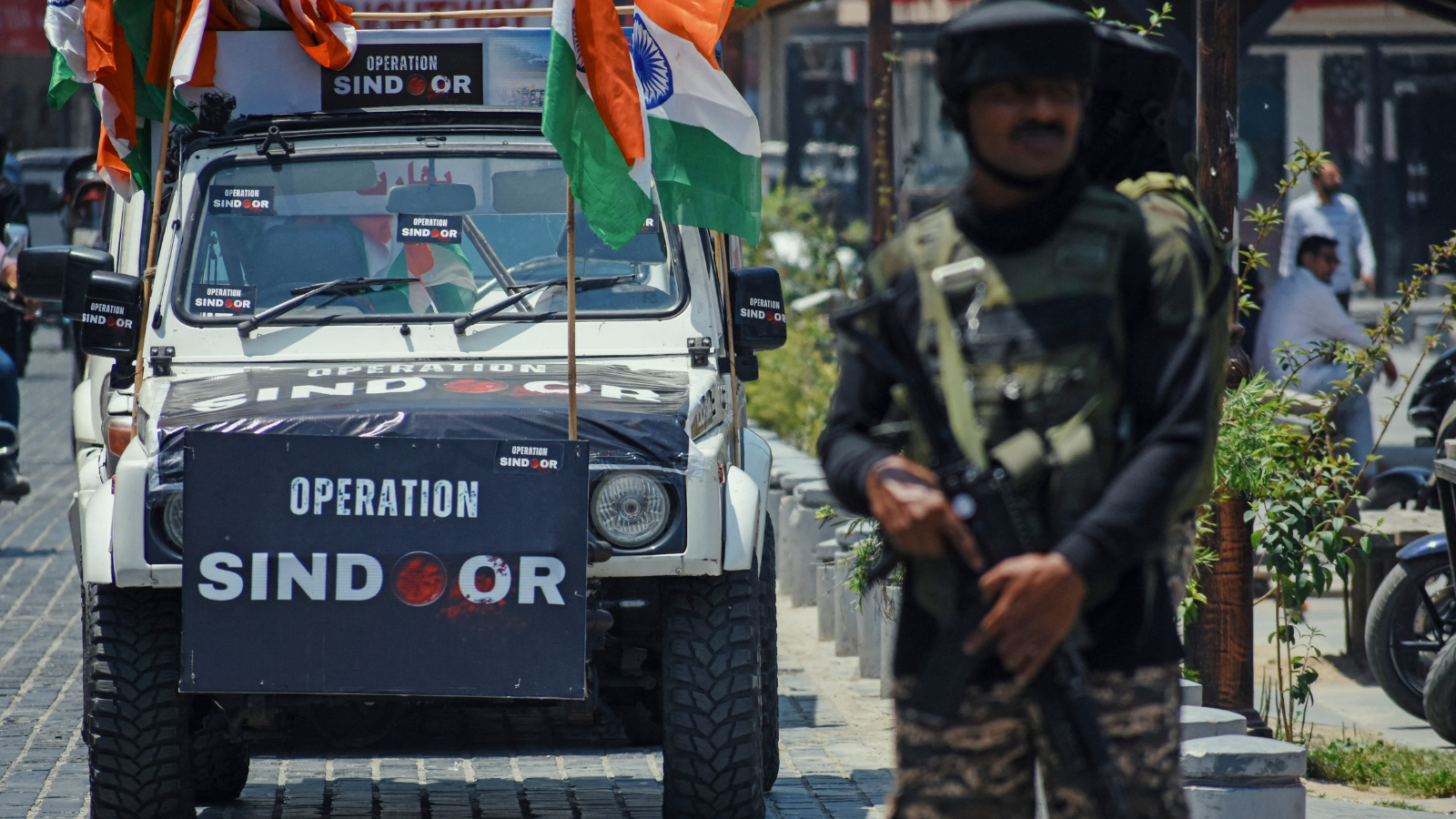
The India-Pakistan conflict that played out between May 6 and May 10, 2025, offers several military lessons. This article presents key takeaways from Operation Sindoor and breaks down how India’s preparations shaped the outcome and what more is needed to strengthen future readiness.

Dinakar Peri