

Commentary
Judy Dempsey
{
  "authors": [
    "Judy Dempsey"
  ],
  "type": "legacyinthemedia",
  "centerAffiliationAll": "dc",
  "centers": [
    "Carnegie Endowment for International Peace",
    "Carnegie Europe",
    "Carnegie Russia Eurasia Center"
  ],
  "collections": [
    "Europe’s Eastern Neighborhood"
  ],
  "englishNewsletterAll": "ctw",
  "nonEnglishNewsletterAll": "",
  "primaryCenter": "Carnegie Europe",
  "programAffiliation": "russia",
  "programs": [
    "Russia and Eurasia"
  ],
  "projects": [
    "Eurasia in Transition"
  ],
  "regions": [
    "Asia",
    "Russia",
    "South Asia",
    "Afghanistan",
    "Central Asia"
  ],
  "topics": [
    "Security"
  ]
}
Source: Getty
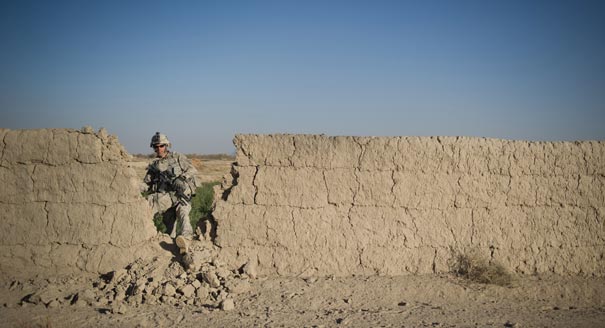
Russia has no intentions of getting involved again in Afghanistan. Yet Central Asian republics now fear instability on their borders as NATO’s 100,000-strong presence ends.
Source: New York Times
As the United States winds down its combat mission in Afghanistan, Russia is looking on, not with Schadenfreude but with extreme concern.
Russia knows what it is like to leave a country that it could not bend to its political will.
When Soviet troops invaded Afghanistan in 1979, the Kremlin had no inkling about how long, costly and unpopular this war would turn out to be.
By the time Soviet leader Mikhail Gorbachev decided to end the occupation in 1989, over 15,000 Soviet troops and over one million Afghans had died in the fighting.Now it is President Barack Obama’s turn to bring home the remaining 68,000 troops by the end of 2014, the subject of my latest Letter from Europe.
Mr. Obama made clear in his State of the Union address that “America’s commitment to a unified and sovereign Afghanistan will endure, but the nature of our commitment will change.”
The American presence will be very small, perhaps not more than 10,000 troops. And that is what worries Russia.
Russia has no intentions of getting involved again in Afghanistan. Yet the Central Asian republics, especially Uzbekistan, now fear instability on their borders as NATO’s 100,000-strong presence ends.
“The rulers of the former Soviet republics neighboring on Afghanistan are really scared,” wrote Mikhail Rostovsky in a fascinating short analysis in Moskovsky Komsomolets, a Russian daily newspaper. “They want Russia to be beside them and hold their hands at the crucial movement.” They also want Russia to be more actively involved in Afghan affairs.
That is the last thing Russia wants. It is in no position to end the drug trade, the insurgency and the corruption, which NATO could not stop. It has no intention of putting its own footprint on the country again.
With the security vacuum left by NATO’s withdrawal, Russia’s only hope, whether naïve or not, is a new and more stable Afghan government.
“The best that can be hoped for is the emergence of a new regime in Kabul, less committed to universal values but on the other hand, more firmly standing on its own feet,” Mr. Rostovsky wrote. What an irony of history that NATO now must be wishing the same.
This article was originally published in the New York Times.

Nonresident Senior Fellow, Carnegie Europe
Judy Dempsey is a nonresident senior fellow at Carnegie Europe
Recent Work
Judy Dempsey
Judy Dempsey
Carnegie India does not take institutional positions on public policy issues; the views represented herein are those of the author(s) and do not necessarily reflect the views of Carnegie, its staff, or its trustees.

In any defense establishment, change is an ongoing process. However, despite the best of intentions, existing bureaucracies, bound by habit and years of socialization, have their limits in implementing transformative change.

Anit Mukherjee

After the chill in ties between 2020 and 2024 that brought India–China relations to their lowest point in several decades, the two countries have engaged each other afresh. This paper argues that there are predominantly four imperatives guiding India’s approach to China, and they exist in an order of priority.

Saheb Singh Chadha

This piece argues that India’s central challenge is not managing a single flashpoint but resolving the underlying tension between expansion and institutional coherency of the BRICS grouping.

Vrinda Sahai

This piece argues that the present Indian strategy, based on opportunistic diversification and utilization of limited strategic reserves, remains inadequate when confronting supply disruptions. It evaluates India’s options in the short, medium, and long terms.
Vrinda Sahai
Trump 2.0 has unsettled India’s external environment—but has not overturned its foreign policy strategy, which continues to rely on diversification, hedging, and calibrated partnerships across a fractured order.



Milan Vaishnav, ed., Sameer Lalwani, Tanvi Madan, …