

Commentary
Alexey Malashenko
{
  "authors": [
    "Alexey Malashenko"
  ],
  "type": "legacyinthemedia",
  "centerAffiliationAll": "",
  "centers": [
    "Carnegie Endowment for International Peace",
    "Carnegie Russia Eurasia Center"
  ],
  "collections": [],
  "englishNewsletterAll": "",
  "nonEnglishNewsletterAll": "",
  "primaryCenter": "Carnegie Russia Eurasia Center",
  "programAffiliation": "",
  "programs": [],
  "projects": [],
  "regions": [
    "North America",
    "United States",
    "Russia",
    "Western Europe"
  ],
  "topics": [
    "Security"
  ]
}
Source: Getty
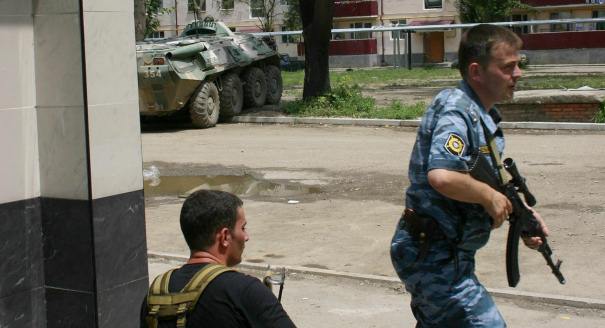
The Boston bombing has heightened tensions in Europe and has had repercussions for Russia, especially in light of the need to provide security at the Sochi Olympics.
Source: The Moscow Times
More than a week has passed since the terrorist attack in Boston. Naturally, emotions have yet to calm down in the U.S. But as time passes, it becomes possible to analyze the event more closely and to determine what exactly happened in Boston and why.
This type of terrorist attack was bound to happen eventually. After the destruction of the World Trade Center in New York on Sept. 11, 2001, it became clear that more attacks would follow and the only question was how many years the U.S. could successfully fend them off. It turned out to be a very long respite — 12 years. Credit must be given to U.S. civil society and its intelligence agencies, border and customs services for having combined their efforts to safeguard the country against attack for so long. Unfortunately, the same is not true for Russia. If you consider the simmering civil war in the North Caucasus, the number of terrorist attacks in this country is almost comparable to that in Iraq.The Boston bombings can also be considered a stroke of bad luck for the reason that almost anything might have provoked them. My theory is that somebody simply offended the Tsarnaev brothers with some offhand remark or ethnic slur. It might sound absurd, but Russians know very well that people from the North Caucasus can quickly take offense and strongly respond to insults, both real or perceived. In this way, a thoughtless comment could have been the tip of the iceberg based on a broader sense that the U.S. has demonized and killed innocent Muslims in Iraq, Afghanistan, Pakistan, Libya and other countries.
The challenge for all security and intelligence agencies engaged in fighting terrorism is how to know what group or individuals are planning to blow up innocent people. That is why the public is always in danger. Those who would argue that terrorism is not such a serious problem and that far more people die from automobile accidents and cancer forget that such deaths are natural, or at most unintended accidents, whereas killing innocent people by using homemade bombs packed with bolts and ball bearings is a cold-blooded act of murder.
The bombing has also heightened tensions in Europe, where the problem of radical Islam is growing along with the increasing number of refugees from the Muslim world. By some estimates, the aftermath of the Arab Spring has only intensified that trend. Who knows what price innocent Europeans might pay if, for example, a caricaturist in a given European country publishes an objectionable portrayal of the Prophet Mohammad and a radical Islamist group responds with a terrorist attack. Muslims are becoming increasingly isolated from traditional Judeo-Christian society, despite all of the efforts by the media to observe political correctness. It is worth noting that commentary in the U.S. media has been remarkably objective and devoid of Islamophobia. One article in the New York Times newspaper was even criticized for being too soft on terrorism.
The Boston bombings have had repercussions for Russia as well. First, it took place during a major sporting event. That immediately calls to mind next year's Olympic Games in Sochi, a prime opportunity for terrorists. Of course, the Russian authorities are committed to doing everything in their power to protect the athletes and fans from a terrorist threat, and the measures already taken are impressive. What's more, the Boston attack has given the Kremlin an added pretext for stamping out extremist activity.
Second, since the suspected terrorists were ethnic Chechens, Moscow can use this fact to justify the harsh measures it has taken over the past decade in the North Caucasus. After all, if extremists from the Caucasus have already appeared in the U.S., then how much more dangerous it must be in Russia, and still more in the North Caucasus, a region right next to Sochi. Extremist groups are undoubtedly already planning attacks against the Olympic Games, perhaps turning to terrorist groups in the Middle East and Afghanistan for assistance and financing.
Another source of support could come from opposition forces in Syria, which include a number of fighters from the North Caucasus. They have always opposed Moscow for supporting the regime of Syrian President Bashar Assad and might be willing to help terrorist groups from the Caucasus disrupt the Olympics.
When tens of thousands of people gather for an event, it is impossible to fully guarantee everyone's safety. It is just possible that some of the sports fans who stood at the finish line of the Boston Marathon also hold tickets to ice hockey or cross-country skiing competitions at the Sochi Olympics. If so, they will probably think twice before attending.

Former Scholar in Residence, Religion, Society, and Security Program
Malashenko is a former chair of the Carnegie Moscow Center’s Religion, Society, and Security Program.
Recent Work
Alexey Malashenko
Alexey Malashenko
Carnegie India does not take institutional positions on public policy issues; the views represented herein are those of the author(s) and do not necessarily reflect the views of Carnegie, its staff, or its trustees.

In any defense establishment, change is an ongoing process. However, despite the best of intentions, existing bureaucracies, bound by habit and years of socialization, have their limits in implementing transformative change.

Anit Mukherjee

How is AI reshaping space security, creating governance challenges, and where does international diplomacy stand today?


Tejas Bharadwaj, Almudena Azcárate Ortega

After the chill in ties between 2020 and 2024 that brought India–China relations to their lowest point in several decades, the two countries have engaged each other afresh. This paper argues that there are predominantly four imperatives guiding India’s approach to China, and they exist in an order of priority.

Saheb Singh Chadha

This piece argues that India’s central challenge is not managing a single flashpoint but resolving the underlying tension between expansion and institutional coherency of the BRICS grouping.

Vrinda Sahai

The U.S.–India semiconductor cooperation story is well-stocked with top-level strategic intent. What remains unresolved, however, are some underlying challenges that will determine whether the cooperation actually functions. Three such friction points stand out.

Shruti Mittal