

Article
C. Raja Mohan, Darshana M. Baruah
{
  "authors": [
    "C. Raja Mohan"
  ],
  "type": "legacyinthemedia",
  "centerAffiliationAll": "dc",
  "centers": [
    "Carnegie Endowment for International Peace",
    "Carnegie China",
    "Carnegie India"
  ],
  "collections": [
    "China’s Foreign Relations"
  ],
  "englishNewsletterAll": "ctw",
  "nonEnglishNewsletterAll": "",
  "primaryCenter": "Carnegie India",
  "programAffiliation": "SAP",
  "programs": [
    "South Asia"
  ],
  "projects": [],
  "regions": [
    "South Asia",
    "India",
    "Pakistan",
    "East Asia",
    "China"
  ],
  "topics": [
    "Economy",
    "Security",
    "Military",
    "Foreign Policy"
  ]
}
Source: Getty
China is unlikely to stop using Pakistan to balance India anytime soon.
Source: Indian Express
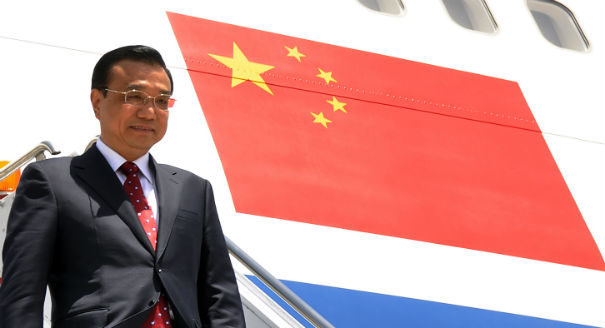
The political transition underway in Pakistan will not dampen in any way the enthusiasm in Islamabad for serenading visiting Chinese Premier Li Keqiang. After wrapping up his engagements in Mumbai, Li heads out to Pakistan, the next destination in his four-nation tour that also includes Switzerland and Germany.
Beijing and Islamabad never stop celebrating their "all-weather partnership," often described as higher than the Himalayas and deeper than the Indian Ocean. The partnership, launched way back in the 1950s, has survived political tumult in both countries over the decades.During his two-day stay in Pakistan, Li will meet President Asif Ali Zardari and have talks with the leaders of the caretaker government and sit down with incoming Prime Minister Nawaz Sharif, who is expected to be sworn in shortly. Li's engagements include an address to the Pakistan Senate.
Much has been made in Delhi of Li's decision to make India the first stop abroad in his tenure as prime minister. The UPA managers are visibly relieved at the peaceful resolution of the Depsang crisis. They are also pleased that PM Manmohan Singh has been frank in telling Li of India's profound concerns about the Chinese approach to the border issues.
But the boundary dispute is only one set of India's difficulties with China. Another perennial problem is China's determination to prop up Pakistan as a counter to India. There is nothing to suggest that the smiling Chinese Premier Li would dilute the partnership with Pakistan in order to please Delhi.
Quite the opposite. Delhi must assume that Beijing will continue to build up Pakistan's strategic capabilities to ensure its parity with India. There is no cheaper option for Beijing than using Pakistan to keep India off balance. Every visit by a senior Chinese leader to Pakistan includes the signing of major new agreements for bilateral cooperation. Li's visit will be no exception. According to the foreign office in Islamabad, at least 12 MoUs will be signed during Li's visit this week.
The Indian security establishment would want to pay special attention to new agreements that Li is likely to announce on upgrading the Gwadar port.
It might be recalled that Islamabad had handed over control of the Gwadar port on the Balochistan coast to Beijing earlier this year.
According to Pakistan Foreign Secretary Jalil Abbas Jilani, Li is expected to sign three MoUs on expanding the facilities at the Gwadar port. Pakistan hopes Li will unveil a commitment to construct an international airport at Gwadar and undertake new projects to link Gwadar to Pakistan's road and rail networks in the Sindh province adjacent to Balochistan.
Without developing its hinterland and connecting it to the rest of the country, Gwadar's potential as a commercial port will remain entirely on paper. Li's visit is likely to see the two sides underline their commitment to transform it into a strategic facility in the coming years.
While some civilians in Delhi have made light of the Chinese "String of Pearls" in the Indian Ocean, India's military planners can't afford to be so complacent. They must see the developments at Gwadar as emblematic of the deepening maritime and naval cooperation between China and Pakistan.
As China prepares to transform Gwadar into a place to reckon with in the Arabian Sea, Beijing is quite close to completing the modernization of the Karakoram Highway that connects China's Xinjiang province with Pakistan-Occupied Kashmir (PoK).
At the end of 2006, the governments of Pakistan and China decided to rebuild the Karakoram Highway that was constructed in the early 1970s. The 1,224-kilometer road across one of the world's most difficult mountainous terrains is expected to be ready by the end of this year. Unlike in the past, the Karakoram Highway will now be open round the year. It will also be able to handle trucks with 40-foot containers. The highway, linked to Gwadar and Karachi ports, helps Beijing realise China's longstanding search for the warm waters of the Arabian Sea.
Li is expected to sign another MoU on the development of a 1,000-megawatt hydropower project in PoK where China's economic and military presence has rapidly risen over the last decade.
For all the smiles in Delhi this week, the problem of Pakistan is unlikely to disappear any time soon from the agenda of Sino-Indian relations.
Former Nonresident Senior Fellow, Carnegie India
A leading analyst of India’s foreign policy, Mohan is also an expert on South Asian security, great-power relations in Asia, and arms control.
Recent Work

C. Raja Mohan, Darshana M. Baruah


Alexander Gabuev, Paul Haenle, C. Raja Mohan, …
Carnegie India does not take institutional positions on public policy issues; the views represented herein are those of the author(s) and do not necessarily reflect the views of Carnegie, its staff, or its trustees.

In any defense establishment, change is an ongoing process. However, despite the best of intentions, existing bureaucracies, bound by habit and years of socialization, have their limits in implementing transformative change.

Anit Mukherjee

As AI grows more sophisticated, as the supply chains that power it become more contested, and as access to frontier models becomes geopolitically charged, India must begin to ask a different set of questions. Not what applications it can build on someone else’s infrastructure but what the world needs.

Konark Bhandari

The Indian Ocean Region hosts one of the densest concentrations of subsea cables in the world. Yet, despite accounting for a significant share of global internet traffic, India’s participation remains limited.

Charukeshi Bhatt

How is AI reshaping space security, creating governance challenges, and where does international diplomacy stand today?


Tejas Bharadwaj, Almudena Azcárate Ortega

After the chill in ties between 2020 and 2024 that brought India–China relations to their lowest point in several decades, the two countries have engaged each other afresh. This paper argues that there are predominantly four imperatives guiding India’s approach to China, and they exist in an order of priority.

Saheb Singh Chadha