

In The Media
John Judis
{
  "authors": [
    "John Judis"
  ],
  "type": "legacyinthemedia",
  "centerAffiliationAll": "",
  "centers": [
    "Carnegie Endowment for International Peace"
  ],
  "collections": [],
  "englishNewsletterAll": "",
  "nonEnglishNewsletterAll": "",
  "primaryCenter": "Carnegie Endowment for International Peace",
  "programAffiliation": "",
  "programs": [],
  "projects": [],
  "regions": [
    "United States",
    "Middle East",
    "Syria"
  ],
  "topics": [
    "Political Reform",
    "Security",
    "Foreign Policy"
  ]
}
Source: Getty
The left’s opposition to American intervention in Syria is not tactical or prudential. There is a civil war going on, and there is a reasonable moral case for backing the rebels against the government.
Source: New Republic
The most vocal opposition to President Barack Obama’s promise to send arms to the Syrian rebels is coming from the political left—to which I normally would consider myself allied. Writing in the Huffington Post, M. J. Rosenberg calls it a return to “19th century imperialism.” John Nichols writes in The Nation that “the notion that the Syrian mess is an American problem, or that the United States can or should choose a favorite in the fight, is highly debatable.” Similar statements can be found in Mother Jones and In These Times.
The left’s opposition to American intervention is Syria is not tactical or prudential. These authors are not arguing that intervention is futile because the rebels have already lost or because al Qaeda has penetrated the opposition or because the war has become a proxy contest in the Middle East. These are legitimate tactical concerns, but the left’s opposition is based on principle, not tactics. It says that the United States should not engage in interventions at all. The most common reference point is George W. Bush’s invasion of Iraq. But Rosenberg also groups Obama’s intervention in Syria with the interventions in the Dominican Republic, Grenada, Panama, Lebanon, the Persian Gulf, the former Yugoslavia, Somalia, Afghanistan (in the early 1980s and after September 11), and Libya.I think this position is wrong. By identifying Obama’s impulse in Syria with Ronald Reagan’s invasion of Grenada or Bush’s invasion of Iraq, the left rules out any possibility of a benign intervention for humanitarian or for worthy geopolitical ends. I also think this position is contrary to the traditional stance of the American and European lefts toward foreign civil wars or wars of independence. That, of course, doesn’t show the position is wrong; but it does suggest that these leftists are betraying their own, and my, historical ideals.
What is happening in Syria is different from, say, what was happening in Iraq in early 2003, the Dominican Republic in 1965, or Grenada in 1983. The Obama administration is not using a supposed threat to American interests to intervene unilaterally and impose its will on a country that is relatively at peace, nor is it intervening (as it did in Guatemala or Vietnam) to back an unpopular regime against a rebellion. American intervention in Syria most closely resembles intervention in the former Yugoslavia in the 1990s. The U.S. is acting with other countries, and it is not trying to impose its own rule or to prop up a client regime.
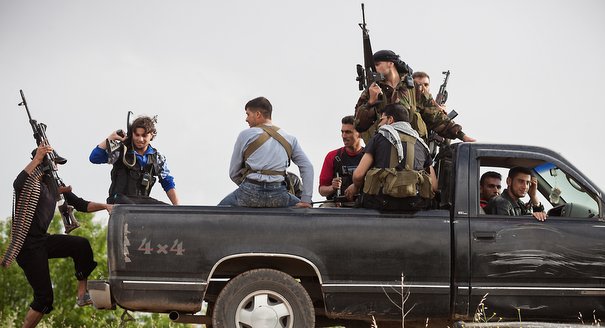
In Syria, there is a civil war going on, and there is a reasonable moral case for backing the rebels against the government. The war began with the Assad regime brutally suppressing peaceful democratic reform protests. The war has already taken as many as 120,000 lives. Assad forces have laid waste to major cities. Some dictators retain a lingering loyalty to their nation and its people, but Bashar Al Assad appears engaged in a war of personal survival. It’s not genocide, but a patria-cide—and belongs on the list of crimes against humanity that other nations should not tolerate.
My own position reflects the historical stance of the American and European left going back to the American and French revolutions. The left in the United States and Europe repeatedly pressured sympathetic governments to defend liberty and independence internationally. Nichols, following the lead of other anti-interventionists on the left and right, quotes John Quincy Adams from 1821 saying that America “goes not abroad in search of monsters to destroy.” But it’s worth looking at the context in which Adams made that statement. A whole variety of movements, editorial pages, and politicians, including Thomas Jefferson and James Madison, were urging Adams to back the Greek struggle for independence against the Turks and Latin American countries’ struggles against Spanish rule. There were a few hotheads calling for the U.S. Navy to steam into the Aegean, but the bulk of proposals, and the ones that concerned Adams, were for recognition or for sending emissaries to the Greeks or Latin Americans. But Adams rejected any initiative.
Over the next 150 years, the left in the U.S. and Europe has urged support for the Russian Revolution of 1917, the Spanish Republicans in the Civil War, the African National Congress in apartheid-era South Africa, and independence for Algeria, Vietnam, and the Portuguese colonies in Africa. Henry Wallace—recently held up by Oliver Stone as a paragon of the left—supported American intervention in the Korean peninsula in 1950. Until recently, the left has always drawn a distinction between these kind of interventions and interventions aimed at buttressing imperial or neo-imperial rule. So the left opposed intervention in Vietnam, the Dominican Republic, and Iraq. But operating in the shadow of these fiascos, much of the left today has refused to back any intervention. That has included Syria today, the Balkans in the mid-1990s, and, incredibly, the attempt to drive Iraq out of Kuwait in 1991.
I remain perplexed about what the United States can do to help the Syrian rebels. I am not a military expert, and I don’t know what is involved in setting up a no-fly zone. I think that whatever we do, we have to do with other countries. And I believe that we have to avoid any commitment to policing a post-Assad Syria. These are reservations that the Obama administration seems to share. But I have no doubt that we should try to do something to rid the world of the Assad regime. And I say that as a card-carrying member of the American left.

Former Visiting Scholar
As a visiting scholar at Carnegie, Judis wrote The Folly of Empire: What George W. Bush Could Learn from Theodore Roosevelt and Woodrow Wilson.
Recent Work
John Judis
John Judis
Carnegie India does not take institutional positions on public policy issues; the views represented herein are those of the author(s) and do not necessarily reflect the views of Carnegie, its staff, or its trustees.

In any defense establishment, change is an ongoing process. However, despite the best of intentions, existing bureaucracies, bound by habit and years of socialization, have their limits in implementing transformative change.

Anit Mukherjee

How is AI reshaping space security, creating governance challenges, and where does international diplomacy stand today?


Tejas Bharadwaj, Almudena Azcárate Ortega

After the chill in ties between 2020 and 2024 that brought India–China relations to their lowest point in several decades, the two countries have engaged each other afresh. This paper argues that there are predominantly four imperatives guiding India’s approach to China, and they exist in an order of priority.

Saheb Singh Chadha

This piece argues that India’s central challenge is not managing a single flashpoint but resolving the underlying tension between expansion and institutional coherency of the BRICS grouping.

Vrinda Sahai

A partnership between India, a country of subcontinental size, and Africa, a continent of fifty-four countries, may seem asymmetric until one notes that both are home to nearly the same number of people—1.4 billion. This essay spells out the existing challenges to the partnership, its optimal potential, and the possible pathways to realize it over the next quarter-century.

Rajiv Bhatia